Sticky disc-brake piston or brake bleed: which problem do you have?
Use lever feel, pad movement, and rotor rub to separate a sticky hydraulic brake piston from air in the system, alignment, or a bent rotor.
 Field guide / sticky-hydraulic-disc-brake-piston-or-needs-bleed
A brake bleed removes air and replaces or manages fluid; it does not automatically free a piston that extends but fails to retract. If rotor rub returns after the brake is used, first observe caliper alignment, rotor runout, and whether both pistons move and return evenly.
The short answer: a soft, inconsistent, or unusually long lever can point toward air or another hydraulic fault. A firm lever plus one pad that stays close to the rotor points more strongly toward alignment, rotor, or piston movement. Use the exact brake maker’s procedure—do not improvise with lubricant near pads and rotors.
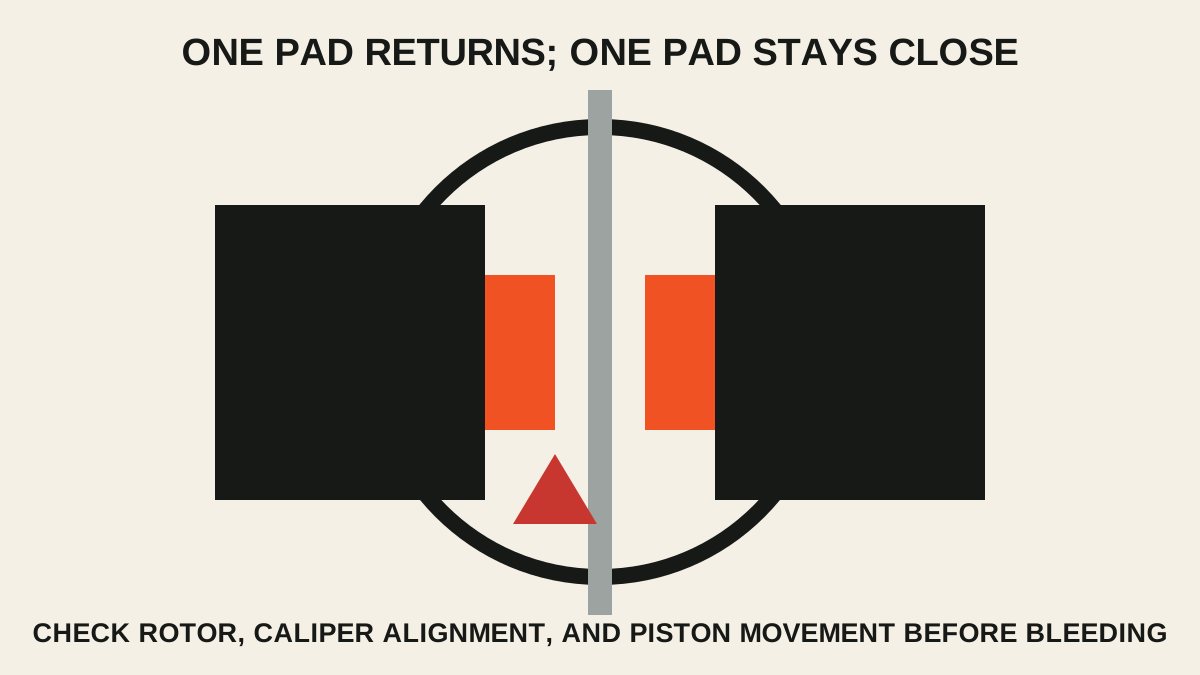
Start with the symptom, not the service interval
Recent r/bikewrench discussions repeatedly ask whether a rubbing brake “needs a bleed.” In one high-engagement thread, resetting the pistons temporarily restored clearance, but the rub returned after the next lever pull. That pattern prompted several competing diagnoses—exactly why a short observation sequence is better than replacing fluid by guesswork.
Check the bike in a stable stand with a bright light or white card behind the caliper:
- Spin the wheel without touching the lever.
- Note whether rubbing is constant or occurs once per wheel revolution.
- Apply and release the brake once.
- Spin again and compare the gap on both sides of the rotor.
- Squeeze the lever slowly and note whether it feels firm, spongy, inconsistent, or unusually close to the bar.
Do not touch the braking surface with bare or oily hands.
What each pattern usually suggests
Rub at one point per revolution
The rotor may have lateral runout—often described as a bent rotor—or the hub/wheel may not be seated consistently. A bleed cannot straighten a rotor. First verify the axle is fully seated and tightened to the bike maker’s instruction, then inspect the rotor against a fixed reference.
Constant rub that changes when the caliper moves
The caliper may be off-centre. Loosen-and-squeeze alignment can work, but tightening a bolt can pull the caliper sideways. Align by sight when necessary, tightening incrementally while watching both pad gaps. Our guide to disc-brake rub after wheel removal covers wheel seating and caliper alignment.
Clearance returns after a reset, then disappears after braking
One or both pistons may not retract evenly. Shimano’s current road hydraulic dealer manual specifically calls for caliper piston maintenance when pistons operate poorly, protrude unevenly, or leave pads touching the rotor. The procedure is detailed and model-specific; it includes wheel and pad removal, controlled piston movement, the correct fluid, and isopropyl-alcohol cleanup.
Lever feels soft or changes from pull to pull
Air, a leak, hose damage, worn parts, or another hydraulic issue may be involved. A correct bleed may be part of the repair, but first inspect for leaked fluid and follow the exact system manual. Shimano now has systems using different oil specifications; its current user guidance warns not to mix them. SRAM systems may use a different fluid entirely. “Mineral oil” or “DOT fluid” is not a generic substitution instruction.
A bleed and piston service solve different things
Bleeding manages the hydraulic column between lever and caliper. Piston service addresses movement at the caliper. They can be required together, but one does not prove the other.
Avoid these common mistakes:
- pulling the lever with no rotor, pad spacer, or bleed block installed;
- letting a piston extend far enough to fall out or leak;
- prying against a ceramic or resin piston with a hard metal tool;
- spraying chain lubricant, general cleaner, or penetrating oil near the caliper;
- reusing pads after they contact brake fluid;
- opening a bleed port simply to “let pressure out” without the maker’s procedure.
If a piston has come out, a seal is damaged, fluid is leaking, or you do not have the correct block and fluid, stop and use a professional mechanic.
A sensible home-to-shop boundary
A beginner can safely check wheel seating, rotor condition, lever feel, pad thickness, and visible pad gaps. Caliper alignment may also be appropriate when the bike and brake manuals are available and the correct torque wrench is used.
Piston maintenance and bleeding demand more: system-specific tools, compatible fluid, contamination control, and a method for preventing over-extension. Shimano labels its dealer manuals for professional mechanics. Reading one is valuable for understanding the job; it does not replace skill or clean tooling.
After any brake work, verify a firm lever, secure fasteners, no leaks, correct pad/rotor thickness, and full stopping power in a traffic-free area. If pads or rotor were replaced, follow the maker’s bed-in process.
Your next step
Use a white card and record a 20-second close-up before and after one lever pull. If the lever is firm but one pad fails to return, take the exact brake model and that observation to a shop or follow its piston-maintenance manual. If the lever is soft or fluid is visible, do not ride until the hydraulic fault is resolved.