Shimano 105 Di2 vs Ultegra Di2: which is worth it?
Compare 12-speed Shimano 105 Di2 and Ultegra Di2 by gearing, controls, complete-bike equipment, service, and the upgrades you will actually use.
 Field guide / shimano-105-di2-vs-ultegra-di2
For most non-racing riders, current 12-speed Shimano 105 Di2 delivers the important electronic-shifting experience. Ultegra Di2 is worth more when you specifically value its lower mass, lever and satellite-control options, brake feel, or the other equipment fitted to that complete bike. A 105 Di2 bike with a useful power meter, better fit, or easier gearing can be the stronger purchase.
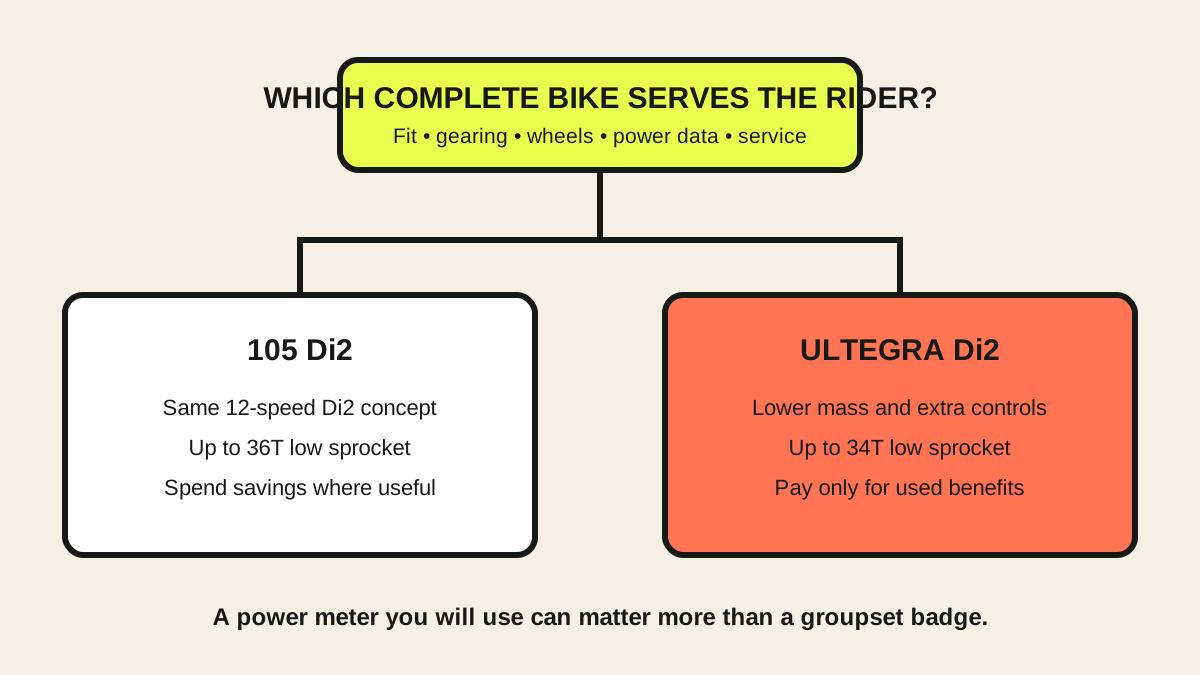
The short answer: compare the whole bikes, not two logos. If fit and wheels are comparable, choose 105 Di2 when it funds a power meter, better tyres, easier gearing, or a lower total price. Pay for Ultegra when its specific control options and lower mass matter to your riding—not because 105 is somehow inadequate.
The comparison that triggered this guide
A current r/cycling thread asked whether to choose 105 Di2 with a power meter or pay more for Ultegra Di2 without one. The 75-comment response shows strong buying intent, but individual preferences in that discussion are not product tests.
This guide compares the R7100-series 105 Di2 and R8100-series Ultegra Di2 components commonly sold on current 12-speed road bikes. Check the exact model codes on any bike because manufacturers can mix cranksets, chains, cassettes, rotors, and other parts.
What is meaningfully the same
Both systems provide:
- 2×12-speed electronic shifting;
- wireless communication from the road shift/brake levers in the standard setup;
- a central rechargeable battery wired to the derailleurs;
- charging, status, and adjustment functions at the rear derailleur;
- reach adjustment at the hydraulic shift/brake levers;
- button customization through Shimano’s E-TUBE system;
- automatic front-derailleur trimming within the Di2 system.
In ordinary riding, both remove mechanical shift-cable friction and deliver consistent button-operated shifts when installed, adjusted, charged, and updated correctly. Neither groupset fixes the wrong frame size, poor lever reach, unsuitable gearing, or neglected brakes.
The differences that can change your decision
| Question | 105 Di2 R7100 series | Ultegra Di2 R8100 series |
|---|---|---|
| Rear derailleur low-sprocket limit | Shimano lists up to 36 teeth for RD-R7150 | Shimano lists 28–34 teeth for RD-R8150 |
| Lever connectivity | ST-R7170 levers are the simpler wireless-only design | ST-R8170 supports wireless or wired connection and optional satellite shifting |
| Lever battery claim | Shimano lists roughly 3.5–4 years for the replaceable coin cells | Shimano lists roughly 1.5–2 years for the replaceable coin cells |
| Mass and materials | Heavier system at the value tier | Lighter components, with the saving spread across the groupset |
| Power-meter option in a complete-bike choice | Often paired with a third-party meter or meter-equipped crank | Shimano offers an Ultegra power-meter crank, but it may not be fitted to the bike you are comparing |
These are generation-specific facts, not permanent rules about the names “105” and “Ultegra.” Shimano can update firmware and compatibility. Check its current manuals and compatibility chart using every component’s full model number before planning mixed parts or satellite switches.
Easier gearing may matter more than lower mass
The RD-R7150 rear derailleur’s stated 36-tooth capacity can make 105 Di2 attractive for steep climbs, long events, or riders who want to preserve cadence. Ultegra RD-R8150 is officially listed for a maximum 34-tooth low sprocket.
That does not mean every 105 bike arrives with an 11–36 cassette, nor that every Ultegra bike has hard gearing. Read the actual chainring and cassette sizes. A 50/34 crankset with an 11–34 cassette gives a 1:1 easiest ratio; the same 34-tooth inner ring with a 36-tooth sprocket is easier again.
Use the road-bike hill-gearing guide to compare complete ratios rather than counting speeds.
When the Ultegra controls are genuinely useful
Ultegra’s wired option and support for additional satellite shifters matter to riders who want shift buttons in another hand position, require a particular cockpit setup, or value its lever and brake characteristics. They do not automatically improve a normal ride from the hoods.
Ask three questions:
- Which extra control will I install or use?
- Can the complete bike’s integrated cockpit route and service it?
- Is the exact lever, switch, derailleur, battery, and firmware combination shown as compatible by Shimano?
If the answer is “I probably will never add one,” do not assign imaginary value to the port.
A power meter changes the comparison only if you use it
A power meter can support pacing, structured training, repeatable testing, and load tracking. It also adds a battery, calibration procedure, app or head-unit workflow, and another compatibility point.
Choose the 105-plus-power option when:
- both bikes fit equally well;
- you already have or plan structured training;
- the meter is dual-sided or single-sided in a way you understand;
- the crank length and chainring setup suit you;
- the meter has clear support, firmware, and battery access.
Choose neither on that basis when the “included” meter forces the wrong crank length, the bike has inferior wheels or fit, or you do not plan to train with power. The first-event power-meter guide can help decide whether the data will earn its cost.
Compare the complete bikes line by line
Copy this order into a note before looking at price:
- Fit and geometry: frame size, stack, reach, cockpit adjustability, and lever access.
- Gearing: chainrings, cassette, and the derailleur’s documented capacity.
- Wheels and tyres: internal rim width, depth, serviceability, tyre clearance, and actual tyres supplied.
- Brakes: rotor sizes, lever comfort, pad type, and local service support.
- Useful measurement: included power meter, mount, or head unit only if you will use it.
- Ownership: warranty, replacement hanger, proprietary cockpit parts, and shop support.
- Groupset tier and mass: only after the items above.
A better wheelset, tyres, and fit can overwhelm a small groupset-weight difference in day-to-day value. Conversely, a good Ultegra bike at a genuine discount may cost less than upgrading a 105 bike part by part later.
Do not plan a piecemeal upgrade without checking compatibility
“I will buy 105 now and upgrade the levers later” can be an expensive plan. Hydraulic hoses may need work, bar tape may need replacing, an integrated cockpit can add labour, and electronic compatibility is model- and firmware-specific.
Buy the bike you are happy to ride in its current form. Treat any future mixed-groupset plan as a separate parts-and-labour quote supported by Shimano’s compatibility chart and a competent mechanic.
Route the decision through the buying checklist
Before paying, put both candidates through the beginner road bike buying checklist. Record the exact model numbers, fit, return terms, gearing, tyre clearance, included accessories, and likely first-year service cost. If buying used, also follow the older Di2 inspection checklist.
Your next step
Write two columns for the complete bikes. Put fit, gearing, wheels, tyres, power meter, controls, warranty, service access, and total price in separate rows. If Ultegra wins only in the groupset-name row, choose 105. If its real control, brake, weight, or complete-bike advantages solve needs you can name, price those advantages consciously.
Sources and further reading
- Shimano: RD-R7150 105 Di2 rear derailleur and 36T capacity
- Shimano: RD-R8150 Ultegra Di2 rear derailleur and 34T capacity
- Shimano: ST-R7170 105 Di2 lever features
- Shimano: ST-R8170 Ultegra Di2 lever features
- Shimano: current E-TUBE compatibility chart
- r/cycling reader context: 105 Di2 with power versus Ultegra Di2