Does the expensive road bike feel better—or does it just fit?
Run a controlled road-bike test ride that separates fit, tyres, setup, and condition from frame price and component prestige.
 Field guide / road-bike-test-ride-fit-or-expensive-feel
An expensive road bike can feel wonderful, but one test ride cannot tell you which part of that feeling came from price. A better size, shorter reach, fresh tyres, correct pressure, tuned controls, and a quiet drivetrain can overwhelm the difference between frame tiers.
The short answer: compare rider position and setup before comparing specifications. A well-fitting mid-range bike is a better purchase than a premium bike whose initial “speed” comes with poor control or discomfort.
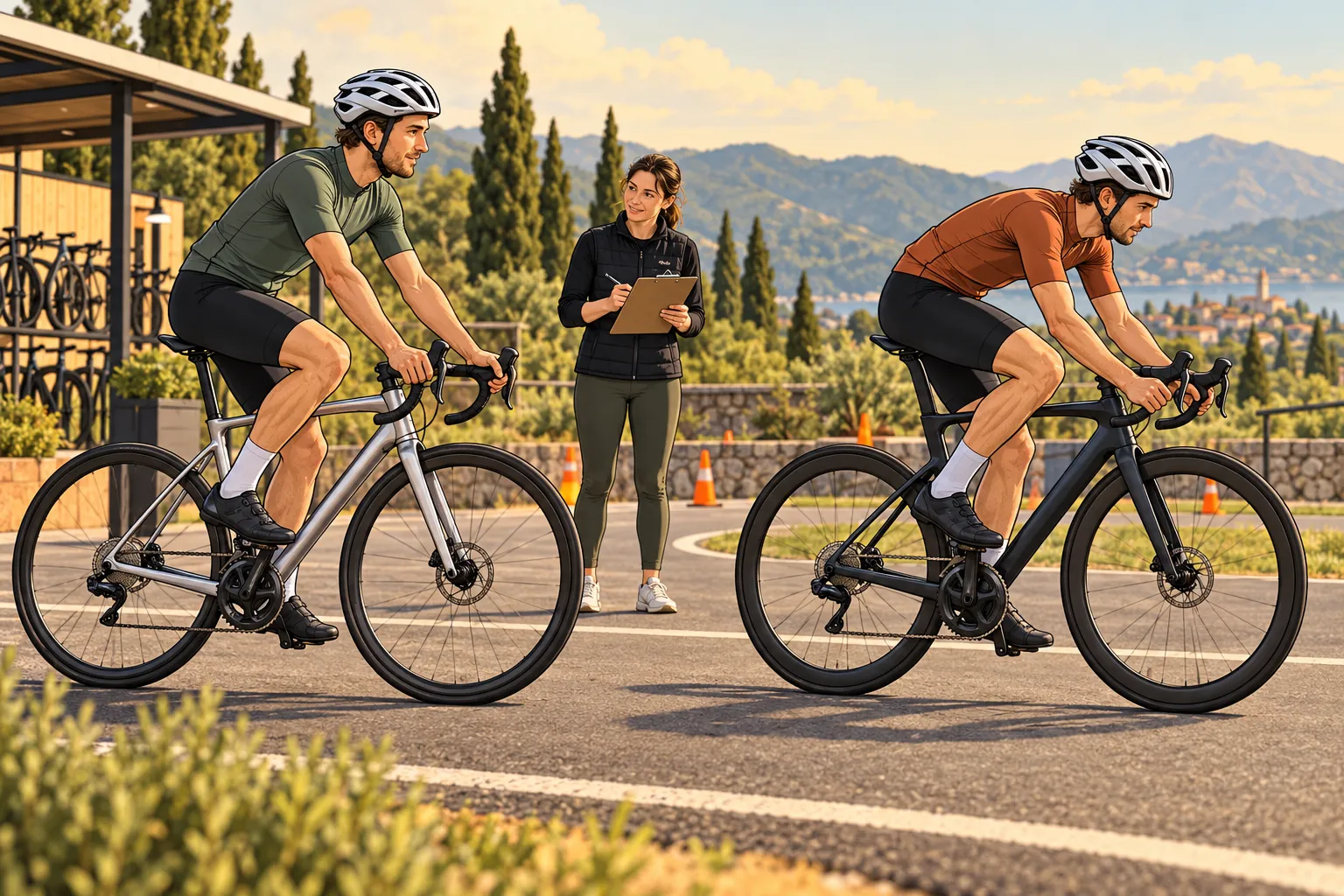
First remove the false comparison
If your current bike is the wrong size or poorly adjusted, almost any correctly sized bike may feel transformative. That does not prove that carbon, electronic shifting, or a premium badge created the improvement.
Before comparing, record on both bikes:
- frame size and geometry, especially stack and reach;
- saddle height, setback, tilt, width, and model;
- crank length, pedals, shoes, and cleat position;
- bar width, hood position, stem length, and spacer height;
- measured tyre width and pressure;
- total load carried;
- obvious maintenance differences.
The useful question is not “Which bike felt faster?” It is “Which differences caused the feeling, and will they still matter after two hours?”
Match the contact points where practical
Ask the shop to set saddle height and lever reach safely for you. If you own a comfortable bike, bring its fit coordinates or use the bike-fit transfer method to establish a reasonable baseline.
Do not force two fundamentally different frames into identical positions. A race bike and an endurance bike may have different handling and intended posture. The goal is to stop an accidental size mismatch from masquerading as a materials test.
If one bicycle needs an extreme stem, prohibited spacer stack, saddle outside its rail marks, or controls you cannot reach, that is purchasing evidence—not a setup challenge to solve later.
Control the easy variables
Tyres and pressure strongly influence road feel. A bike on supple, correctly inflated wider tyres may feel calmer and quicker on rough pavement than another on old, overinflated rubber. Ask what is fitted and whether both tyres are within their approved pressure and compatibility limits.
Also check:
- are both drivetrains clean and adjusted;
- are the brake pads rubbing;
- do wheels spin freely and run true;
- are bearings free of play or roughness;
- are accessories adding rattles or weight;
- is one bike freshly serviced while the other is neglected?
Do not spend thousands to solve a dragging brake or worn tyre.
Ride the same short protocol
Use the same safe loop and sequence for each bike:
- Start and stop: can you mount, steer slowly, and reach both brakes without strain?
- Hoods: ride easily for several minutes and notice hands, neck, back, hips, and saddle support.
- Shifting: shift under light load across the usable range. Judge access and consistency, not just sound.
- Rough surface: use the same short imperfect section to compare vibration and control.
- Climb: use a moderate rise to check gearing and seated position.
- Turn: make predictable low-risk turns and note whether the bike follows a line naturally.
- Repeat: return to the first bike if possible. Memory exaggerates novelty.
Avoid sprinting away from the shop and calling the livelier bike the winner. A short acceleration rewards tyres, gearing, freehub sound, and excitement more than all-day suitability.
Score outcomes, not prestige
After each ride, write one sentence for:
- brake access and confidence;
- low-speed stability;
- hand, saddle, neck, back, and knee comfort;
- usable climbing gear;
- vibration on the same rough section;
- adjustment room for your intended position;
- service complexity and replacement cost;
- the specific improvement you would be paying for.
A premium bike may legitimately win through lower mass, cleaner shifting, aerodynamic integration, wheel quality, or the simple joy that makes you ride more. Those are valid wants if the budget is comfortable. They are not a reason to ignore fit, proprietary parts, or maintenance access.
Use a cooling-off test before buying
Ask yourself:
- Would this bike still be the choice with ordinary paint and no brand name visible?
- Can the current bike achieve most of the comfort gain through fit, tyres, or service?
- Does the new bike solve a known limitation or create a new desire?
- Can you afford the complete ownership cost without sacrificing essential kit and maintenance?
- Is there a return or exchange process long enough to test the fit properly?
Run the new-bike fit test before the return window closes if you buy. For the entire purchase sequence, use the beginner road-bike buying checklist.
Your next step
Book consecutive tests of the best-fitting mid-range and premium candidates. Bring one page containing your current fit coordinates and the seven scoring criteria above; make the decision after both rides, not while holding the expensive bike.
Sources and further reading
- r/cycling: entry-level to premium bike discussion — demand signal for separating a major size/fit change from component and frame upgrades.
- r/cycling: modern bike versus older bike discussion — demand signal showing that perceived gains vary; anecdotes were not treated as controlled evidence.
- r/cycling: second-road-bike discussion — high-engagement editorial signal for upgrade decisions; individual purchases were not used as recommendations.