Mechanical vs electronic shifting: which should your next road bike have?
Choose between cable-operated and electronic road-bike shifting by comparing ride feel, maintenance, repair cost, charging, hand effort, and the complete bike.
 Field guide / mechanical-vs-electronic-shifting-road-bike
Before you view or pay
Check fit, condition, and starter gear first
Use the buying checklist to choose the right path: used-bike viewing, first-bike fit and type, hidden repair costs, or starter gear.
Electronic shifting is a convenience upgrade, not an entry ticket to serious road cycling. A well-installed mechanical groupset can shift accurately for years. Electronic systems make each shift lighter, enable configuration and extra controls on some models, and remove derailleur cable wear—but add batteries, software, higher replacement costs, and system-specific parts.
The short answer: buy electronic shifting when effortless button presses, extra control locations, or easier operation with limited hand strength are worth the price to you. Choose mechanical when value, simpler field diagnosis, broad shop familiarity, and freedom from charging matter more. Compare complete bikes, not one feature in isolation.
Why riders disagree so strongly
Recent r/cycling discussions ask how much of an upgrade electronic shifting really is and whether money is better spent on electronic shifting or another wheelset. The answers split because “worth it” combines several different questions: how the buttons feel, whether a cable shift currently causes pain, what else the money could buy, and how much the owner values charging and configuration.
Those preferences are useful demand signals, not proof that one system is universally faster, safer, or more reliable. Start with the problem you want the new bike to solve.
What actually changes on the bike
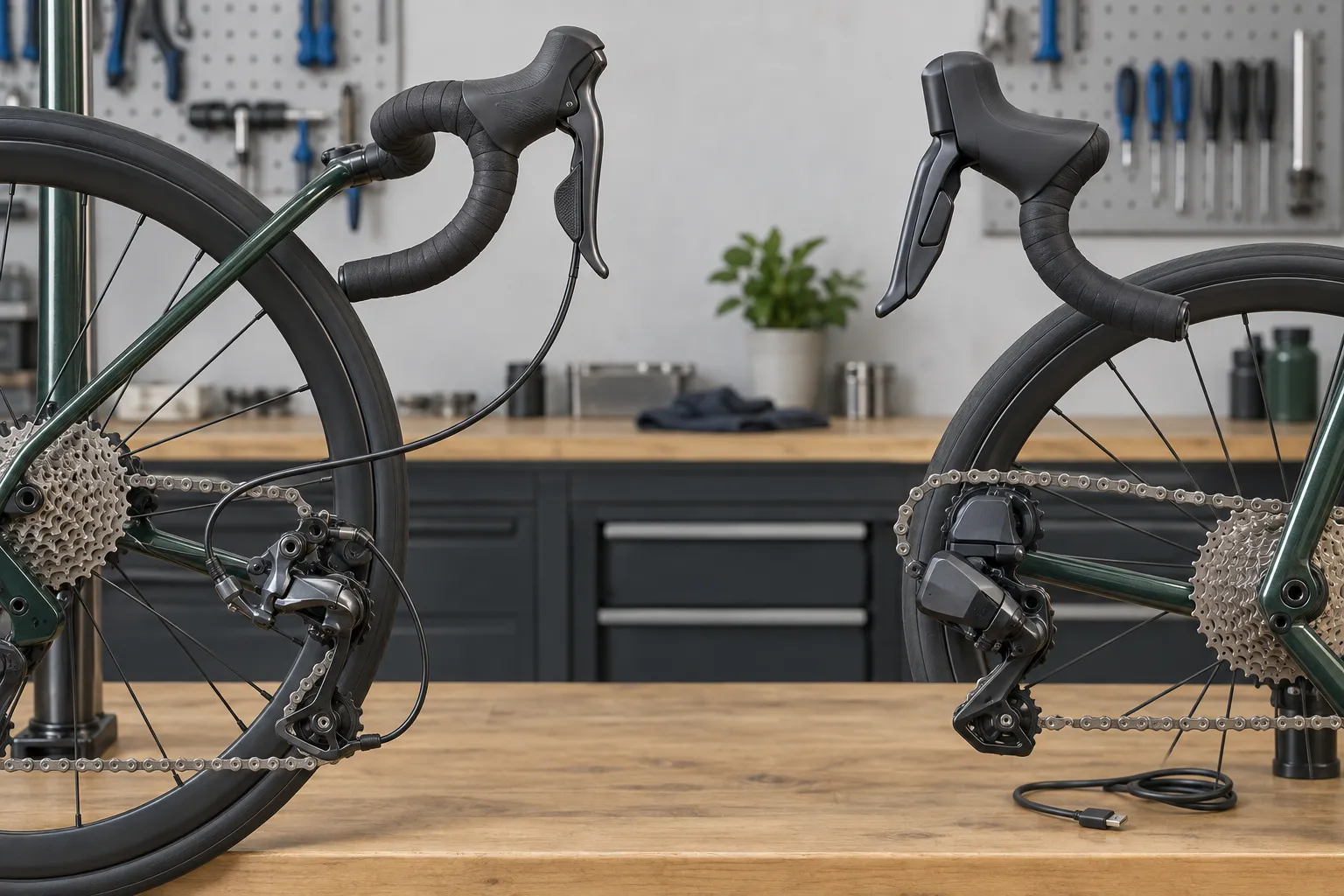
Mechanical road shifting uses the lever to pull or release a cable. That cable moves the derailleur. Cable tension, housing condition, routing, lever travel, and derailleur adjustment all influence the shift.
Electronic shifting turns a button press into a command for a motor at the derailleur. Depending on the system, power may come from a central internal battery or removable batteries, while shifter buttons may use their own small cells. Current Shimano road Di2 documentation, for example, separates the system into levers, wiring or wireless pairing, derailleurs, battery, charging, adjustment, and firmware-supported configuration.
Neither design changes the basic drivetrain job. The chain still has to move between compatible sprockets and chainrings under sensible load.
Where electronic shifting earns its price
Electronic is most compelling when one of these benefits matters on nearly every ride:
- Very light control effort. A button can be easier than sweeping a brake lever, especially for a rider with limited hand strength or range of motion. Discuss pain or a medical limitation with an appropriate clinician as well as a fitter.
- Consistent control input. Cable friction and housing contamination no longer determine lever effort.
- Additional shift buttons. Some systems support satellite controls for the drops, climbing position, or aero extensions.
- Configurable logic. Supported apps may let you swap button functions, choose multi-shift behaviour, or coordinate front and rear shifts.
- No derailleur cable replacement. There is no mechanical shift cable to fray, corrode, stretch into its housing, or route through an integrated cockpit.
These are quality-of-use benefits. They do not automatically make the complete bike fit better, brake better, roll faster, or suit your roads.
What the upgrade also asks from you
Electronic systems introduce a different checklist:
- charge the main battery or removable derailleur batteries;
- replace small shifter batteries when required;
- learn the system’s battery indicators and low-power behaviour;
- keep the correct charger available;
- maintain current compatible firmware when the maker requires it;
- budget for more expensive damage to a lever or derailleur;
- confirm that local shops and travel destinations can support the system.
A flat battery is preventable, but only if charging fits your habits. Before a long event or trip, check every battery separately; “the derailleur is charged” may not confirm the shifter cells.
Mechanical shifting is not the budget punishment
A clean, correctly routed mechanical system can offer crisp shifts with a clear tactile click. It also gives a home mechanic visible causes to check: cable tension, a damaged outer housing, contamination, a bent hanger, or poor indexing.
Mechanical remains a strong choice when:
- the lower-priced bike fits you better or leaves money for essential equipment;
- you travel where replacement electronic parts may be scarce;
- you prefer a system without charging and pairing;
- you already understand cable maintenance;
- crash or transport damage cost is a serious concern;
- the bike will see harsh utility use and inexpensive replacement parts matter.
Mechanical does not mean maintenance-free. If lever effort rises, shifting becomes inconsistent, or a cable begins to fray, use the cable-and-housing replacement guide before another barrel-adjuster turn.
Do not upgrade a fault you have not diagnosed
Poor mechanical shifting does not prove that mechanical shifting is poor. Check for a worn chain, worn cassette, bent derailleur hanger, damaged cable housing, incorrect indexing, loose wheel, or incompatible parts first. Our rear-derailleur indexing guide shows what the barrel adjuster can—and cannot—fix.
Electronic systems also need a straight hanger, correct chain length, compatible cassette, accurate setup, and sound connectors. A motor cannot compensate for bent hardware or drivetrain wear.
Compare two complete bikes in this order
When two bikes differ by more than shifting, use this sequence:
- Fit and geometry: can you reach the controls, hold the position, and adjust it sensibly?
- Tyre clearance and gearing: do they suit your roads and hills?
- Brake system and wheel standards: are parts appropriate and supportable?
- Serviceability: can you get the proprietary cockpit, hanger, battery, charger, and small parts?
- Total budget: include pedals, shoes if wanted, spares, tools, lights, and initial fitting.
- Shifting preference: test both systems under light and moderate pedalling load.
Do not spend the emergency-repair or helmet budget to obtain electronic shifting. Use the complete first-road-bike budget and buying checklist before comparing upgrade prices.
A simple decision rule
Choose electronic when the complete bike fits, the extra cost is comfortable, charging is easy to make routine, and you can name a benefit you will use. Choose mechanical when electronic would force a compromise in fit, tyres, gearing, service access, or financial margin.
If you remain undecided, test ride both and then ride the mechanical bike again. If its shifting disappears beneath you after five minutes, it is already doing its job.
Your next step
Write down the exact price difference between two complete bikes, then list what that money displaces. Test the reach to both brake levers, make front and rear shifts from the hoods and drops, and ask the shop to show the battery check, charging point, replacement-part prices, and roadside low-battery behaviour before you choose.