Can you wear leggings over bib shorts for cold-weather cycling?
Ordinary leggings can work over bib shorts. Test seams, pedalling freedom, warmth, chafing, weather protection, and alternatives before a long cold ride.
 Field guide / leggings-over-bib-shorts-cold-weather
Before you buy
Check the starter kit first
Print the one-page buying brief for helmet, lights, water, phone, and repair compatibility before comparing upgrades.
You can wear ordinary leggings over padded bib shorts for cold-weather cycling. It is a reasonable low-cost setup when the leggings stretch freely, have no troublesome seams, stay clear of the drivetrain, and have been tested on a shorter ride first.
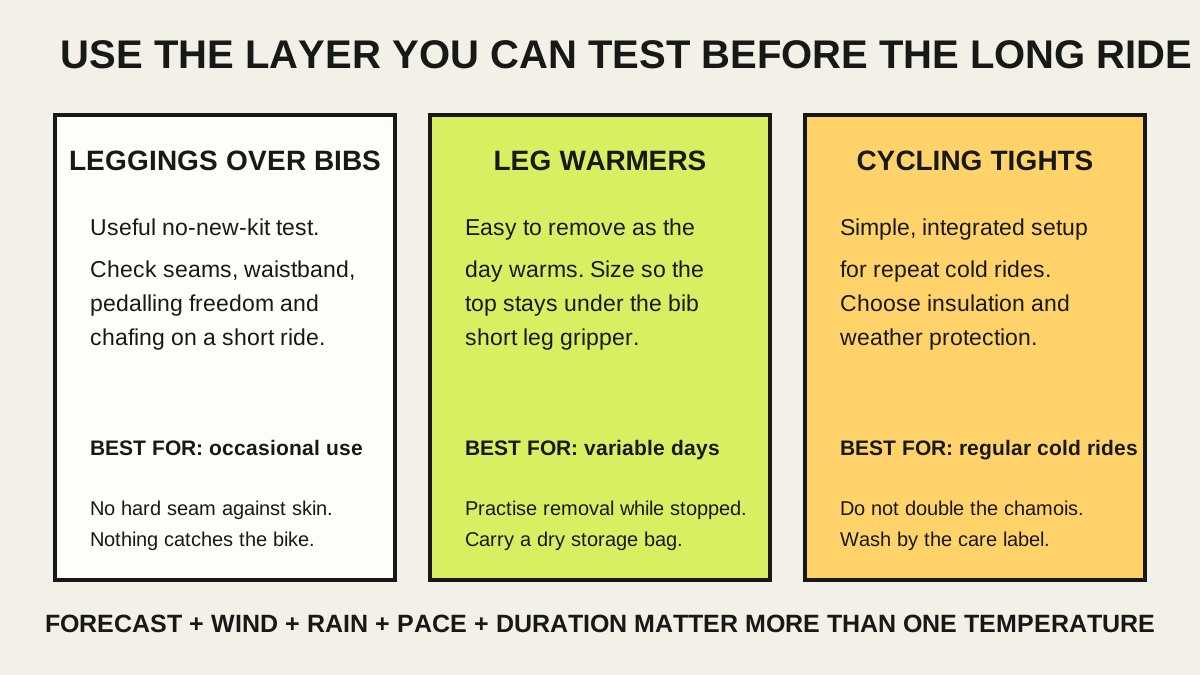
The short answer: keep the bib shorts next to your skin so the chamois sits where it was designed, then wear smooth, close-fitting leggings over them. Test the complete combination before a century or long group ride. Leg warmers are easier to remove as the day warms; dedicated cycling tights are simpler for frequent cold rides.
The current rider question
A recent r/cycling discussion asks whether leggings over bib shorts are enough for a first cool-weather century. Another highly discussed thread compares short bibs, leg warmers, lightweight tights, and winter tights.
Those discussions show the demand and range of personal preferences. They do not create a universal clothing chart: two riders can need different layers in the same air temperature because wind, rain, pace, duration, body size, acclimatisation, and stops differ.
Put the padded layer next to the skin
Wear the bib shorts as normal, without underwear, then pull the leggings over them. This keeps the chamois stable and avoids adding another underwear seam between you and the pad.
Do not stack two padded shorts or wear padded tights over padded bib shorts unless both garments were explicitly designed to work together. Two pads can bunch, hold moisture, change saddle contact, and create friction.
If you are new to bibs, read what to wear under cycling bib shorts before building the winter layer.
Inspect ordinary leggings before riding
The label does not need to say “cycling,” but the garment must work on a bike. Check it off the bike first:
- Seams: avoid a thick centre seam, zip, pocket edge, or raised logo where it presses against the saddle, groin, or knee.
- Stretch: pedal-like knee and hip flexion should not pull the waistband down or compress the kneecap.
- Length: fabric should cover the intended skin without bunching behind the knee.
- Ankles: cuffs must stay away from the chain, chainring, crank, and pedal.
- Waistband: it should not dig in when bent forward.
- Surface: very loose or flared fabric can snag the bicycle.
- Visibility: dark clothing is not a substitute for legally required lights and reflectors.
Turn the cranks by hand while the bike is supported and confirm nothing contacts moving parts.
Run a short test, not a mirror test
An outfit can feel fine standing upright and fail after 30 minutes in the riding position. Test the exact socks, shoes, bibs, leggings, upper layers, gloves, and headwear on a short route with an easy bailout.
During and after the ride, check:
- pressure or rubbing at every seam;
- restriction at the hip or knee;
- the leggings sliding down or rotating the bib legs;
- dampness and chill during stops;
- overheating on climbs;
- whether you can operate brakes and zips with gloves;
- whether removed layers fit safely in a pocket or bag.
Do not make a first long ride the garment test. Small friction on a 20-minute ride can become a painful skin problem after several hours.
Compare the three practical options
Ordinary leggings over bib shorts
This is the low-cost experiment when you already own suitable leggings. It works best in dry conditions and moderate cold, depending on the fabric. Many everyday leggings provide little wind or rain protection, and cotton-rich material can stay wet.
The advantage is availability. The downside is unknown seam placement, cycling durability, pocket interference, and weather performance.
Knee or leg warmers
Warmers turn existing bib shorts into a variable-weather system. Wear the top under the bib-short leg gripper so the overlap does not expose skin as you pedal. They should stay up without constricting the thigh.
Remove them only while stopped safely. Put them in a dry bag or pocket so wet fabric does not soak food or electronics. Practise taking shoes off and removing warmers at home; roadside acrobatics are not required.
Full-length cycling tights
Tights are the simplest repeated-cold-ride choice. Some include a chamois and replace bib shorts; others are unpadded and layer over them. Confirm which type you are buying.
Compare insulation, wind resistance, water resistance, ankle closure, reflective details, and care instructions. “Winter” ranges from lightly brushed fabric to heavy wind-blocking construction.
Dress for the complete ride, not the first five minutes
It is normal to feel slightly cool before pedalling, but you should not begin shivering or unable to operate the controls. A century adds long exposure, slow sections, queues, puncture stops, and the possibility of finishing after sunset.
Plan around:
- the lowest temperature, not only the afternoon high;
- wind speed and direction;
- rain and road spray;
- expected pace and waiting time;
- exposed descents after sweaty climbs;
- route bailouts and indoor shelter;
- daylight and working lights;
- dry gloves or an emergency layer.
Leg warmth is only one part. Hands must brake and shift securely, feet must retain useful sensation, and upper layers must manage sweat without leaving you dangerously cold when stopped.
Avoid arbitrary temperature rules
Online clothing charts can be useful packing prompts, but they are not safety boundaries. A calm, dry 10°C / 50°F ride can feel very different from the same temperature in strong wind and rain. A hard solo effort produces more heat than a slow event with repeated stops.
Build your own log. Record temperature range, wind, precipitation, pace, layers, and where you felt cold or overheated. After three comparable rides, that evidence is more useful than copying a stranger’s cutoff.
A long-ride packing check
For a cool-weather event, carry or arrange:
- one removable wind layer;
- dry gloves or liners if the forecast justifies them;
- a small waterproof bag for wet layers and electronics;
- working front and rear lights if darkness is possible;
- event contact details and bailout transport;
- food and water accessible with the clothing on.
Do not stuff so many layers into jersey pockets that they can fall into the wheel. Use a secured saddle, frame, or handlebar bag where needed.
Your next step
Put your usual bib shorts under the smoothest close-fitting leggings you own and complete a short test in similar conditions. If the seams stay quiet, movement remains free, and warmth is appropriate, the combination is valid. If the day will warm or you ride cold weather regularly, compare leg warmers or purpose-built tights before the next long ride.
Sources and further reading
- British Cycling: practical winter clothing and preparation
- r/cycling reader context: leggings over bib shorts for a cool-weather century
- r/cycling reader context: the gap between bib shorts and winter tights — both Reddit threads were used as demand signals, not universal temperature evidence.