Keep your current bike or buy a new one? Run this upgrade audit
Separate repair needs, fit and use limits, and genuine wants before replacing a road or gravel bike that still completes your rides.
 Field guide / keep-current-bike-or-buy-new-one
You do not need to replace a bike because it is six years old, aluminium, mechanically shifted, or less expensive than current models. Replace it when it cannot safely and economically meet a requirement that matters—or buy a new one because you want a different experience and can afford it. Do not disguise one reason as the other.
The short answer: write down the limitation you feel on real rides. Test whether service, fit, tyres, gearing, luggage, or technique solves it. Price that complete solution against a complete new bike. If the old bike remains safe, fits, carries what you need, and finishes your trips comfortably, carbon and electronic shifting are optional benefits, not an expiry notice.
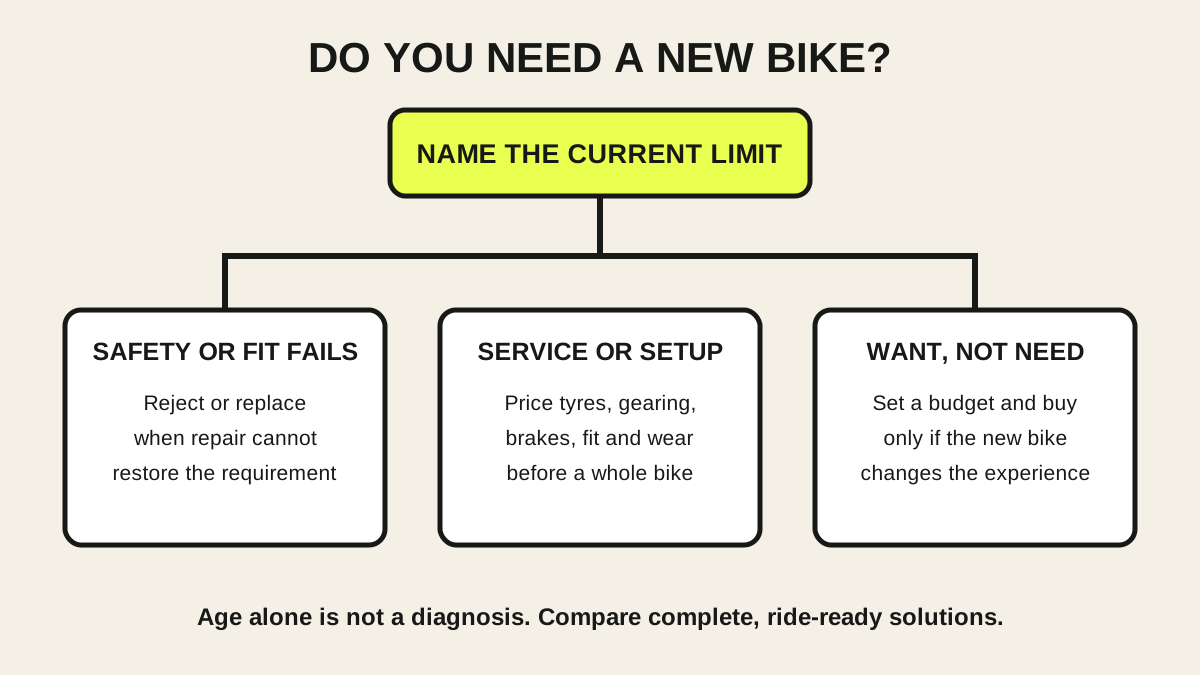
Start with the ride the bike already completes
A current r/cycling question describes a six-year-old aluminium gravel bike with 105 components that has completed multi-day trips. The owner wonders whether carbon and electronic shifting are needed for occasional bikepacking and Sunday rides.
The completed trip is useful evidence. It does not prove the bike is perfect, but it proves that a generic “upgrade” recommendation must beat a working baseline.
For three representative rides, record:
- route surface, climbing, distance, and weather;
- pain or control problems;
- gears you could not use or wished you had;
- luggage capacity and handling;
- braking and tyre confidence;
- mechanical faults or repeated adjustment;
- what you enjoyed and what you wished felt different.
“Old” and “not carbon” are descriptions, not symptoms.
Gate 1: safety and structural condition
Inspect the frame, fork, cockpit, wheels, tyres, brakes, drivetrain, bearings, and luggage mounts. Check open recalls for the exact model and components. Ask a workshop for a written estimate if you cannot assess wear.
Replacement becomes rational when:
- structural damage cannot be repaired responsibly;
- corrosion or seized parts make reliable service uneconomic;
- the frame or fork lacks safe clearance for the tyres the route requires;
- essential replacement parts are unavailable;
- the total repair cost approaches a better complete solution;
- the bike’s documented rider, luggage, or use limits do not cover the job.
Ordinary consumables do not condemn the frame. Chains, cassettes, tyres, brake pads, cables, bar tape, and bearings are expected to wear. Compare the post-service bike with the new bike, not a neglected bike with a showroom bike.
Gate 2: fit and control
A bike that creates persistent pain, cannot provide safe brake access, or cannot be adjusted within component limits has a genuine problem. But a saddle, bar, stem, cleat, or setup change may solve it for far less than a replacement.
Write down the exact fit issue. “I want more comfort” is too broad. Useful statements include:
- “I cannot reach the brake levers securely from the hoods.”
- “My hands become numb after 90 minutes despite changing position.”
- “The front end cannot be raised further within the steerer limits.”
- “My heels hit the bags because the frame is too short for this load.”
Use the beginner fit and comfort guide before assuming a more expensive frame material is the remedy.
Gate 3: category and carrying requirements
Replacing a bike makes sense when your riding has genuinely changed. A fast endurance road bike, an all-road bike, and a loaded gravel bike overlap, but they do not offer identical tyre clearance, mounts, gearing, geometry, or load capacity.
List pass-or-fail requirements:
- largest measured tyre plus safe clearance;
- mudguard and rack mounts;
- lowest required gear;
- number and location of bottles;
- luggage load and attachment;
- road versus rough-surface split;
- local service and spare-part access.
If credit-card bikepacking remains important, confirm how the candidate carries luggage before celebrating its weight. Deeply integrated cockpits, proprietary posts, and hidden routing may be attractive, but they can change fit adjustment, travel packing, and field service.
Service the comparison bike first
If the current bike has dull shifting, rough bearings, old tyres, dragging brakes, and tired tape, almost any test bike will feel miraculous. That comparison measures maintenance as much as design.
Before a serious test ride:
- Correct known safety faults.
- Set appropriate tyre pressure.
- Clean and lubricate the drivetrain.
- Confirm normal shifting and braking.
- Match saddle height and pedal system where possible.
- Bring the luggage or load that matters.
Then test the same climb, broken road, descent, and steady section. Note control, comfort, usable gears, and carrying—not merely the first acceleration away from the shop.
Price three complete options
Build three totals:
| Option | Include |
|---|---|
| Keep and service | Inspection, worn parts, fit changes, tyres, labour |
| Targeted upgrade | Service plus the one component solving a named limit |
| New bike | Bike, pedals, fit, luggage, guards, tools, delivery, first service |
Resale value can reduce the new-bike total, but do not count it until you have a realistic local price. Likewise, do not call a component upgrade cheap if it triggers new wheels, a freehub, bottom bracket, brake hoses, labour, or tools.
Use the complete road-bike buying checklist on the new candidate. A new bike should pass the same fit, brake, serviceability, and complete-cost gates as a first bike.
Carbon and electronic shifting are allowed to be wants
Carbon construction can enable different shapes, weights, and ride characteristics. Electronic shifting can deliver consistent button-operated shifts and useful customisation. Neither feature is required to average a particular speed, finish a tour, or justify enjoying cycling.
Wanting them is a valid reason if:
- the complete bike fits and suits the route;
- replacement batteries and proprietary parts are acceptable;
- the purchase does not displace essential maintenance, safety gear, or the trips themselves;
- you prefer the bike after a meaningful test rather than a specification comparison.
The honest sentence “I want a new bike because it excites me” leads to a better purchase than inventing a performance emergency.
Your next step
Ride your current bike on one representative route and record three limitations. Book an inspection if any are safety-related. Price the smallest fix for each, then test one new candidate against the serviced baseline. Buy only when you can name what the new bike changes—or when you consciously decide that joy is worth the budget.
Sources and further reading
- r/cycling reader context: whether a capable six-year-old bike needs carbon and electronic shifting — used as a current decision signal; product suggestions and ride-quality anecdotes were not treated as universal facts.