Is a loud road-bike freehub normal, and can it replace a bell?
Separate normal freehub clicking from sudden sound changes, slipping, drag, and grinding—and learn why a loud hub is not a dependable substitute for a bicycle bell.
 Field guide / is-loud-road-bike-freehub-normal
A loud, steady click or buzz while coasting can be completely normal. Freehub volume varies with the engagement design, lubrication, hub shell, spokes, and rim. What matters more than loudness alone is whether the sound changed suddenly and whether the hub still engages, coasts, and turns normally.
The short answer: compare the sound with the same wheel’s normal behaviour. Consistent clicking with clean engagement and no drag is usually a characteristic, not a fault. Sudden silence, a new grind, intermittent engagement, chain movement while coasting, or side-to-side play needs inspection. Keep a bell or voice signal; freehub noise is uncontrolled and may be inaudible where you need it.
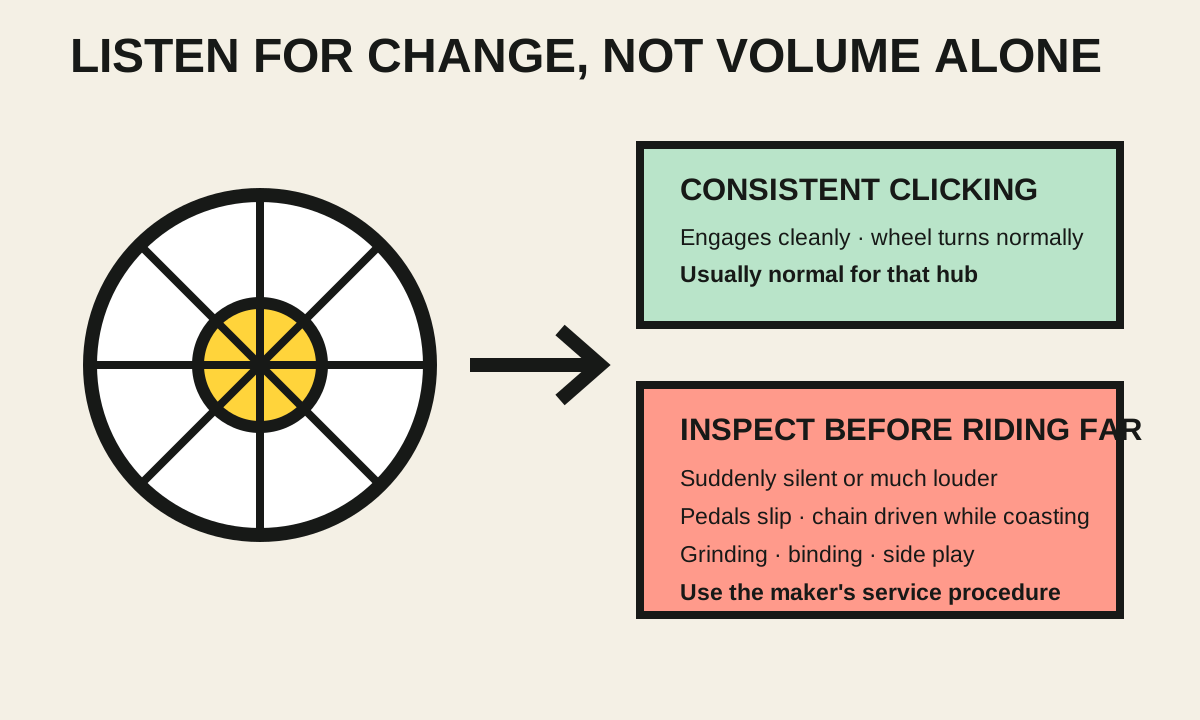
What makes the clicking sound
When you pedal, the freehub mechanism connects the cassette to the rear hub so torque drives the wheel. When you stop pedalling, the wheel can rotate faster than the cassette and the engagement mechanism passes over its mating surfaces. Pawls or toothed ratchet rings commonly create the repeated clicks.
Different designs produce different pitches and pulse rates. A deep carbon rim can amplify vibration differently from a shallow aluminium rim. A higher number of engagement points can change the frequency, but high price does not guarantee loudness and loudness does not prove quality.
A recent r/bikewrench post asked whether a very loud new rear-wheel sound was normal. Other current discussions ask whether freehubs have become louder and describe using the noise instead of a bell. These threads show recurring uncertainty; they do not diagnose an unseen hub.
Run five checks without opening the hub
1. Confirm when the sound occurs
Lift the rear wheel securely and turn the cranks forward. Then stop pedalling and let the wheel coast.
- Clicking only while coasting is consistent with normal freehub operation.
- Grinding while pedalling and coasting may involve bearings, brake rub, a seal, or another rotating part.
- A noise once per wheel revolution points away from the freehub’s rapid engagement clicks.
Keep fingers, hair, and clothing away from spokes, cassette, chain, and brake rotor.
2. Test engagement gently
With the bicycle stationary and the rear wheel prevented from rolling, rotate the crank forward gently until the drive engages. Repeat at several crank positions. It should pick up consistently rather than slipping through a large unpredictable movement.
Do not stamp on the pedal for this test. A sudden slip under body weight can cause a fall and may damage the drivetrain.
3. Watch the chain while coasting
Spin the rear wheel forward and let it coast. The cassette should rotate independently without strongly driving the chain and cranks forward. A small amount of movement can occur from seal drag, cold grease, or drivetrain condition, but the chain should not go slack or threaten to derail.
If the chain is pulled forward and bunches while coasting, use the freehub-drag diagnosis before riding farther.
4. Check play and smoothness
With the wheel correctly installed, hold the rim and test gently for side-to-side movement. Spin the wheel and feel for binding or roughness. Confirm that brake rub is not being mistaken for hub drag.
Play can come from hub adjustment, bearings, axle interfaces, or an insecure wheel. Follow the wheel-hub play check and the exact hub manual.
5. Compare with a known recording
Record ten seconds of the wheel coasting in a quiet place when it is working normally. Note the temperature and whether the wheel is on or off the bike. A later comparison is more useful than comparing your hub with a different wheel in an online video.
Changes that deserve inspection
Book or perform model-correct service when:
- a previously audible freehub becomes nearly silent during one ride;
- engagement becomes delayed, intermittent, or slips;
- clicking changes to grinding, scraping, or irregular clunks;
- the cassette or freehub has new side play;
- the wheel no longer coasts normally;
- the chain and cranks are driven forward while coasting;
- water contamination, pressure washing, or a deep immersion occurred;
- the maker’s maintenance interval has arrived.
DT Swiss, for example, publishes separate technical manuals for pawl, Ratchet, Ratchet EXP, DEG, and other systems. Its Ratchet EXP maintenance notice specifies using only the tools and lubricants in the relevant technical manual and recommends shorter intervals under rain, snow, dust, or frequent wet transport. That is a good reminder not to apply one internet grease recipe to every hub.
Do not pack in grease just to make it quiet
Lubrication affects sound, but the engagement mechanism must move freely. Excessively thick or excessive grease can slow pawls or ratchets, especially in cold conditions. The result can be failed engagement: the crank moves but the wheel does not drive immediately.
Use only the lubricant type and amount stated for the exact hub. If the manufacturer does not publish a user service procedure, ask its support team or a competent wheel mechanic. Do not spray general lubricant through gaps; it can wash contamination into bearings or reach the brake rotor.
If you dislike the normal sound, the lowest-risk choices are to accept it, ask the manufacturer whether a quieter approved service is possible, or choose a quieter hub at the next wheel purchase. Replacing a complete hub normally requires rebuilding the wheel and is rarely a small sound-only job.
Why a loud freehub does not replace a bell
Freehub sound is conditional: it happens only while coasting or backpedalling. It points mostly from the rear wheel, varies with speed and surroundings, and can disappear under traffic, wind, headphones, conversation, or hearing impairment. You also cannot give one clear, timed warning without changing your pedalling.
A bell or voice is deliberate. You can use it early, slow down, observe the response, and pass only when there is room. The Great Britain Highway Code says cyclists should fit a bell; equipment rules vary elsewhere, so check the local requirement.
On a shared path:
- reduce speed before the person or animal;
- give a bell or calm voice warning early;
- wait for evidence you were noticed;
- leave generous space;
- be prepared to stop regardless of the warning.
Noise never transfers responsibility to the person ahead. Use the shared-use path guide for passing and speed decisions.
Your next step
Lift the rear wheel and identify whether the sound occurs only while coasting. Check engagement, chain behaviour, play, and drag. If all four are normal and the sound is stable, record a baseline and ride. If any function changed, find the exact hub model and its manual before adding lubricant or opening it.