Is an 11–28 cassette outdated for a road bike?
Decide whether an 11–28 road cassette suits your hills, fitness, chainrings, and derailleur instead of replacing it because newer bikes use wider ranges.
 Field guide / is-11-28-cassette-outdated
Before you buy
Check the starter kit first
Print the one-page buying brief for helmet, lights, water, phone, and repair compatibility before comparing upgrades.
An 11–28 cassette is not obsolete. It is a close-ratio road cassette with an 11-tooth smallest sprocket and a 28-tooth largest sprocket. It can be excellent on flatter roads and fast group rides, but it may leave a newer rider short of easy gears on long or steep climbs.
The short answer: keep an 11–28 if you can climb your normal roads at a sustainable effort without grinding. Consider a larger largest sprocket when you regularly run out of easy gears, your cadence collapses, or climbing makes you avoid routes. “Newer” is not the test; usable gearing is.
What 11–28 actually tells you
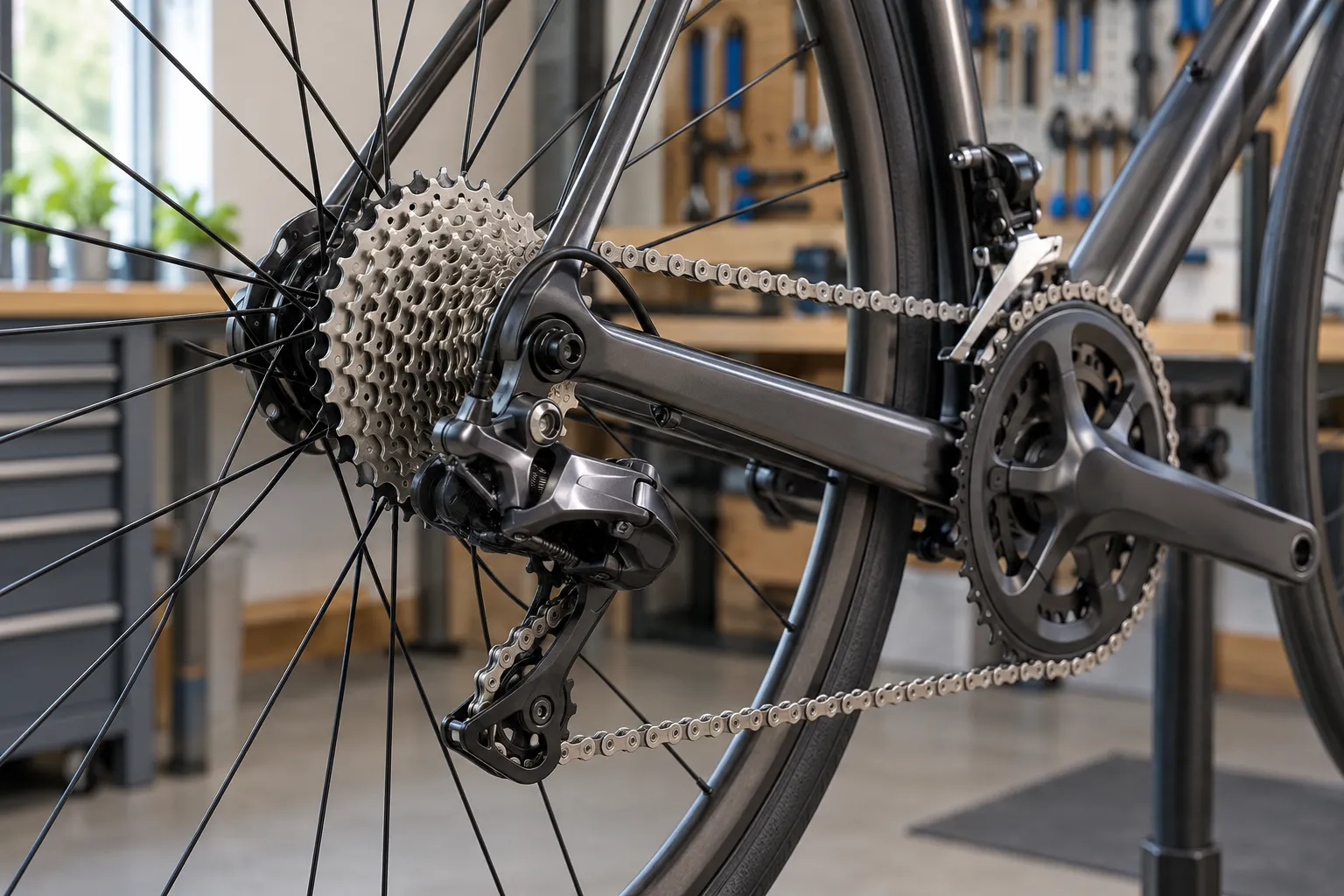
The two numbers describe only the smallest and largest rear sprockets. On Shimano’s 11-speed 105 CS-R7000 cassette, the 11–28 sequence is 11, 12, 13, 14, 15, 17, 19, 21, 23, 25, and 28 teeth. Shimano also documented 11–30 and 11–32 versions for the same generation.
Those small jumps are the attraction. On rolling or flat roads, you can often change one gear without a large cadence change. A wider cassette gives an easier climbing gear, but usually introduces larger jumps somewhere in the range.
Your front chainrings change the result. A 34-tooth inner ring paired with a 28-tooth rear sprocket is easier than a 36-tooth inner ring paired with the same cassette. Do not compare cassette numbers while ignoring the crankset.
Keep it when these statements are true
An 11–28 remains a sensible choice when:
- your usual routes are flat or gently rolling;
- you can finish the climbs without repeatedly standing from necessity;
- your breathing and legs, rather than the lack of another gear, set the pace;
- you value close steps for steady cadence;
- the cassette, chain, and shifting are in good condition;
- you do not avoid rides because of the gearing.
A bicycle does not become unrideable because current product pages show 30-, 32-, or 34-tooth largest sprockets. If the current range matches the job, replacing it is an expense rather than an upgrade.
Change it when the lowest gear is the limit
Consider a larger cassette if you often reach the 28-tooth sprocket early in a climb and still have to push an unsustainably hard gear. Other useful signals are repeated low-cadence straining, walking climbs you want to ride, or avoiding routes because the gearing is too tall.
First confirm that the bike actually shifts onto the 28-tooth sprocket and that brakes, bearings, tyres, and drivetrain condition are not making the bike harder to pedal. Then compare ratios with the easy road-bike gearing guide.
There is no shame in an easier gear. It lets you choose effort more freely and can make pacing a climb far more manageable.
Compatibility decides what you can fit
Do not order an 11–32 or 11–34 cassette from the tooth count alone. Confirm:
- the exact rear-derailleur model and its approved largest sprocket;
- the derailleur’s total capacity with your chainrings;
- cassette speed count and freehub interface;
- any spacer requirement;
- the chain type, condition, and required length;
- the manufacturer’s B-gap and adjustment procedure.
A larger sprocket may require a different derailleur, a longer chain, or both. A chain sized for 11–28 can be dangerously short on a larger cassette. Our guide to fitting a bigger road-bike cassette walks through those checks.
Do not treat an aftermarket hanger extension as automatic permission to exceed the derailleur maker’s specification. It changes geometry but does not prove adequate capacity, chain length, or shift quality.
Do not replace good gearing to solve a fitness comparison
Getting dropped on a steep group climb does not prove that an 11–28 is defective. The other riders may have lower gearing, different body mass, better pacing, or more climbing-specific fitness.
Use one representative climb as a test. Note the front ring, rear sprocket, whether you could keep the effort controlled, and whether you wanted one or two genuinely easier ratios. That evidence is more useful than comparing the bike with a current catalogue.
Your next step
Ride your normal steepest climb without trying to match someone else’s speed. If the 34×28 or equivalent lets you pedal steadily, keep it. If you are forced into repeated grinding, record your derailleur model and use the bigger-cassette compatibility checklist before buying parts.
Sources and further reading
- Shimano CS-R7000 exploded view and official 11–28 tooth sequence
- Shimano cassette installation manual listing approved CS-R7000 ranges
- r/cycling reader context: whether an 11–28 cassette is outdated — used as a demand signal, not evidence that one range suits every rider.