How to secure a bike inside a garage
Use layered garage bike security with a fixed anchor, suitable lock, access routine, serial records, registration, and a realistic recovery plan.
 Field guide / how-to-secure-bike-inside-garage
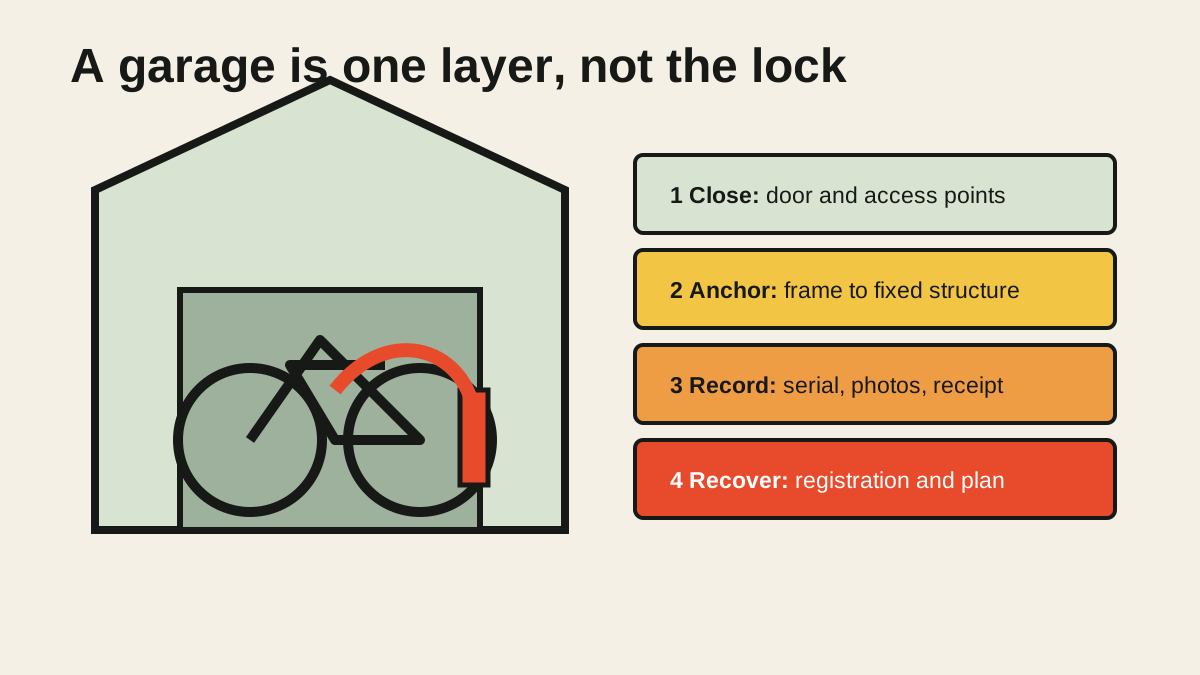
A closed garage door is not enough bicycle security. Lock the bike’s frame to a properly installed fixed anchor inside the garage, secure vulnerable access points, record the serial number and distinguishing details, register the bicycle where an appropriate service exists, and decide in advance what you will do if it disappears.
The short answer: treat the garage as the outer layer and the frame-to-anchor lock as the inner layer. Build a routine that still works when someone forgets the door, and keep evidence somewhere other than the bicycle. Trackers and cameras may support recovery, but they do not replace physical security or justify confronting anyone.
Why an indoor bike still needs a lock
A widely discussed r/cycling post described a new bicycle taken after a garage door was accidentally left open. The personal story is not evidence of a universal theft rate, but the underlying failure mode is clear: one forgotten door removed the only barrier.
Garages also have windows, side doors, shared access, remote controls, contractors, and periods when the main door is open for cars or chores. Layered security does not blame the owner for theft. It makes one mistake or defeated barrier less decisive.
Layer 1: control the garage access
Inspect the garage as a room, not just a parking space.
Check:
- the main door closes and latches reliably;
- side doors have appropriate locks and sound frames;
- windows cannot provide easy reach to releases or visible targets;
- emergency releases remain compliant with local safety requirements;
- remotes and keys are not left in an unlocked vehicle;
- shared users know the closing routine;
- the bicycle is not advertised by an open door for long periods.
If you rent or share the building, obtain permission before changing hardware. Do not disable required emergency access or fire-safety features.
A door-open alert or camera can notify you, but notification is not physical resistance. Test alerts from outside the home and confirm they reach the right people during quiet hours.
Layer 2: install a fixed anchor correctly
Secured by Design, the UK police security initiative, advises storing cycles in a locked garage or substantial shed and securing them to a strong ground or wall anchor even while indoors.
Choose an anchor and fasteners designed for the actual substrate. Concrete, solid masonry, timber framing, and hollow block need different systems. The installation must not weaken the building, hit utilities, create a trip hazard, or place the lock where tools have easy leverage.
Useful placement principles:
- pass the lock through the bicycle frame, not only a removable wheel;
- keep the lock and chain off the floor where practical;
- leave little empty space inside a U-lock or chain loop;
- position the anchor so the bike can be locked every time without moving half the garage;
- prevent the bicycle from falling onto cars, heaters, doors, or sharp objects;
- retain access for maintenance without removing the anchor.
If the substrate or hidden services are uncertain, use a qualified installer. A premium anchor attached with unsuitable fixings is theatre.
Layer 3: use a suitable lock every time
Choose a security-rated product appropriate to local risk and the value of the bicycle. Ratings differ by country, insurer, and testing scheme, so check the current policy rather than relying on a marketplace phrase such as “heavy duty.”
Lock the main frame to the anchor. Then assess removable parts:
- secure quick-release or high-value wheels with a second lock or approved security hardware;
- remove easily detached lights, computers, bags, and tool rolls;
- do not place a lock around a hydraulic hose, cable, spoke, or carbon tube in a way that can crush it;
- keep keys and combinations away from the garage.
A cable can retain accessories, but a thin cable should not be the primary security for the frame. Two different lock types can require different tools, although no combination is undefeatable.
Make locking the bike easier than skipping it. If the chain lives under a pile of boxes, the system will fail on a tired evening.
Layer 4: record ownership before anything happens
Create a record stored off the bicycle and outside the garage:
- frame serial number and its exact location;
- make, model, size, colour, and year;
- clear photographs from both sides;
- close-ups of unique marks, components, and damage;
- purchase receipt or other proof of ownership;
- component serial numbers where useful;
- current replacement value and upgrade receipts;
- registration details.
Do not publish the full serial number in public posts unless the relevant recovery system advises it. Keep the record accessible from your phone or cloud account if local privacy choices allow.
Register the bike with a reputable service used by your local police, campus, municipality, or cycling organisation. Registration does not prevent removal, but it can make ownership easier to establish if the bicycle is found.
Layer 5: understand trackers, cameras, and insurance
A tracker can report a location only when its network, battery, signal, mounting, and anti-stalking behaviour permit. It can be found and removed. Read whether an AirTag is enough for bike theft protection before hiding one in the frame.
A camera may document access, clothing, vehicle, and time. It may also miss a face, overwrite footage, or fail to alert. Aim and retain footage within local privacy laws and building rules.
Insurance terms vary widely. Before relying on a policy, ask in writing:
- whether a detached or shared garage is covered;
- required lock rating and anchoring method;
- whether an open or unlocked door changes coverage;
- proof-of-ownership and serial-number requirements;
- limits for accessories and upgrades;
- deductible and claim deadline.
Do not state that a claim will or will not be paid based on internet anecdotes. Read the actual policy for your address and storage setup.
Build a closing routine that survives real life
Use a short checklist near the exit or in a household reminder:
- Bicycle frame locked to anchor.
- Garage main door fully closed.
- Side door and accessible windows secured.
- Remote and keys inside the home.
- Door-open alert active.
For a shared home, assign responsibility when the garage is left open for work. A timer can prompt a check after a delivery, wash, or car repair.
Do not store the bicycle against corrosive chemicals, standing water, or a heater just to hide it. The unheated-garage storage guide covers condensation and maintenance separately from theft.
If the bike is missing
Prioritise personal safety. Do not enter a property, chase someone, arrange a confrontation, or recover the bicycle alone.
Instead:
- Confirm the bicycle was not moved by another authorised person.
- Preserve camera footage and access logs.
- Record the time window without disturbing evidence.
- Report the theft through the appropriate local channel.
- Provide serial number, photos, registration, and proof of ownership.
- Notify the insurer within its deadline if applicable.
- Mark the bike stolen in the relevant registry.
- Share only the information local authorities or recovery services recommend.
Listings can be monitored without contacting a suspected seller. Pass credible matches to the relevant authority and follow its instructions.
Your next step
Tonight, photograph the serial number and test the garage closing routine. Within a week, install or verify a substrate-appropriate anchor and lock the frame to it every time—even when the door is closed.
Sources and further reading
- Secured by Design: police guidance for pedal-cycle security
- Secured by Design: bicycle and garage security guidance
- r/cycling reader context: bicycle stolen from an open garage — used as a current prevention question signal; insurance and recovery anecdotes were not treated as policy or legal advice.