How to read bicycle helmet safety ratings without mixing the tests
Use certification as the legal baseline, compare helmets within one independent rating system, and treat fit, condition, and coverage as separate decisions.
 Field guide / how-to-read-bicycle-helmet-safety-ratings
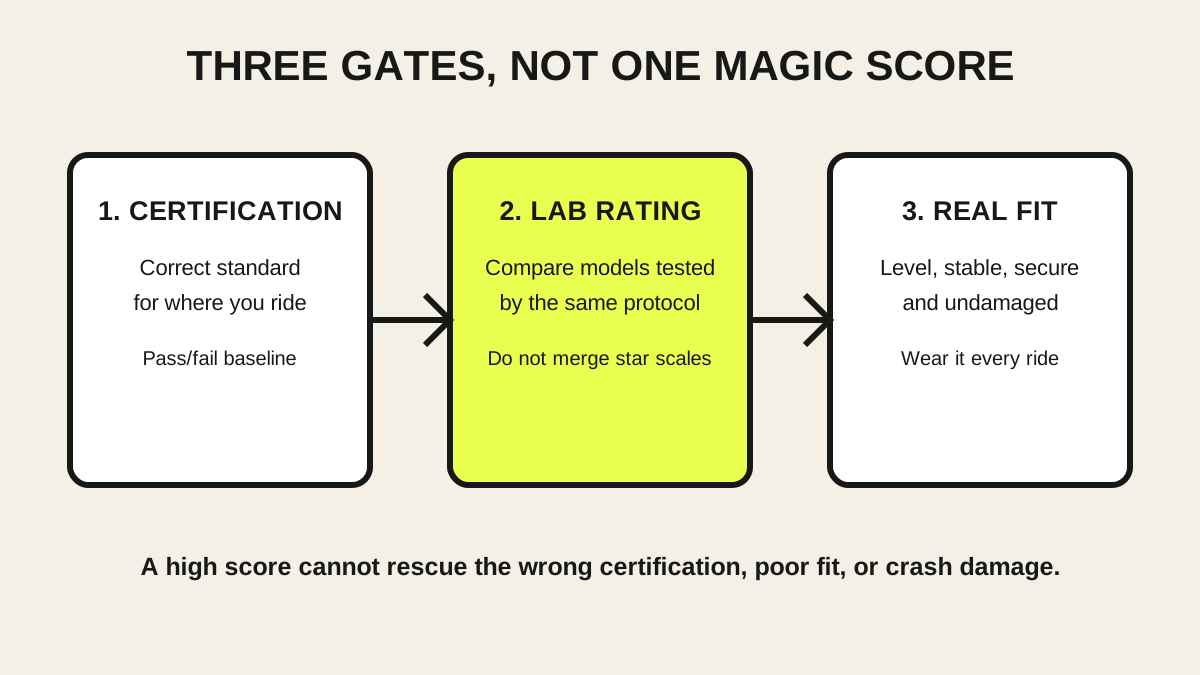
An independent helmet rating can help you choose between certified helmets, but its stars are not a universal safety unit. Virginia Tech and Australia’s Helmet STAR use different impact setups, calculations, and scoring bands. Compare models within one system; do not average or translate stars between systems.
The short answer: first confirm that the exact helmet carries the certification required where you ride. Then prefer a strong result from a credible independent test that includes your exact model and size. If two systems disagree, study what each tested instead of declaring one “wrong.” Finally, reject any helmet that cannot sit level, remain stable, and fasten correctly on your head.
Why two reputable rating systems can disagree
A current r/cycling discussion asks why riders often rely on Virginia Tech ratings when Helmet STAR tests additional properties. Commenters also found examples where the same helmet received very different star results.
That is not automatically evidence that either laboratory is unreliable. It is evidence that the word “star” has no meaning without the protocol behind it.
Virginia Tech’s current bicycle protocol uses 24 impacts across six helmet locations at two energies. Its drop tower measures linear acceleration and rotational velocity, weights each impact scenario, and calculates a STAR value related to estimated concussion risk. Lower numerical STAR values are better; four or five displayed stars are its recommended bands.
Helmet STAR uses linear impacts onto flat and kerb-shaped anvils, oblique impacts onto a moving surface, a fit check, stability testing, and chin-strap strength testing. Its final score therefore combines a different set of questions.
Different impact locations, headforms, surfaces, speeds, weighting, scoring, sizes, and samples can change the order. The useful question is not “Which star is true?” It is “Which protocol and result help with my decision?”
Certification and ratings are not substitutes
Certification is a market-access baseline. It normally asks whether a helmet passes the relevant requirements, not whether it outperforms every other certified model.
An independent rating compares performance under the laboratory’s additional test design. Virginia Tech explicitly describes its work as supplementing pass/fail standards with sports-specific comparison. A five-star result does not replace the certification label, and a certification label does not mean every compliant helmet earns the same independent score.
Before buying:
- Check the physical label inside the exact helmet, not only a retailer’s generic description.
- Confirm the certification is accepted where you will use it.
- Match the precise model name, generation, and tested size to the rating database.
- Check whether the rating page notes a different regional version.
Do not assume a familiar brand name or similar shell shape proves that two variants are identical.
Compare within one database first
Use an independent database as a shortlist tool:
- filter for the riding category you actually need;
- remove helmets unavailable in the correct size;
- compare scores produced by the same protocol;
- check whether the model has the required certification;
- then try the strongest practical candidates.
Virginia Tech warns that STAR values are not comparable across sports because the methods and weightings differ. The same discipline applies across organisations: a four-star result in one database is not mathematically “80%” of a five-star result elsewhere.
If one model performs strongly in two independent systems, that is useful converging evidence. If it performs strongly in one and poorly in another, inspect the protocols and prioritise neither score blindly. You can also choose a different model that performs consistently and fits well.
Fit can eliminate the laboratory winner
Laboratory results cannot tell you whether a retention system fits your head shape. Try the helmet with your normal eyewear and any thin approved cap.
Check that:
- the shell sits level rather than exposing most of the forehead;
- the size-adjustment system secures the helmet without painful pressure points;
- the straps lie flat and meet around the ears;
- the buckle closes securely without resting on the throat;
- a firm head shake does not make the helmet slide;
- glasses, hair, hearing aids, or a cap do not destabilise it;
- you will willingly wear it for every ride.
A slightly lower-ranked helmet that fits securely is a better real-world choice than a highly rated helmet that tilts back, creates pain, or is left at home. Use the full road-cycling helmet fit check before removing labels or riding outside.
Ratings do not cover every buying question
Independent impact testing does not automatically answer:
- night visibility;
- ventilation in your climate;
- compatibility with prescription glasses;
- replacement-pad availability;
- crash-replacement policies;
- durability of small adjustment parts;
- comfort after several hours;
- whether a used helmet has an unknown impact history.
Do not buy a used helmet whose history and age you cannot verify. Do not keep riding a helmet after a crash merely because the shell still looks smooth. Follow the helmet maker’s inspection and replacement instructions; read when a cycling helmet needs replacement for the decision sequence.
Build a defensible shortlist
Create a four-column note for each candidate:
| Gate | Evidence to record |
|---|---|
| Certification | Label and market requirement |
| Independent rating | Database, tested model and size, score |
| Fit | Level position, stability, strap and pressure-point check |
| Ownership | New condition, date, support and replacement parts |
Reject a candidate that fails any gate. Between survivors, price, weight, ventilation, colour, and features can break the tie. Expensive does not automatically mean better impact performance; check the result rather than inferring it from retail price.
Your next step
Choose one independent database relevant to your market and shortlist three certified four- or five-star helmets in your size and budget. Try them on, perform the stability check, and buy the best-fitting survivor. Save a photo of its internal certification and date labels with the receipt.
Sources and further reading
- Virginia Tech: bicycle helmet ratings, method, and technical documents
- Helmet STAR: testing explained
- r/cycling reader context: comparing Virginia Tech and Helmet STAR results — used as a current question signal; anecdotes and model claims in replies were not treated as laboratory evidence.