How to choose a bike fitter before you book
Choose a bike fitter by checking their assessment process, qualifications, measurement records, follow-up policy, and approach to pain before paying for an appointment.
 Field guide / how-to-choose-a-bike-fitter
A good bike fitter should first understand the rider, the bike, the riding, and the problem. They should explain each change, record the starting and finished positions, and offer a clear way to review the result. A wall of certificates is less useful if the appointment is rushed, unexplained, or treated as a one-time verdict.
The short answer: ask how the fitter takes a history, observes you riding, handles pain, tests changes, documents measurements, and manages follow-ups. Choose someone whose scope matches your need—and who is willing to say when a symptom belongs with a clinician rather than another spacer or saddle adjustment.
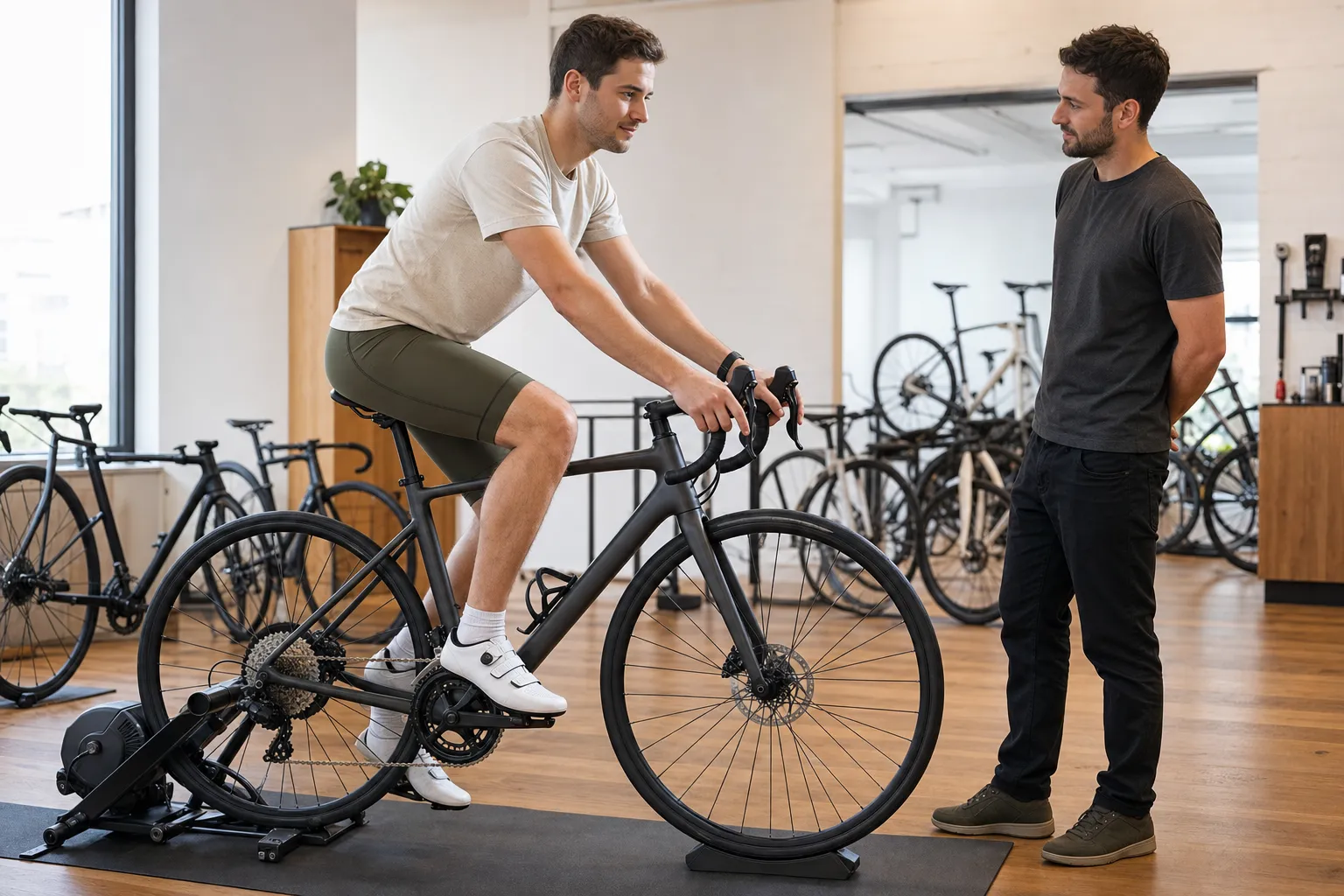
Start by defining the job
“Bike fit” can mean a quick saddle check, a new-bike sizing session, a performance position, or an assessment of discomfort. Those are not interchangeable services.
Write one primary reason for booking:
- choosing the correct size before buying;
- making brake and shift controls easier to reach;
- improving comfort for longer rides;
- transferring a known position to another bike;
- reviewing a position after a large equipment change; or
- investigating pain or numbness alongside appropriate clinical care.
Then describe your normal rides: surface, duration, hills, pace, indoor or outdoor use, and any event goal. A position designed around short racing efforts may be a poor answer for a new rider who wants relaxed three-hour rides.
If you are still shopping, confirm whether the service is a pre-purchase sizing consultation or a fit performed on a bike you already own. Do not pay for a detailed fit that assumes the wrong frame can always be corrected with components.
Ask these questions before booking
What happens before I start pedalling?
The fitter should ask about riding history, goals, previous bikes, current comfort, injuries, relevant health history, and the exact circumstances in which symptoms appear. They may assess mobility or movement within their competence, but the session should not turn a few body measurements into a diagnosis.
A current Reddit discussion about a fit that involved major changes after only a brief history and ride observation attracted substantial attention because riders recognised the uncertainty. That thread is an editorial demand signal, not evidence about any individual fitter.
How do you observe and test the position?
Ask whether you will ride under controlled conditions and whether the fitter checks more than a single frozen angle. A useful process usually considers control access, pelvic stability, saddle interaction, reach, hand pressure, pedalling, and your feedback.
Technology can support that work. Motion capture, pressure mapping, lasers, and adjustable fitting bikes do not replace careful questioning or judgment. The fitter should be able to explain a recommendation without hiding behind the software.
How many changes might you make at once?
Several adjustments may be connected, but you should still understand what changed and why. Ask how the fitter distinguishes the effect of saddle height, setback, tilt, cleat position, handlebar reach, and control position.
Research on seat position shows that changing saddle location can alter discomfort, pressure distribution, muscle activity, and pedal forces. The small study does not provide a universal ideal position; it supports the practical point that fit variables interact and deserve controlled testing.
What record will I receive?
Ask for before-and-after measurements with defined reference points. A useful report may include:
- saddle height, setback, and angle;
- handlebar reach and drop;
- stem length and spacer arrangement;
- handlebar and hood position;
- cleat fore-aft, lateral, and rotational position;
- crank length and relevant component dimensions; and
- parts changed or recommended.
Photographs can help, but numbers need repeatable landmarks. “Saddle raised 8 mm” is incomplete if nobody recorded how the original and new heights were measured.
What is the follow-up policy?
Clarify the time window, number of reviews, cost, and what information to bring back. Some issues appear only outside, on longer rides, or after repeated sessions. A fit without any route for feedback places too much confidence in one appointment.
Ask what happens if the new position causes pain. A responsible answer should include reducing or stopping the provoking riding, reviewing the exact changes, and referring outside the fitter’s scope when appropriate—not simply telling every rider to adapt.
Match qualifications to the problem
There is no single worldwide licence that makes every bike fitter equivalent. Training programs, professional registers, physiotherapy credentials, coaching experience, and years in a shop describe different knowledge.
For straightforward setup, an experienced fitter with a transparent process may be appropriate. For persistent pain, injury, neurological symptoms, or a complex medical history, look for a licensed healthcare professional with cycling experience, or a fitter who works directly with one. Verify professional registration with the relevant local regulator rather than relying only on a website biography.
Do not assume that racing experience makes someone a clinical expert, or that clinical credentials alone guarantee deep knowledge of cycling equipment. Scope and process matter together.
Treat these as warning signs
Pause before booking if the service promises one mathematically perfect position, guaranteed speed, guaranteed pain elimination, or diagnosis outside the provider’s qualifications.
Other warning signs include:
- no meaningful questions about goals, symptoms, or previous setup;
- large changes with no explanation or baseline measurements;
- pressure to buy one saddle, insole, or cockpit before testing the cause;
- no written record of the final position;
- dismissal of numbness or worsening pain as normal adaptation;
- no follow-up route; or
- certainty that every problem has one equipment answer.
Online reviews can reveal whether appointments feel respectful and whether follow-ups happen, but they cannot validate every technical decision. Ask a local club, physiotherapist, or trusted shop for context, then interview the fitter yourself.
Prepare so the appointment answers your question
Bring the bike as normally ridden, your usual shorts, shoes, pedals, and any insoles. Clean the bike enough to adjust safely. Tell the fitter about replacement parts, crashes, slipping components, or a trainer setup that feels different from outdoor riding.
Create a one-page note with:
- Your primary goal.
- Typical weekly riding and longest recent ride.
- Any symptom’s location, onset, duration, and whether it persists off the bike.
- Recent changes to training, bike, shoes, pedals, or saddle.
- What already felt good on this or another bike.
Do not deliberately provoke severe pain before the session. If the fitter needs to understand a symptom, a precise history is safer than arriving after one more damaging ride.
What a good result looks like
A fit result is a documented, testable starting point. You should leave knowing what changed, why it changed, what a short adaptation period may feel like, which symptoms mean stop, and how to report back.
Evidence for fitting is promising in some contexts but limited and varied. A recent systematic review of bike-fitting interventions for cyclists with lower-back pain found only three eligible studies and warned that different protocols and short follow-up limited generalisation. That is a reason for careful follow-up, not a reason to expect nothing.
Your next step
Send two prospective fitters the same five questions: what history they take, how they test changes, what records you receive, what follow-up is included, and how they handle pain outside their scope. Choose the clearest process, then take a baseline note using change one bike-fit setting at a time.
Sources and further reading
- Systematic review: bike-fitting interventions and lower-back pain
- Primary research: seat position, discomfort, pressure, and pedal force
- British Cycling: DIY road and mountain bike fit
- r/cycling reader context: questions raised by a recent fit experience
Reddit was used to identify the selection question. No individual account was used to judge a provider or verify a health claim.