How to break a cycling training plateau without just riding harder
Audit the metric, consistency, training specificity, recovery, and retest conditions before changing one part of a stalled cycling plan.
 Field guide / how-to-break-cycling-training-plateau
A cycling plateau is not automatically proof that you need more intervals. First confirm that the result has truly stalled, then audit consistency, specificity, recovery, and test conditions. Change one variable for a defined block and retest under comparable conditions.
The short answer: compare like with like, review at least several weeks rather than one bad ride, and identify the weakest part of the system. More training helps only when insufficient training is actually the limiter.
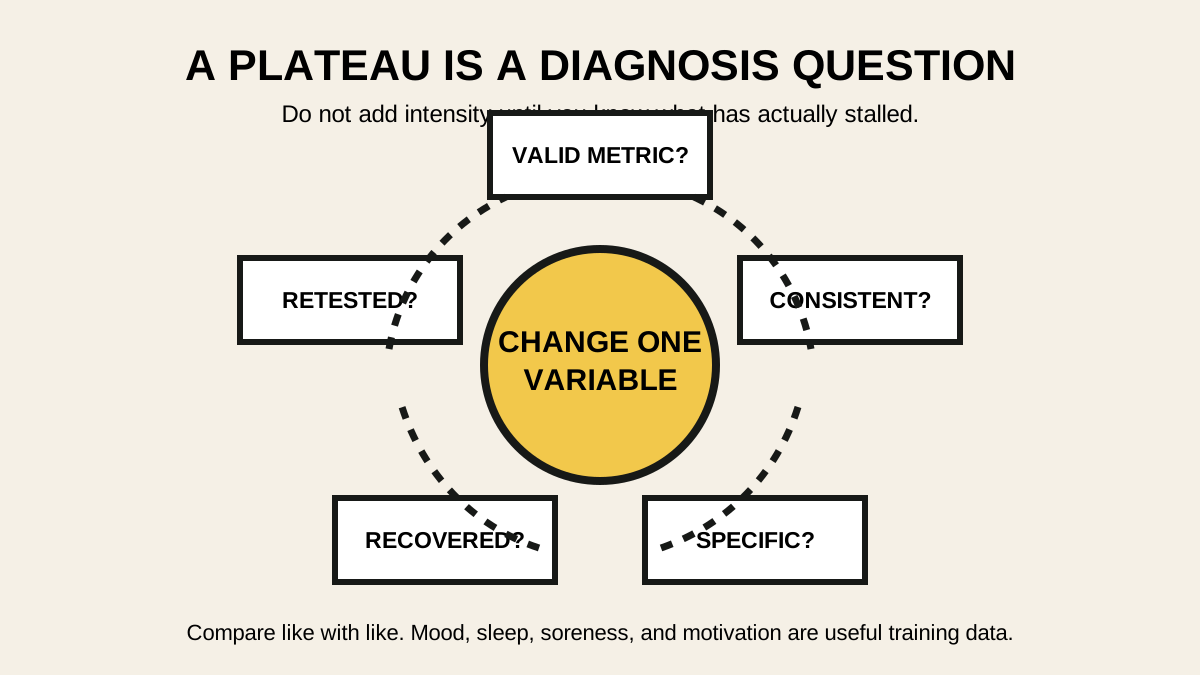
Decide what has actually plateaued
A current r/Velo discussion about FTP gains stalling attracted competing suggestions about volume, intensity, recovery, and life stress. That disagreement is the useful editorial signal: “I stopped improving” is incomplete until the rider defines the outcome and the observation period.
Write down one primary outcome:
- power from the same repeatable test;
- time on the same climb in comparable conditions;
- ability to complete a specific workout;
- endurance at a steady conversational effort;
- comfort and control over a target distance;
- performance in a particular event.
Average outdoor speed is a poor plateau measure when routes, wind, traffic, temperature, tyres, clothing, and riding companions change. Read why average speed is a poor beginner scoreboard before treating a slower week as lost fitness.
Check whether the change is larger than normal noise
One test can move because of pacing, calibration, cooling, sleep, nutrition, accumulated fatigue, motivation, or equipment setup. A study in trained cyclists found a properly conducted 20-minute FTP protocol repeatable, but not perfectly identical: its reported coefficient of variation was 2.9%. That does not create a universal 2.9% rule for every rider, device, or protocol. It shows why small changes should not be overinterpreted.
For a cleaner comparison:
- use the same power meter or smart trainer;
- calibrate it as the manufacturer specifies;
- repeat the same warm-up and test protocol;
- keep cooling and indoor temperature similar;
- test at a similar time after an easier training period;
- record sleep, recent illness, soreness, food, and motivation;
- repeat an unexpected result before rebuilding the plan around it.
Do not translate a platform estimate, ramp test, 20-minute test, and outdoor climb into one seamless trend. Research shows FTP-derived measures can correlate with laboratory markers without being interchangeable with them.
Audit consistency before complexity
Look at the last six to eight weeks on a calendar. Count completed weeks, not ambitious workouts saved in an app.
Ask:
- Were easy rides actually completed?
- Did travel, work, illness, weather, or bike problems repeatedly remove sessions?
- Did each missed week trigger an overly hard “catch-up” week?
- Did your total riding swing sharply between very little and too much?
- Have you practised the outcome you are testing?
If consistency is the gap, the solution is usually a smaller repeatable plan. Use the beginner cycling plan without a power meter to give each ride one clear job.
Match the training to the result you want
General riding can keep improving general fitness while a specific score stays flat. Long easy rides do not fully rehearse short climbing power; repeated short virtual races may not build the calm pacing and fueling needed for a long event.
For the next block, choose one emphasis:
| Stalled outcome | Useful emphasis | What not to add at the same time |
|---|---|---|
| Completing longer rides comfortably | Gradually extend one easy ride and practise fueling | Extra hard intervals and another long ride |
| Sustained climbing or time-trial effort | One controlled sustained session each week | Multiple unrelated maximal tests |
| Short repeated efforts | One session with repeatable short work and full recovery | Turning every easy ride into a race |
| Riding more often | Short, low-friction sessions on fixed days | A large duration jump |
| Event readiness | Terrain, pacing, position, and fueling that resemble the event | Chasing an unrelated app score |
Keep the rest of the week stable enough that you can tell whether the change helped.
Audit recovery and total life load
Training stress is only one part of recovery. Sleep disruption, under-fueling, manual work, running, strength training, family stress, travel, and illness all draw from the same week.
An expert consensus on recovery and performance recommends monitoring both training demands and recovery because responses vary between and within athletes. You do not need a laboratory dashboard. A short daily record can include:
- sleep duration and quality;
- leg soreness or heaviness;
- mood and willingness to train;
- ordinary resting heart rate, if you already measure it consistently;
- appetite and fueling;
- illness symptoms;
- whether easy riding still feels easy.
One poor day is ordinary. A pattern across several days, together with declining performance, is a reason to reduce load and investigate—not to prove toughness. Take a cycling recovery week before deciding that fitness has disappeared.
Change one variable for a defined block
Choose the smallest change that addresses the audit. Examples include:
- add 15–20 minutes to one easy ride;
- replace one random hard ride with a specific repeatable session;
- make one demanding day genuinely easy;
- schedule a lighter week;
- improve trainer cooling;
- practise pacing or fueling on the test route.
Hold the change for three to six weeks when health, experience, and schedule allow. Do not increase frequency, duration, and intensity together. If pain, illness, or severe fatigue is present, the correct block may be rest and qualified assessment.
Retest without turning testing into training
Pick the retest date before the block begins. Reuse the same protocol and record the same context. Then assess more than one line on the screen:
- Did the primary measure change?
- Did the same work feel more controlled?
- Can you repeat sessions with less disruption?
- Are sleep, mood, and motivation stable?
- Did the plan fit real life?
If the result stays flat but the block was consistent, specific, and recoverable, change the next most likely limiter. If the block was not completed, simplify it before searching for a more advanced method.
Your next step
Write one sentence defining the stalled outcome and one page containing the previous six weeks of completed training, sleep, illness, and other exercise. Circle the first failed check in the audit, change one variable, and book a comparable retest. That is a training experiment; “ride harder” is only a guess.
Sources and further reading
- Study: reliability of a 20-minute FTP protocol in competitive cyclists
- Study: FTP is not interchangeable with laboratory lactate parameters
- Consensus statement: recovery and performance in sport
- r/Velo reader context: discussion about stalled FTP gains — used as an editorial demand signal, not as personalised training evidence.