Can five hours a week prepare you for an ultra-distance cycling event?
Use limited indoor time to build consistent fitness, then protect outdoor rehearsals for handling, pacing, food, navigation, sleep, and equipment.
 Field guide / five-hours-week-indoor-ultra-distance-training
Five to six training hours per week can build meaningful cycling fitness. It cannot reproduce every demand of a 500 km event. Use indoor time for consistent aerobic work, then reserve selected outdoor days for the skills and systems that a trainer cannot test.
The short answer: a finish may be realistic for some experienced riders and unrealistic for others with the same weekly hours. Start from your present longest comfortable ride, event terrain, time limit, and recovery—not the event distance alone. Build one quality session, two easy rides, and one longer session most weeks; progress gradually and rehearse the full event system outdoors.
The current question is really about constraints
A new r/cycling thread asks how to prepare indoors for a 500 km event with about 10,000 metres of climbing while working full-time and raising children. The proposed week includes VO2 work, strength, Zone 2, and one longer trainer ride.
That list contains useful ingredients, but the schedule should begin with the rider’s present capacity and the event’s completion requirements. Five hours for an already durable rider with several long events completed is not the same as five hours for someone whose longest ride is 60 km. A generous multi-day time limit is not the same challenge as an aggressive single-stage cut-off.
Do not ask whether five hours is “enough” in isolation. Ask which risks those five hours can reduce—and which remain untested.
Audit the event before building workouts
Write down:
- single-stage or multi-day format;
- total distance and climbing;
- longest distance between services;
- road surface and technical descending;
- likely darkness and sleep strategy;
- mandatory equipment and lighting;
- resupply, water, and mechanical support;
- cut-off times and bailout options;
- expected weather range;
- your longest recent ride and back-to-back riding experience.
A 500 km course with 10,000 m of climbing asks for more than a large aerobic engine. It tests pacing judgment, comfort, contact points, digestion, lighting, navigation, mechanical self-sufficiency, attention, and decisions under fatigue.
Give each weekly session one job
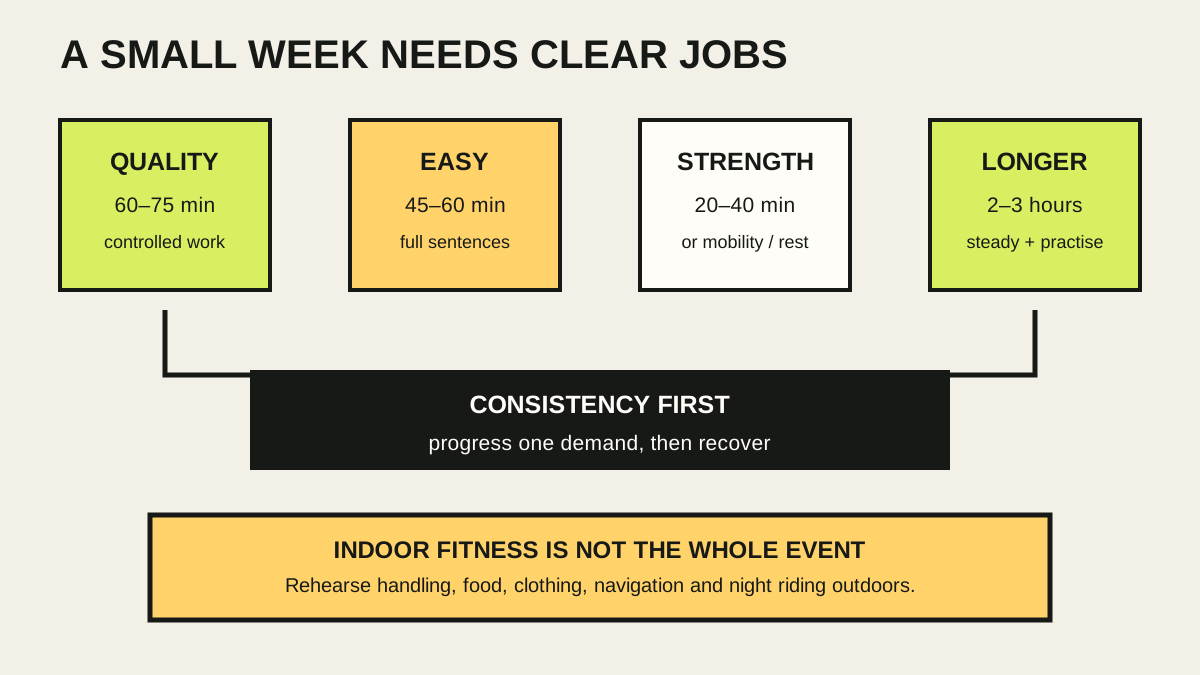
For a healthy, experienced rider already training consistently, a five-to-six-hour template might contain:
One controlled quality ride: 60–75 minutes
After a progressive warm-up, accumulate repeatable work at an effort matched to the current training phase. Early winter does not automatically require maximal VO2 intervals. Tempo, sustained climbing-style work, cadence practice, or a modest interval set may be more repeatable.
The final repetition should retain stable form. A session that destroys the next two rides is too expensive for a small weekly budget.
Two easy rides: 45–60 minutes each
Ride at a conversational effort. These sessions build frequency, support aerobic work, and give you practice holding back. One can include easy cadence drills or a few brief technique efforts without turning into a second hard day.
Use the talk test and simple training log if power or heart-rate zones are uncertain.
One longer steady ride: two to three hours
Build this from a duration you already tolerate. Indoors, use a strong fan, drink normally, change hand position, stand briefly, and practise the food you may use outside. Trainer time often creates more continuous contact-point load because there are fewer corners, stops, and natural changes in position.
Not every week needs the maximum duration. A shorter long ride completed consistently can be more useful than repeatedly dreading or abandoning a heroic indoor session.
Optional strength: 20–40 minutes
Strength work can support general health and robustness, but it shares the same recovery budget. Place it where it does not ruin the quality or long ride, and reduce it when cycling load rises. Read how to combine cycling and strength training before stacking hard lower-body work on consecutive days.
A sample week is a starting hypothesis
One arrangement could be:
| Day | Session | Main job |
|---|---|---|
| Monday | Rest | Absorb the weekend |
| Tuesday | 60–75 min quality | Controlled sustained work |
| Wednesday | Short strength or mobility | General robustness |
| Thursday | 45–60 min easy | Aerobic frequency |
| Friday | Rest | Protect the long session |
| Saturday | 2–3 hours steady | Endurance, food, contact points |
| Sunday | 45–60 min easy | Ride gently on used legs |
Move the days around work and family. Preserve the pattern: hard work separated by recovery, a longer session, and enough easy riding that “easy” remains honest.
Progress only one costly demand
Choose one change for a two- or three-week block:
- add a small amount of time to the longer ride;
- add one controlled interval;
- make the quality intervals slightly longer;
- add modest climbing resistance while keeping cadence controlled;
- add an easy back-to-back ride;
- practise more event equipment during the long session.
Then use a lighter week. British Cycling’s guidance emphasises that load comes from intensity, duration, and frequency, while work, travel, and daily life also consume recovery. Persistent poor sleep, declining performance, low motivation, unusual soreness, or repeated failed workouts are reasons to reduce load, not add determination.
Use a cycling recovery week before fatigue decides the schedule for you.
Indoor fitness must be exported outdoors
As weather and daylight improve, replace selected trainer sessions with outdoor rehearsals. You do not need to ride the full event distance, but you do need evidence that the complete system works.
Prioritise:
- progressively longer outdoor rides over similar terrain;
- two substantial days back to back if the event demands repeated riding;
- long climbs and safe descending while tired;
- food and fluid you can obtain and tolerate;
- darkness, lights, batteries, and reflective equipment;
- navigation with deliberate rerouting practice;
- clothing changes and wet or cold contingencies;
- puncture and chain-repair competence;
- the exact bags, contact points, and load;
- a realistic stop, sleep, and bailout plan.
An indoor power target cannot tell you whether a saddle becomes intolerable after eight hours, your light mount slips on rough roads, or your stomach accepts convenience-store food at midnight.
Do not turn every minute into intensity
Time-crunched riders are often told that hard intervals compensate for limited volume. Intensity is useful, but it does not replace every adaptation, skill, or tolerance developed by longer riding. Two or three hard sessions plus a hard long ride can also become four hard sessions wearing different labels.
Keep one primary quality day until recovery data supports more. If a group ride, hard climb, running session, or physical work becomes intense, count it. Structured intervals and a hard hilly ride both create load.
WHO’s activity recommendations provide a general health baseline, not proof of readiness for an ultra-distance event. Event preparation must exceed “healthy enough to be active” in ways specific to the course and rider.
Create decision gates before entering or starting
Set review dates. Eight to twelve weeks out, ask:
- Can I complete the planned longer rides and recover normally?
- Have I tested consecutive riding days?
- Can I fuel, navigate, descend, and repair the bike under realistic conditions?
- Is the event cut-off plausible at my conservative moving pace plus stops?
- Do pain, numbness, sleep loss, or medical concerns need professional help?
- Is there a shorter distance, later event, or supported category if evidence says no?
Changing the goal is not failure. It is the same risk management that keeps training sustainable.
Your next step
Write the event demands beside your current longest comfortable ride. Put four sessions into next week’s real calendar: one controlled quality ride, two conversational rides, and one longer steady session. Leave at least two genuine recovery days, then log whether the week was repeatable before adding anything.
Sources and further reading
- WHO guidelines on physical activity and sedentary behaviour
- British Cycling: overtraining, training load, and recovery
- British Cycling: why event-distance rides are not always required in training
- r/cycling reader context: winter indoor training for a time-limited ultra-distance goal — used as a current question signal; replies were not treated as personalised coaching.