Structured cycling intervals or a hard hilly ride?
Both can build fitness. Use intervals for a repeatable dose and hilly rides for terrain-specific, engaging work, then control intensity and recovery across the week.
 Field guide / cycling-intervals-vs-hilly-ride
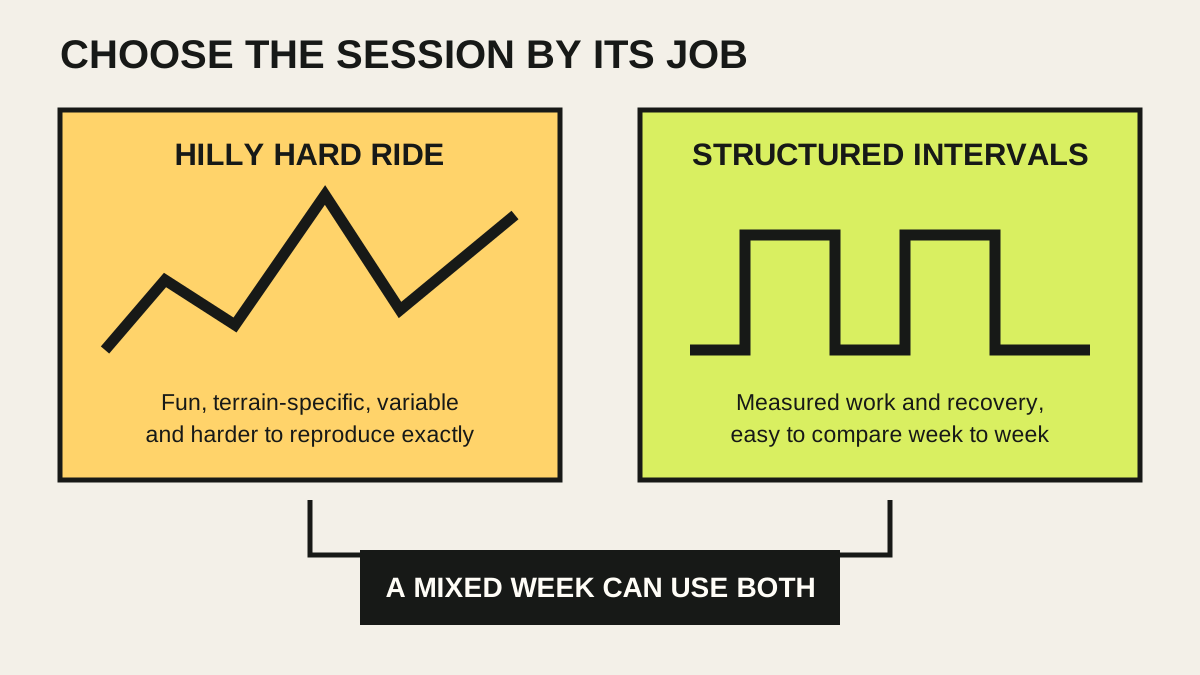
A hard hilly ride can be a useful training session. Structured intervals are not automatically better; they are easier to measure, repeat, and progress. Choose between them by the job of the day, then keep the rest of the week recoverable.
The short answer: use structured intervals when you need a known amount of work and recovery that can be compared week to week. Use a hilly route when motivation, handling, pacing on real terrain, and enjoyment matter more. A rider with three weekly sessions can mix both, but two hard rides are still two hard rides.
The current rider dilemma
A recent r/cycling discussion asks about the benefits of structured intervals compared with a regular hilly ride. The rider enjoys changing scenery and hard climbs but finds repeated timed work dull.
That preference matters. A theoretically precise session you avoid is less useful than a sensible hard ride you complete consistently. The answer is not “fun or science”; it is to understand what precision buys and how much you need.
What structure gives you
A structured workout defines:
- the purpose of the session;
- work duration;
- target intensity or effort cues;
- recovery duration and intensity;
- number of repetitions;
- warm-up and cool-down;
- the rule for stopping or reducing the set.
That makes the training dose easier to repeat. If you complete four controlled five-minute efforts this week, you can repeat them next week or change one variable. Traffic, wind, gradient, and enthusiasm have less influence on the prescription, especially indoors.
Structure is particularly useful when time is tight, the goal requires sustained work at one intensity, or you tend to start every climb too hard and fade.
What the hilly ride gives you
A hilly route combines fitness with road-specific skills:
- choosing gears before the gradient bites;
- pacing a climb whose slope changes;
- staying controlled while breathing hard;
- cornering and descending safely after an effort;
- adapting to wind, surface, and terrain;
- learning which efforts you can repeat without collapsing.
It can also be more enjoyable. Enjoyment supports consistency, and consistency matters. The tradeoff is variability: the hard sections may be too short, too long, too steep, or separated by recoveries that do not match the intended session.
Do not confuse “hard” with one specific adaptation
A ride containing short steep attacks, long threshold-like climbs, coasting descents, traffic stops, and a sprint home is a mixed session. It may be productive, but it is not the same as accumulating a planned amount of one kind of work.
That distinction matters when preparing for a specific event or trying to understand why progress has stalled. It matters less for a newer rider who mainly needs consistency, one controlled hard stimulus, and enough easy riding to recover.
Avoid inventing a precise physiological label from heart rate alone. Heart rate lags on short climbs, and gradient changes the muscular demand. Use power if you have reliable equipment, but keep breathing, perceived effort, technique, and terrain safety in the decision.
Three ways to train on real hills
Let the route define the efforts
Ride selected climbs at a controlled hard effort and recover easily between them. This is the simplest option and works when the route naturally gives useful work and enough recovery.
Record the number of climbs, approximate duration, perceived effort, and whether the final effort was still controlled. Do not attack every rise.
Repeat one safe climb
Choose a climb with low traffic, good sight lines, a safe turnaround, and a descent you can handle calmly. Use the lap button at the same start and finish points. Repeat the climb at the planned effort and make the descent genuinely easy.
Stop the set if traffic, weather, debris, fading light, braking, or concentration makes the descent unsafe. The workout never outranks the road.
Use timed efforts across rolling terrain
Begin and end by time rather than summit, but choose a stretch without junctions or technical descending. If the interval reaches a stop sign or hazardous section, abandon the interval. Do not surge through it to save the data.
A practical three-ride week
For a rider already consistent and healthy enough for harder work, one example is:
- Measured session: controlled intervals on a trainer or safe repeatable route.
- Easy ride: conversational effort, with no secret climb attacks.
- Long hilly ride: mostly sustainable riding with a small number of purposeful hard climbs.
This is not a universal prescription. Running, strength training, fast group rides, physical work, poor sleep, and life stress add load. If the long hilly ride becomes hard from start to finish, the measured session may need to be easier, shorter, or removed.
Beginners should first use how to add your first cycling intervals, which gives a conservative session and stop rules.
Progress without making every ride worse
Choose one progression at a time:
- add a small amount of total work;
- make efforts slightly longer;
- add one repetition;
- shorten recovery modestly;
- hold the same work more evenly;
- use terrain closer to the goal.
Do not add repetitions, length, intensity, and a harder weekend simultaneously. Repeat a successful session before progressing it. The goal is a pattern you can recover from, not the most impressive workout file.
Measure the hilly ride honestly
After both session types, note:
- total hard time, approximately;
- the longest continuous hard effort;
- whether power or pace faded;
- perceived effort for the first and last climb;
- safety interruptions;
- how you felt the following day;
- whether the session made you more or less willing to train again.
This turns an unstructured ride into usable evidence without pretending it was a laboratory protocol.
When to choose each option
Choose structured intervals when you need repeatability, limited-time efficiency, controlled progression, or a specific event demand. Choose hills when the terrain itself is the goal, outdoor skill matters, or structure is undermining motivation.
Choose both when you can recover from both. Choose neither when illness, pain, unusual fatigue, or unsafe conditions make easy riding or rest the better training decision.
Your next step
Give your next hard ride one sentence of purpose before leaving. If it is “accumulate four controlled climbs,” mark the start and finish and log each effort. If it is “enjoy a hard hilly route,” stop pretending every rise needs a personal best and keep the next ride genuinely easy.
Sources and further reading
- British Cycling: understanding training intensity
- British Cycling: introduction to interval training
- r/cycling reader context: structured intervals compared with hilly rides — used as a current demand signal; replies were not treated as personalised coaching.