Do amateur cyclists need blood lactate testing?
Lactate testing can refine training thresholds when a reproducible protocol will change a decision, but most riders should build consistency before buying more data.
 Field guide / do-cyclists-need-blood-lactate-testing
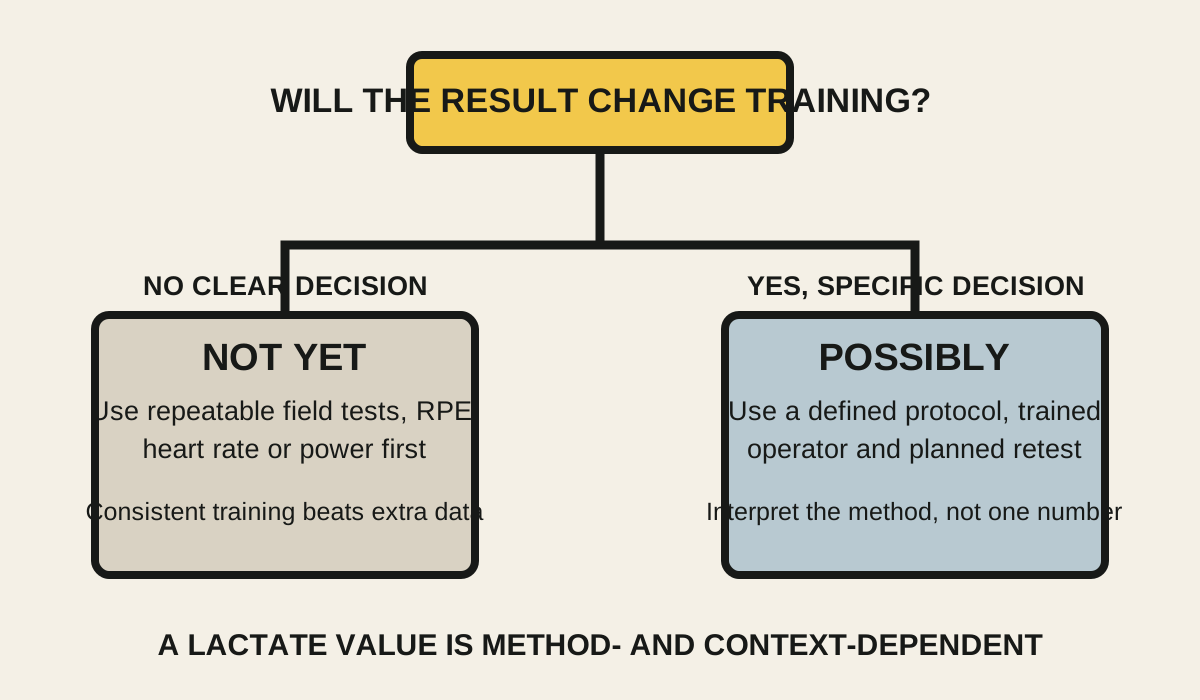
Most amateur cyclists do not need blood lactate testing to improve. It becomes useful when you already train consistently, have a specific question about threshold or zone prescription, and will use a reproducible protocol and retest under comparable conditions. A single home reading is not an indisputable definition of “zone 2.”
The short answer: start with perceived effort, repeatable routes or field tests, and heart rate or power if available. Pay for lactate testing when its result will change a real training decision, the tester can explain the threshold method, and you can repeat the test. More precision is not more accuracy if protocol, sampling and interpretation drift.
What the test actually measures
During a staged cycling test, workload increases while small blood samples are analysed for lactate concentration. The resulting curve can help identify workload regions associated with changes in lactate response. Those regions may be used alongside ventilation, heart rate, perceived exertion and power to describe training intensity.
There is not one universal “lactate threshold” calculation. Researchers use several landmarks: the first rise above baseline, fixed concentrations, increases above a measured baseline, Dmax methods, or comparisons with maximal lactate steady state. The chosen protocol and definition affect the reported wattage and heart rate.
A study of 14 well-trained male cyclists found several lactate-derived thresholds repeatable under its controlled graded-test protocol, but methods did not all perform equally. Another study of 21 elite cyclists concluded that a single graded test could not precisely predict heart rate or power at maximal lactate steady state. Those findings support careful method selection—not the idea that any meter and ramp produce certainty.
When testing can be worth it
Consider a professional test when:
- you train regularly enough that narrow zone distinctions affect the plan;
- a coach will use the result to prescribe and review sessions;
- generic percentages of maximum heart rate or FTP appear to misclassify your response;
- you need a controlled baseline before a defined training block;
- you can repeat the same protocol after the block; or
- field tests are impractical or produce inconsistent pacing.
The most useful output is not a dramatic peak value. It is a documented relationship among workload, lactate, heart rate, breathing and perceived effort that can guide sessions outside the lab.
Ask what decision changes if the first threshold is 15 watts higher or lower. If the answer is “none,” testing is probably curiosity rather than a training requirement—and curiosity is fine if you price it honestly.
When simpler tools are enough
Skip lactate testing for now when consistency, recovery, fuelling or basic intensity control is still the main limiter. A beginner who alternates very hard weeks with long gaps does not need a finer zone boundary; they need a sustainable week.
Useful lower-cost baselines include:
- perceived effort and the talk test on steady rides;
- heart rate on the same climb or indoor workload;
- power and heart-rate drift during a controlled endurance session;
- a repeatable submaximal route; and
- a field threshold test only when the rider is ready for that effort.
You can build an effective plan without power using the beginner training-plan guide. Riders new to structured work should add their first intervals before optimising laboratory thresholds.
Why DIY testing is easy to misread
Home testing looks simple—ride stages, prick a finger, record numbers—but several variables move the curve:
- warm-up length and intensity;
- stage duration and power increments;
- whether workload is truly steady;
- recent training, sleep, illness and fatigue;
- carbohydrate intake, hydration and environment;
- sampling site and technique;
- strip storage, meter condition and sample contamination; and
- the calculation used to identify a threshold.
Short stages may not let lactate response stabilise. Large increments reduce resolution. Squeezing, sweat, an insufficient sample or a poorly handled strip can distort a reading. Even clean data still requires a defined interpretation method.
Blood is also a biological hazard. Do not share lancets, improvise disposal, or turn a group ride into unsupervised testing. A qualified exercise physiologist or appropriately trained clinician should be able to explain infection control as clearly as the graph.
Questions to ask a testing provider
Before paying, ask:
- What exact cycling protocol will you use and why?
- Which lactate landmarks or threshold method will you report?
- How do you control warm-up, stage length, nutrition and prior training?
- Is the ergometer or power meter calibrated and repeatable?
- How will results translate into sessions and outdoor cues?
- What pre-test screening and stop criteria do you use?
- Can the same protocol be repeated later?
- Will you provide raw stage data, not only coloured zones?
A provider should discuss uncertainty. A result reported to the nearest watt without protocol context is presentation, not proof.
How to use a result sensibly
Treat zones as working ranges, then compare them with breathing, perceived effort, heart rate and the demands of your goal. Weather, altitude, accumulated fatigue and fuelling can change the relationship on a given day.
Retest only when enough training has occurred to make comparison useful and when conditions can be made similar. Do not chase daily lactate numbers or rewrite the plan after one anomalous sample. If repeated hard sessions fail, use the failed-workout recovery guide before assuming the threshold is wrong.
Your next step
Write one sentence beginning, “I will use this test to decide…” If you cannot finish it concretely, keep training with simpler measures. If you can, choose a provider who documents the protocol, method, raw data and retest conditions.
Sources and further reading
- Pallarés et al.: validity and reliability of ventilatory and blood-lactate thresholds in well-trained cyclists
- Bentley et al.: correlations between threshold methods and maximal lactate steady state in elite cyclists
- Valenzuela et al.: functional threshold power as an alternative to lactate landmarks in road cyclists
- r/Velo discussion: first-time home blood-lactate testing and interpretation questions — used as an editorial signal; personal testing claims were not treated as verified facts.