Why cycling and running VO₂ max estimates do not match
Understand why a watch can show different cycling and running VO₂ max values, which sensors affect each estimate, and how to use the trends without treating them as lab results.
 Field guide / cycling-vs-running-vo2-max-estimates
Cycling and running VO₂ max values can differ without either one being “the real number.” A wearable estimates each sport from different inputs and a different movement model, while your training history and exercise mode can also change the oxygen uptake you reach during a test.
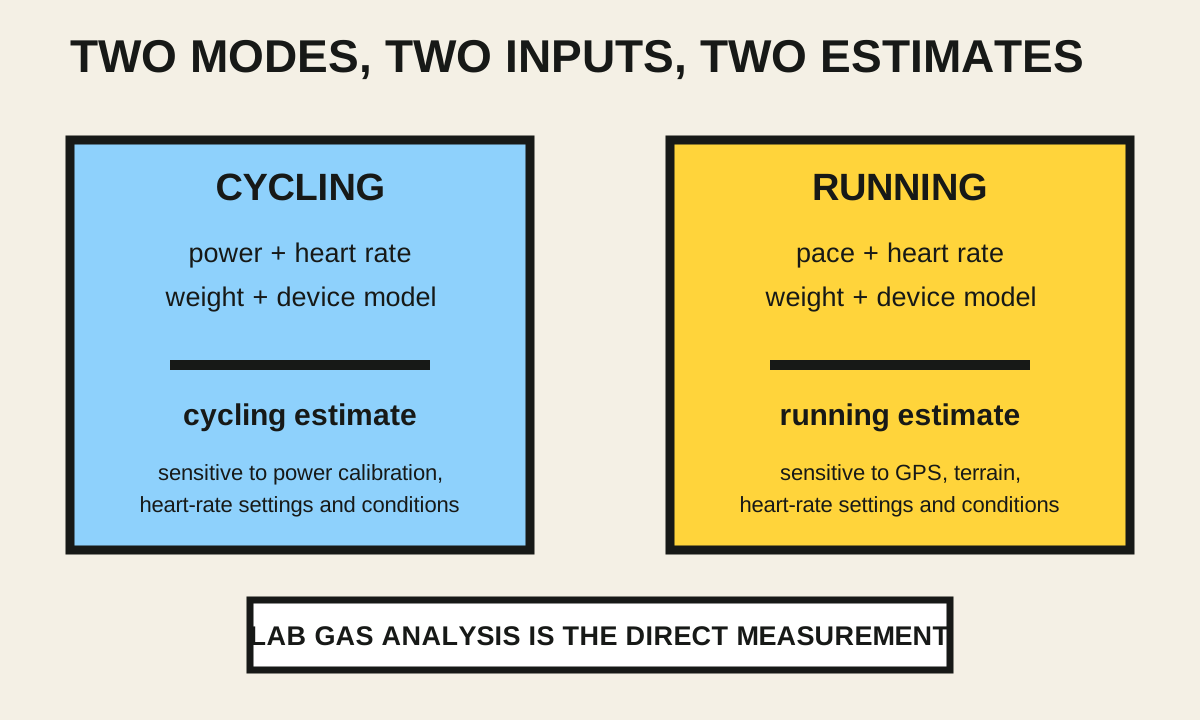
The short answer: compare cycling with your own cycling trend and running with your own running trend. Check power calibration, heart-rate settings, body weight, sensor quality, and qualifying activity requirements before interpreting a jump. Only a graded test with respiratory gas analysis directly measures oxygen uptake.
What the number means
VO₂ max is the maximum rate at which the body can take in, transport, and use oxygen during demanding exercise. It is commonly expressed relative to body mass in millilitres of oxygen per kilogram per minute.
In a laboratory, the athlete performs a progressively harder test while respiratory equipment measures oxygen and carbon dioxide in exhaled air. A watch or bike computer usually does not measure those gases. It estimates a value from relationships among external work, pace, heart rate, body data, and a proprietary model.
A current high-engagement Reddit discussion asked why a triathlete’s cycling and running VO₂ max estimates differed. The replies are a demand signal, not a substitute for the device instructions or exercise physiology.
Why the activity changes the result
Running and cycling recruit muscles differently, support body weight differently, and use different movement patterns. Training adaptations are partly specific to the activity. A trained cyclist may express more of their aerobic capacity on a bike than a new runner can express while running; a trained runner may show the reverse.
Research using direct tests supports this activity effect. A study of trained triathletes found cycling VO₂ max averaged close to, but below, treadmill running in that sample. Other work found runners produced higher values on a treadmill while cyclists produced higher values on a cycle ergometer. Those group results do not provide a correction percentage for an individual. Protocol, posture, training history, equipment, and population matter.
The practical conclusion is modest: different values are plausible, and neither should be converted into the other with a universal formula.
Why the device inputs differ
For Garmin’s current cycling estimate, the official requirements include a compatible power meter and heart-rate data during a qualifying cycling activity. Running estimates use GPS pace and heart rate under their own conditions. Other brands use different eligibility rules.
That creates different error paths.
Cycling estimate inputs
- power-meter accuracy, zero offset, battery, temperature compensation, and crank-length setting;
- heart-rate accuracy and the device’s maximum-heart-rate setting;
- accurate rider weight;
- indoor-trainer data source and recording device;
- steady enough effort for the algorithm to evaluate the relationship.
Running estimate inputs
- GPS pace and distance quality;
- hills, surface, wind, heat, and stops;
- wrist or chest-strap heart-rate quality;
- maximum-heart-rate setting;
- accurate body weight and qualifying activity duration.
A power meter reading 5% high can make the cycling performance look better at the same heart rate. A maximum-heart-rate setting that drifts upward can make the same observed heart rate look like a lower relative effort. A hot day can raise heart rate at a familiar power or pace. None of these proves that fitness changed.
Which value is “real”?
Use three different labels:
- Lab-measured value: obtained from respiratory gas analysis under a stated protocol.
- Cycling estimate: inferred from cycling-specific data and the device model.
- Running estimate: inferred from running-specific data and the device model.
The lab value is a measurement for that test mode and day, not an eternal property. The wearable values are useful estimates when the inputs remain consistent. They can be impressively close for some people and meaningfully wrong for others.
Do not average the cycling and running numbers. Do not choose whichever is higher as your identity. Use performance in the sport—repeatable power, pace, duration, recovery, and event results—alongside the trend.
Audit a surprising jump or drop
Before changing training, check:
- Did the device firmware or algorithm update? Read the manufacturer release notes.
- Did maximum heart rate change automatically? Compare the current setting with the previous one and correct only with evidence.
- Is body weight current and entered in the correct units? Relative VO₂ max depends on mass.
- Was the power meter calibrated or zeroed as specified? Check batteries, crank length, pedals, and the maker’s procedure.
- Did the data source change? A smart trainer, single-sided meter, dual-sided meter, and estimated virtual power may not agree.
- Were conditions unusual? Heat, altitude, illness, fatigue, dehydration, wind, hills, and poor GPS can affect the relationship.
- Was this one activity or a sustained trend? Wait for several comparable sessions.
Do not manually alter inputs until the number looks pleasing. Settings should represent reality, not tune the score.
How to use the estimate well
Use the value as a slow trend under stable conditions:
- compare the same sport and device;
- keep sensor setup consistent;
- compare similar routes or indoor protocols;
- interpret several weeks, not one ride;
- note illness, heat, altitude, and equipment changes;
- pair the trend with actual repeatable performance.
If cycling power at a familiar submaximal heart rate improves across several controlled rides, that is useful even if the displayed VO₂ max stays flat. If the estimate rises while power, recovery, and workouts deteriorate, investigate the inputs before celebrating.
Our power and heart-rate disagreement guide explains how fatigue, heat, and settings can separate the two signals. Riders who cross-train should also keep running and cycling heart-rate zones distinct.
Do you need a power meter?
You do not need a VO₂ max estimate—or a power meter—to become fitter. A device may require a power meter to generate its cycling number because power gives an external-work input. That is a feature requirement, not a statement that cycling without power is ineffective.
Beginners can track duration, route completion, perceived effort, recovery, and heart rate if useful. Buy a power meter when the training information justifies its cost, not to unlock one coloured gauge. The beginner no-power training plan provides a workable alternative.
When a lab test is worth considering
A qualified lab assessment may be useful when a coach or clinician needs a controlled baseline, sport-specific research data, or medically supervised exercise testing. It is not required to set ordinary beginner rides.
Choose a provider that explains the protocol, calibration, test mode, qualifications, safety screening, and how results will change decisions. A cycling test and a treadmill test answer related but not identical questions.
Your next step
Open your device settings and record current body weight, maximum heart rate, sensor source, power calibration method, and firmware version. Then compare the next four cycling estimates only with cycling and the next four running estimates only with running. Look for a trend that agrees with performance—not a single number that wins.
Sources and further reading
- Garmin Support: current VO₂ max estimate requirements
- Study: VO₂ peak comparison in runners, cyclists, and swimmers
- Study: maximal oxygen uptake using trained and untrained muscles
- r/GarminWatches demand signal: cycling versus running VO₂ max — used as a current reader-question signal; individual comments were not treated as measurements.