Should running and cycling use different heart-rate zones?
Running and cycling can produce different heart rates at similar perceived effort. Verify the sensor, set sport-specific baselines, and stop copying zones between sports.
 Field guide / running-vs-cycling-heart-rate-zones
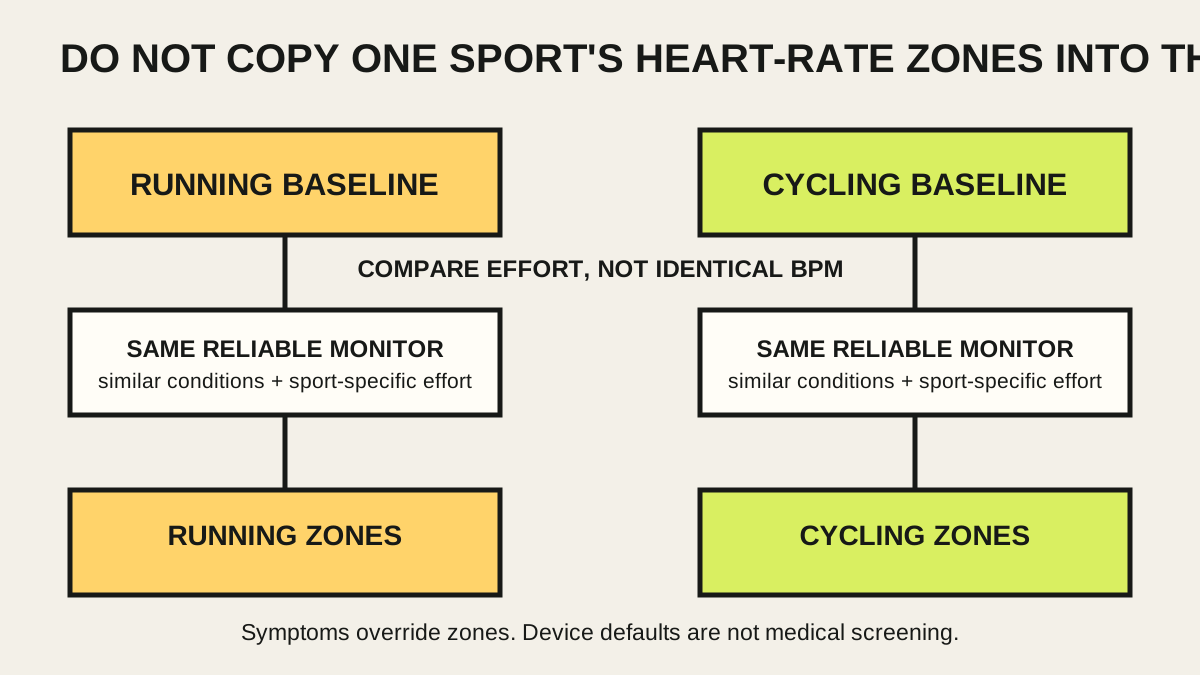
Running and cycling should usually have separate heart-rate baselines when you train seriously in both sports. The same beats-per-minute value can represent a different relative effort because body position, active muscle mass, movement economy, sport experience, cooling, and local muscle fatigue differ.
The short answer: first verify both activities with the same reliable monitor. Then set running zones from running evidence and cycling zones from cycling evidence. Do not lower or raise a cycling target simply to make it match a running screenshot. Perceived effort, breathing, power or pace, conditions, and symptoms still matter.
The current question is not answered by one formula
A current r/cycling thread describes a large heart-rate difference between running and cycling. Replies offer confident but conflicting explanations. That is a useful warning: an absolute number without age, symptoms, validated maximum, threshold, power, pace, conditions, training history, and sensor quality is not enough for diagnosis or a personalised prescription.
Research does show that exercise mode can change measured responses. In one study of moderately trained participants at maximal lactate steady state, heart rate was lower during cycling than running even though time to exhaustion and perceived exertion were similar. Another study in endurance-trained men found higher peak heart rate and oxygen uptake in running than cycling. Those group findings do not predict an exact difference for one person.
First rule out a measurement problem
Before changing zones, use the same heart-rate monitor in both sports when possible. A difference between a wrist watch on the run and a chest or arm sensor on the bike may be partly a device comparison.
Check:
- the sensor is worn exactly as its maker specifies;
- electrodes or optical contact are prepared correctly;
- the battery, strap, and firmware are current;
- there are no abrupt jumps, long flat lines, or implausible peaks;
- running cadence has not been mistaken for heart rate;
- the device has not silently applied different zone models;
- both files show the same units and data source.
Compare the raw trace with breathing and perceived effort. A value that suddenly rises while pace, power, breathing, and sensation remain unchanged deserves a sensor check before a physiology story.
Find out what created each zone
“Zone 2” can mean different things. Apps may calculate boundaries from:
- an age-estimated maximum heart rate;
- a highest recorded heart rate;
- heart-rate reserve using resting heart rate;
- an estimated lactate-threshold heart rate;
- a laboratory or field test;
- another platform’s imported settings.
Three-zone, five-zone, and seven-zone models also place boundaries differently. Write down the source and model for both sports. If one set came from a running threshold test and the cycling set is an age-formula default, the labels are not comparable.
Avoid unsupervised maximal testing when it is medically inappropriate or when you lack a safe protocol and environment. A qualified coach, exercise physiologist, or clinician can select the right assessment for the question.
Why the same person can see different numbers
Movement and posture differ
Running is weight-bearing and uses the body differently from seated cycling. Cycling concentrates force through a constrained movement and can be limited by local leg fatigue before the cardiovascular system reaches the same response seen while running.
Training history is specific
A trained runner who recently began cycling may have strong general aerobic fitness but limited cycling economy, pedal coordination, and local muscular endurance. A cyclist beginning to run can experience the reverse mismatch. Fitness transfers partly; skill and tissue tolerance do not transfer completely.
Conditions change the response
Outdoor running may offer different cooling from indoor cycling. Heat, a weak trainer fan, dehydration, fatigue, caffeine, stress, altitude, and medication can alter heart rate at a given workload. Compare like with like before interpreting a gap.
Cycling setup can cap the effort
An unsuitable cadence, excessive resistance, poor position, or pain may make the legs stop while heart rate remains below a running value. That does not prove the bike fit is the cause, but it does justify checking gearing, cadence, comfort, and whether the cycling effort is actually comparable.
Build two practical baselines
For several weeks, record similar sessions in each sport with:
- duration and route or trainer conditions;
- pace for running and reliable power or route context for cycling;
- average and peak heart rate plus the full trace;
- talk-test result and perceived effort;
- temperature, cooling, hydration, sleep, and fatigue;
- whether the limiter was breathing, legs, pain, or motivation.
Use a sport-specific threshold or submaximal assessment when the training plan requires one. Repeat the same protocol under similar conditions; do not test constantly until the result looks flattering.
How to use the zones day to day
For an easy session, begin with breathing and the talk test. You should be able to speak in comfortable sentences. Use pace or power conservatively and observe heart rate rather than chasing a number every few seconds.
For structured cycling, use cycling power and cycling heart-rate context. For running, use running pace and running heart-rate context. A multisport watch should store separate profiles if it supports them.
Heart rate lags behind a sudden effort, so it is a poor steering target for the opening seconds of a hill or interval. Across longer steady work, the trend becomes more informative. Use what to do when cycling power and heart-rate zones disagree when the mismatch occurs inside cycling itself.
When the gap needs more than training advice
Seek appropriate medical evaluation rather than internet zone adjustment when the difference comes with chest pain, fainting, a new irregular rhythm, severe or unusual breathlessness, unexplained loss of performance, or a marked change from your normal response. Bring the raw files, device details, medication list, symptom timeline, and context.
A high or low personal number is not automatically dangerous or safe. Symptoms and clinical context matter more than comparison with another rider.
Your next step
Open the settings for both sport profiles and record what produced each zone. Use the same reliable monitor for three comparable running and cycling sessions, and log perceived effort and the limiting sensation. Keep separate baselines unless a qualified assessment gives a reason to combine them.
Sources and further reading
- Comparative study: maximal lactate steady state in cycling and running
- Study: heart-rate-based lactate minimum testing in running and cycling
- r/cycling reader context: large running and cycling heart-rate discrepancy — used as a demand signal; replies were not treated as medical assessment.