Cycling or running for fitness: how should a beginner choose?
Compare cycling and running by access, impact, time, skills, enjoyment, and recovery, then use a four-week trial instead of searching for one universal winner.
 Field guide / cycling-or-running-for-fitness
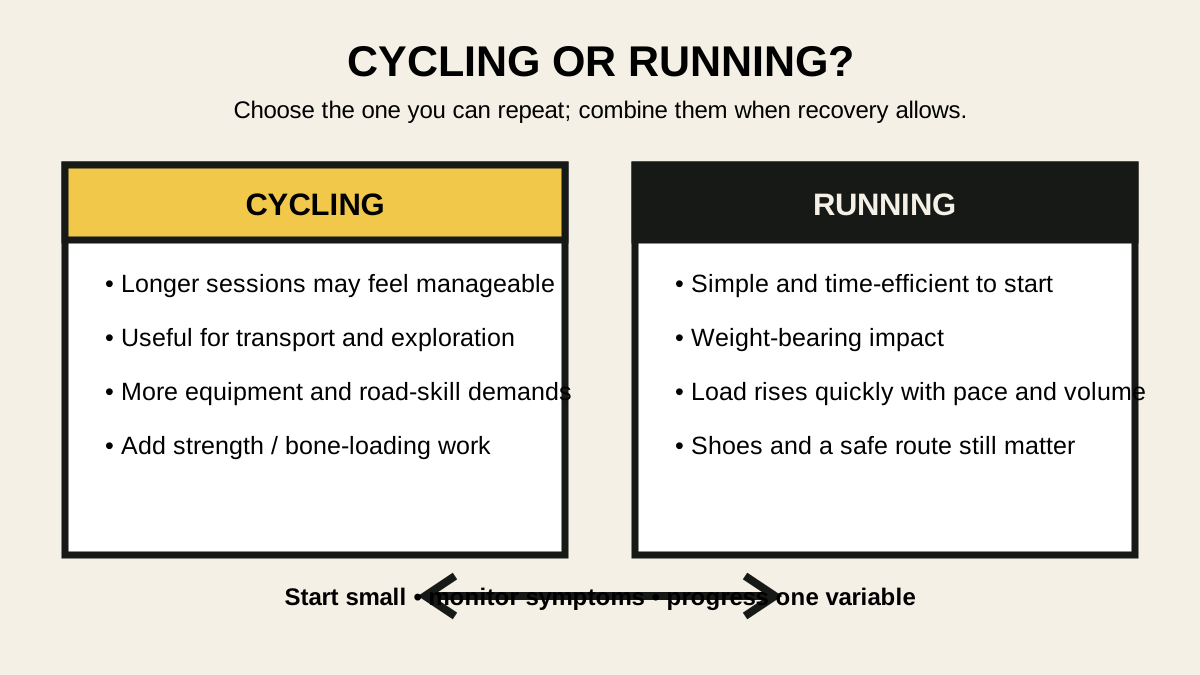
Cycling and running can both build aerobic fitness. Cycling usually makes longer low-impact sessions and transport easier; running is simpler to start, time-efficient, and weight-bearing. The better choice is the one your body, location, budget, and schedule let you repeat.
The short answer: do not choose from calorie claims or sporting identity. Run a four-week trial, start below your apparent cardio limit, and judge enjoyment, symptoms, recovery, access, and consistency. Combining both is valid when the total load remains manageable.
Why there is no universal winner
A highly discussed r/cycling thread asked whether cycling could replace running and marathon racing when recurring physical problems were changing the calculation. That question appears in many forms: Which burns more? Which is kinder? Which gets me fit faster?
Reddit experiences cannot diagnose pain or prove which activity will suit another person. The useful signal is that people are not choosing two abstract exercises. They are choosing between different equipment, surfaces, skills, time demands, loads, and kinds of enjoyment.
Compare the real tradeoffs
| Decision factor | Cycling | Running |
|---|---|---|
| Starting equipment | A safe, fitting bike, helmet, repair basics, and a suitable route | Suitable shoes and a safe route |
| Session length | Longer easy sessions may be comfortable and practical | A meaningful session can fit a shorter window |
| Mechanical impact | Non-weight-bearing and normally lower impact | Weight-bearing with repeated impact |
| Skill demands | Braking, steering, gears, traffic, maintenance, punctures | Pacing, form, surfaces, traffic, and gradual tissue adaptation |
| Transport and exploration | Can cover substantial distance and replace some journeys | Simpler from the front door but covers less ground |
| Weather fallback | Indoor trainer is possible but adds setup and cooling needs | Treadmill or indoor track may be available |
| Typical friction | Cost, storage, traffic confidence, maintenance | Impact tolerance, rapid workload increases, repetitive routes |
“Low impact” does not mean low load. A long ride can still irritate knees, hands, neck, back, or contact points, especially when position or progression is poor. Running is not automatically harmful either; the starting dose and progression matter.
Use health guidelines as a floor, not a sport contest
The US Physical Activity Guidelines list both bicycling and running as aerobic activity. They recommend that adults work toward a mix of aerobic and muscle-strengthening activity while emphasising that some activity is better than none.
The same guidelines identify running and resistance exercise as examples of bone-strengthening activity. Cycling is not weight-bearing, so a cycling-only routine should not be assumed to cover every strength or bone-loading need. That does not make running mandatory: walking, jumping where appropriate, and resistance training may contribute depending on health and ability.
For general fitness, weekly consistency matters more than proving that one sport is physiologically superior.
Choose cycling when these benefits solve your problem
Cycling is a strong first choice when:
- you enjoy exploration, group rides, or active transport;
- running impact currently limits exercise and a clinician agrees cycling is suitable;
- you prefer longer steady sessions;
- you have access to safe routes or indoor equipment;
- learning equipment and road skills sounds interesting rather than burdensome.
You do not need a racing bike or clipless pedals to test that preference. A safe hybrid, borrowed bike, or indoor cycle can answer the enjoyment question before a major purchase. If buying becomes likely, use the beginner road bike buying checklist to budget for fit, condition, and essential gear—not only the frame.
Choose running when these benefits solve your problem
Running is a strong first choice when:
- setup time and equipment simplicity are decisive;
- you have only short exercise windows;
- safe running routes are much easier to access than safe cycling routes;
- you enjoy local events and the straightforward progress markers;
- weight-bearing activity is appropriate and valuable for you.
Running fitness can help when you begin cycling, but it does not remove the bike-specific adaptation phase. The runner-to-cyclist guide explains why aerobic capacity can outpace leg, position, handling, and contact-point tolerance.
Combine both without doubling the hard days
You can run and ride in the same week. Count both as training rather than calling every bike session “recovery.” A simple beginner pattern might be:
- one easy run or run-walk;
- one easy conversational ride;
- one choice session in the activity you currently prefer;
- at least one full rest day;
- one or two appropriately scaled strength sessions.
Keep only one demanding aerobic session at first. If you add cycling, reduce something else before discovering how you recover. Soreness, sleep disruption, loss of motivation, worsening performance, or pain are signals to reassess the total week.
Run a four-week decision trial
Week 1: test access
Complete one easy 20–30 minute session of each activity, using run-walk intervals if needed. Record preparation time, travel, cost, route stress, and how you felt afterward.
Week 2: test repeatability
Repeat each session without making it faster. Note whether you wanted to do it, whether ordinary life was affected, and whether any symptom returned.
Week 3: test a realistic week
Do two sessions of the leading activity and one of the other. Keep all three easy. This tests schedule fit rather than peak performance.
Week 4: choose the next eight weeks
Score each activity from one to five for:
- enjoyment;
- safe local access;
- total setup friction;
- comfort during and after;
- recovery by the next day;
- cost and storage;
- connection to a goal you care about.
Choose a primary activity, keep the other as optional cross-training, or continue a balanced split. Revisit the choice when seasons, health, or goals change.
Do not use pain as the only decision tool
Switching sports can reduce exposure to one irritating movement while introducing another. If pain is persistent, recurrent, severe, associated with swelling or weakness, or changes normal walking and daily activity, get qualified assessment. Do not use cycling to ride through a running injury—or running to escape a poor bike fit—without understanding the problem.
If comfortable weight management is the goal, use the beginner cycling and weight-loss guide for a sustainable approach rather than comparing inflated calorie estimates from devices.
Your next step
Schedule one deliberately easy cycling session and one deliberately easy run or run-walk within the next seven days. Use the same simple scorecard after both. Choose the activity you can repeat safely and willingly; the best theoretical workout is useless when its practical friction keeps it off the calendar.
Sources and further reading
- Physical Activity Guidelines for Americans, second edition
- CDC: examples of moderate- and vigorous-intensity activity
- r/cycling reader context: considering a switch from running to cycling — used as an editorial question signal; personal medical experiences were not treated as evidence.