How to check whether your bike torque wrench is trustworthy
Screen a bicycle torque wrench for range, damage, storage, repeatability, and calibration limits before using it on safety-critical parts.
 Field guide / check-bike-torque-wrench-accuracy
You cannot decide that a torque wrench is trustworthy from price, colour, or a smooth ratchet. Check whether its range suits bicycle values, whether the maker states an accuracy and calibration route, how it has been stored and handled, and whether its release is repeatable. A homemade weight test can be a useful screen, but it is not a calibration certificate.
The short answer: use a wrench with documented instructions and accuracy, keep the target comfortably inside its working range, inspect it before use, and stop at the first release. If its history is unknown, it was dropped, readings vary, or a safety-critical job has little margin, have it calibrated or use a known-good tool.
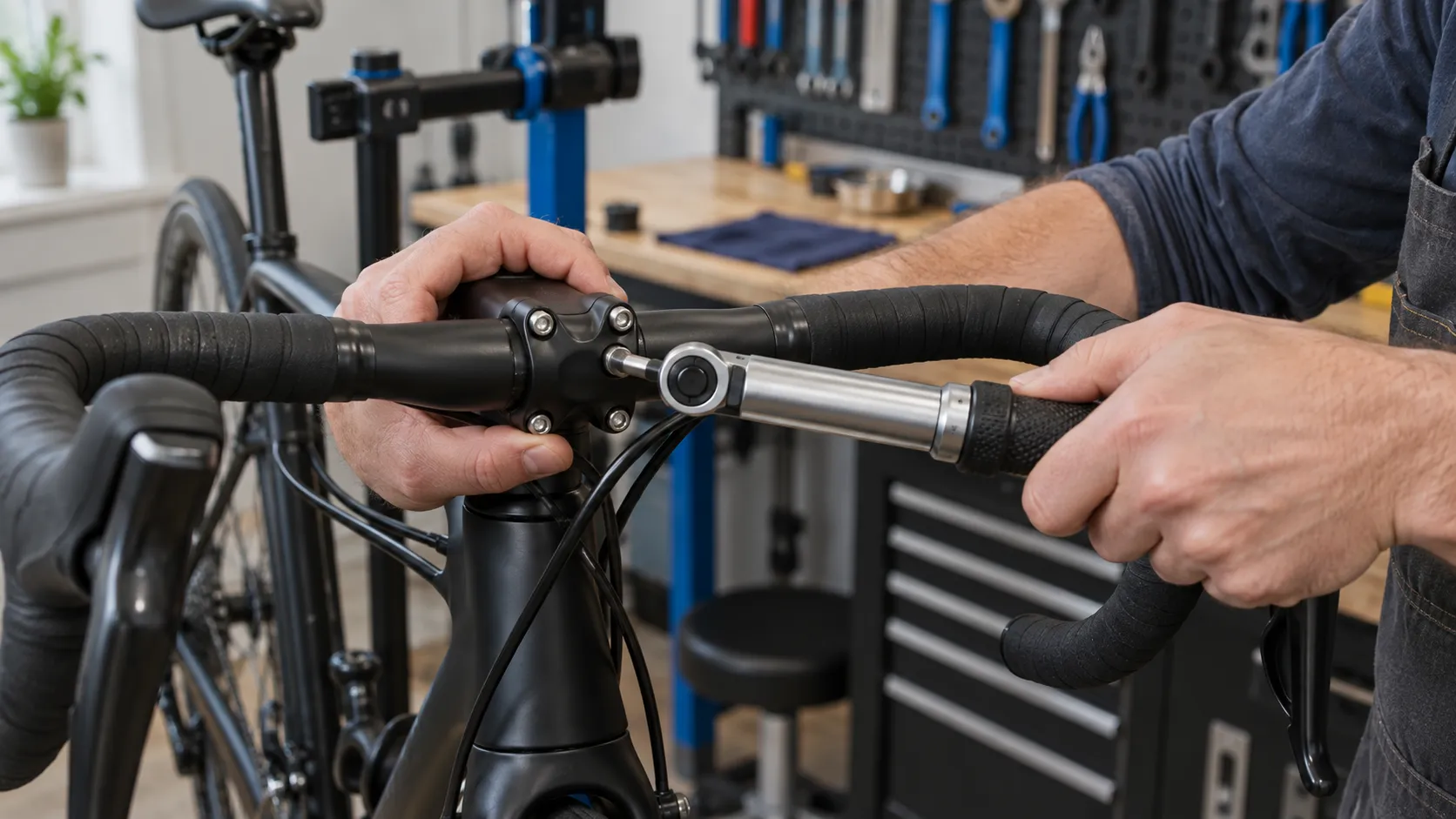
“It clicked” is not evidence by itself
A click-type wrench contains a mechanism set to release at an intended torque. It can still click early or late. At low settings the release may be felt more than heard, and repeatedly pulling after the first release can continue loading the bolt.
The current Park Tool TW-5.2 instructions specify a 2–14 Nm range, stated accuracy of ±4%, smooth loading, immediate release after the first click, storage at the lowest marked setting, and professional inspection or recalibration after extended use. Those details apply to that tool, not automatically to every wrench.
Read your own manual. A seller listing that says “bike torque wrench” is not a substitute.
Start with six document checks
Before trusting a wrench, confirm:
- Maker and model are identifiable. Instructions and support should match the exact tool.
- The unit is clear. Newton metres, inch-pounds, and foot-pounds are not interchangeable.
- The stated range covers the job. A 2–14 Nm wrench cannot tighten a 40 Nm lockring.
- Accuracy is specified. Look for a stated tolerance, not only many scale markings.
- Direction is supported. Some tools measure accurately only in one direction.
- Calibration or service exists. Know whether the maker, retailer, or accredited laboratory can check it.
Use the torque-wrench buying guide to select the right range before evaluating accuracy.
Inspect its history and condition
Treat a torque wrench as a measuring instrument. Ask whether it has been dropped, used as a breaker bar, stored at a high setting, exposed to water or solvent, overloaded beyond range, or left loose in a toolbox.
Do not use it when:
- the square drive, head, handle, or scale is bent or loose;
- the setting collar will not lock;
- the scale does not return as designed;
- the ratchet skips;
- the release feels gritty, inconsistent, or absent;
- corrosion or impact damage is visible;
- its service history cannot support the risk of the job.
A neat case does not prove the tool inside remained calibrated.
Check technique before blaming the wrench
False readings often come from the setup:
- wrong or partially seated bit;
- pulling from the wrong place on the handle;
- jerking instead of applying steady force;
- holding the head or extension;
- using a crow-foot adapter without accounting for changed effective length;
- tightening a cross-threaded, dirty, corroded, or bottomed-out bolt;
- using dry torque on lubricated threads when the manual specifies otherwise;
- continuing through several clicks.
Use the component maker’s current torque, thread preparation, and sequence. A perfectly calibrated wrench can accurately perform the wrong procedure.
A repeatability screen at home
If the maker allows normal cycling of the tool, exercise it according to its instructions before assessment. Compare several releases at the same middle-range setting using a proper torque analyser or a controlled fixture. They should occur consistently.
Some people hang a known mass from a measured lever arm to estimate applied torque. The physical relationship is torque = force × perpendicular distance, but a useful test requires an accurate mass, local gravitational assumption, exact centre-of-drive measurement, a level arm, minimal friction, safe restraint, and controlled loading. Small setup errors can exceed the tolerance you are trying to measure.
Use such a test only to identify a large error. Do not adjust an internal calibration screw from an online video or declare a tool certified because one improvised measurement looked close. Calibration compares the tool across multiple points and records traceability and uncertainty.
Compare tools cautiously
Putting two torque wrenches on the same bolt does not cleanly reveal which is correct. The first tool changes the joint, static friction differs from moving friction, and the second pull may increase torque before it releases.
A dedicated torque analyser is better. If two tools disagree materially and neither has current calibration evidence, stop. Do not average them or choose the lower number by instinct.
Know when calibration is the right answer
Arrange calibration or replacement when:
- the wrench was dropped or overloaded;
- releases become inconsistent;
- it has had heavy or long service;
- the maker’s interval has arrived;
- the tool’s history is unknown;
- a high-consequence carbon or safety-critical joint depends on it;
- a comparison suggests error outside the stated tolerance.
Park Tool explicitly notes that torque devices can drift with repetitive use and offers calibration for supported models. Other manufacturers have different intervals and processes. Follow the maker of the actual wrench.
Store it without creating the next error
For an adjustable click wrench, follow its manual’s storage setting. Park Tool specifies the lowest number on the scale for its TW-5.2 and TW-6.2—not an invented value below the scale. Keep it dry, protected from impact, and separate from general ratchets.
Beam, digital, and preset tools have different care. Do not copy click-wrench storage rules onto another mechanism.
Record the purchase date, calibration date, and any impact or overload. A strip of tape on the case is enough.
Your next step
Find the exact manual and write down the range, direction, stated accuracy, storage position, and calibration method. Inspect the tool and practise one smooth release on a non-critical fixture within range. If any of those facts are missing—or the result is inconsistent—do not let the next test piece be your stem or carbon seatpost.
Sources and further reading
- Park Tool: TW-5.2 and TW-6.2 use, accuracy, care, and calibration instructions
- Park Tool: torque-wrench use and care
- Park Tool: torque-device calibration and repair
- r/bikewrench reader context: uncertainty about inexpensive torque-wrench accuracy
Reddit supplied the recurring tool-trust question. Individual brand opinions and unverified home-test results were not treated as calibration evidence.