Can you ride a bare aluminium bike frame without paint?
Decide whether exposed aluminium is only cosmetic or needs corrosion control, coating, structural inspection, or a stop-riding decision.
 Field guide / can-you-ride-bare-aluminium-bike-frame
Small areas of exposed aluminium are often a cosmetic coating problem, not an immediate structural failure. Aluminium naturally develops a thin oxide film when exposed to air. That does not make every bare frame maintenance-free: road salt, trapped moisture, dissimilar metals, damaged joints, and deep corrosion can still create problems.
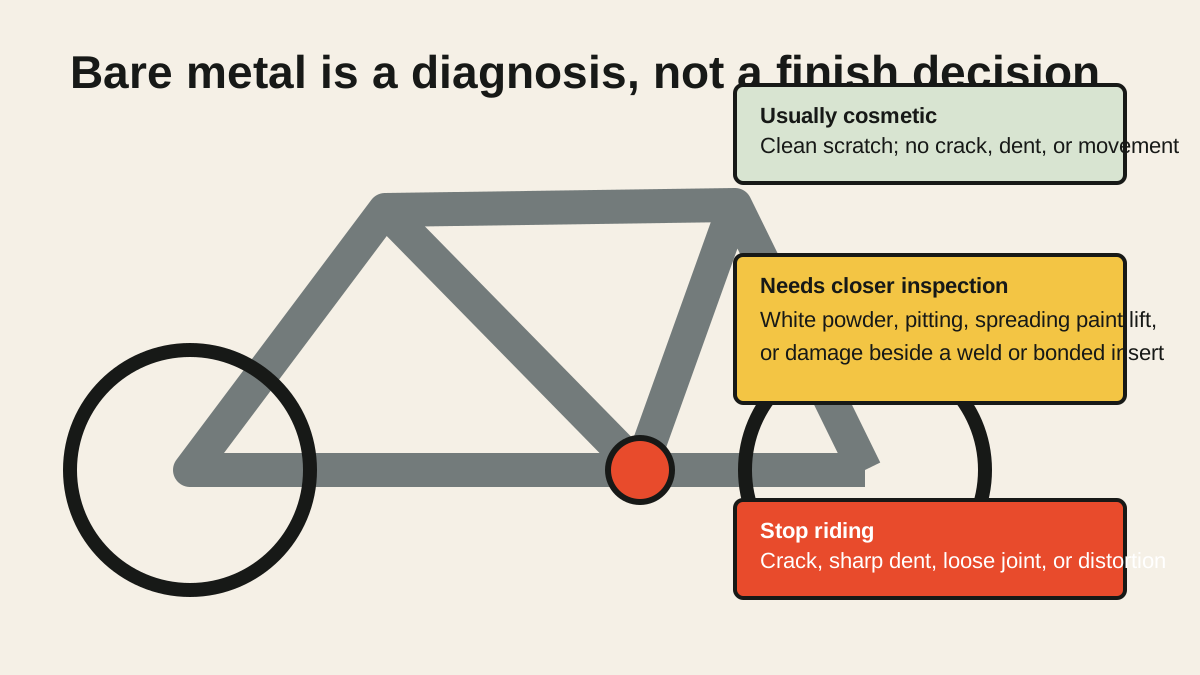
The short answer: clean and inspect the area before deciding. A shallow scratch in sound aluminium can usually be protected with a frame-maker-approved coating. Do not deliberately strip a frame or ride through white powder, pitting, a crack, a dent, a loose insert, or damage beside a weld without expert advice.
Why bare aluminium does not behave like bare steel
A recent r/bikewrench topic asked whether an aluminium frame could be left unpainted after its coating was removed. The useful answer begins with material behaviour, not appearance.
The Aluminum Association explains that aluminium exposed to air forms a thin protective oxide coating. Unlike the flaky red rust familiar on untreated steel, this oxide can slow further reaction. Surface treatments still matter because they improve durability, appearance, and resistance in harsher environments.
The conclusion is not “aluminium cannot corrode.” Moisture held against the surface, salts, crevices, and contact with dissimilar metals can defeat a simple cosmetic assumption. A bicycle also contains welds, threaded inserts, bearing seats, cable ports, and clamped interfaces where condition matters more than colour.
First identify why the coating is missing
The response depends on the cause.
A small stone chip or cable rub
This is commonly local. Clean it, inspect under bright light, stop the abrasion source, and follow the frame maker’s touch-up guidance.
A crash, clamp, or transport impact
Do not treat exposed metal as the whole problem. Look for a dent, crease, distortion, cracked weld, loose bottle boss, or changed wheel alignment. Use the post-impact road-bike inspection before coating anything.
Bubbling paint or white residue
This can indicate moisture or corrosion beneath the finish. Do not scrape until it “looks clean” and declare success. Photograph the untouched area, clean only as directed, and ask the manufacturer or a frame specialist whether the coating must be removed for inspection.
Deliberate stripping
Removing all paint or anodising is a refinishing project. Chemical strippers, blasting media, sanding, heat, and polishing can remove material, damage markings, contaminate joints, or erase evidence needed for warranty. Get the frame maker’s written process first.
Run a careful inspection
Wash the area with mild soap and water and dry it fully. Avoid aggressive abrasives at this stage.
Use a bright, low-angle light and check:
- whether the mark is a coating chip or a groove in the metal;
- white or grey powder, pitting, or cavities;
- a line that continues beyond the damaged paint;
- a sharp dent, crease, or tube flattening;
- cracking at either end of a weld;
- movement at a bonded or riveted insert;
- corrosion around bottle bolts, cable ports, headset seats, bottom bracket, or seatpost;
- a continuing source of rub from cable housing, a bag, clamp, tyre, or chain.
Clean marks beside a weld can be difficult to interpret. If the line remains visible after gentle cleaning or changes under load, stop riding and obtain a frame assessment. Do not sand away a possible crack before someone sees it.
Protect a genuinely cosmetic chip
When the frame maker confirms the damage is cosmetic, the aim is to keep contamination and moisture out and prevent further coating lift.
- Remove the rubbing cause.
- Clean and dry the area without enlarging it.
- Mask bearings, brake surfaces, threads, labels, and moving parts.
- Apply only a compatible touch-up or clear protective coating recommended for the frame finish.
- Allow the full cure time before clamping, washing, or riding.
- Photograph the repair and recheck it after wet or salty rides.
Nail varnish and generic clear coat are often suggested online, but compatibility with the existing finish is not universal. A small wrong coating can wrinkle paint or trap contamination. Manufacturer advice is the safer starting point.
For a high-rub location, a replaceable protective patch can sit over a fully cured repair. The patch should not hide a structural inspection point that needs monitoring.
Treat interfaces differently from open tube surfaces
Do not paint bearing seats, bottom-bracket faces, brake mounts, threads, or other precision interfaces unless the manufacturer specifically instructs it. Added coating can alter fit or alignment.
Where aluminium contacts steel, titanium, carbon, or another metal, use the exact assembly compound, grease, washer, or isolation hardware specified by the component and frame makers. Do not improvise a blanket rule. The seatpost guide on grease or anti-seize for a metal seatpost shows why material pair and manual both matter.
Remove and inspect a seatpost at the maker’s service interval, especially after wet use. A stuck post is easier to prevent than extract.
When a full bare-metal finish makes sense
A professionally refinished aluminium frame can be safe and durable when the process suits the alloy, heat treatment, joints, and intended coating. The important word is professionally.
Before committing, ask:
- Does stripping affect the frame warranty?
- Which chemical or mechanical process is approved?
- Must bearings, inserts, threads, and serial markings be protected?
- Will the refinisher inspect for cracks and corrosion first?
- Which conversion coating, primer, paint, powder coat, or anodising process is suitable?
- Will heat from a curing process stay within the frame maker’s limit?
- How will faces and threads be restored afterward?
If the cost approaches a sound replacement frame, refinishing may be an emotional or aesthetic choice rather than the economical one. That is fine—just price inspection, preparation, coating, and rebuild together.
Your next step
Photograph the bare area before touching it, clean it gently, and classify it as a chip, rub, impact, under-film corrosion, or deliberate stripping project. For a simple chip, ask the frame maker for a compatible touch-up. For every other category, obtain inspection guidance before covering evidence.
Sources and further reading
- The Aluminum Association: guidelines on aluminium oxide and water staining
- The Aluminum Association: protective oxide behaviour
- r/bikewrench reader context: can an aluminium frame be left bare? — used as a current demand signal; frame-specific advice still requires the manufacturer.