Can you reuse bicycle spokes with a replacement rim?
Reuse spokes only when the replacement rim, hub, lacing, nipples, calculated lengths, and spoke condition all support it—not because both rims share a wheel-size label.
 Field guide / can-you-reuse-spokes-with-replacement-rim
You can sometimes reuse spokes when replacing a bicycle rim, but only after calculating the required left- and right-side lengths for the new build and inspecting every spoke. A matching “700C,” “28-inch,” or rim depth does not prove the old spokes are correct.
The short answer: the safest like-for-like reuse case is an undamaged hub, the same lacing pattern, a replacement rim with the same drilling and closely matching effective rim diameter (ERD), correct nipple engagement, and healthy spokes of the calculated length. A deeper or shallower rim often changes ERD, which changes spoke length. Calculate; do not guess.
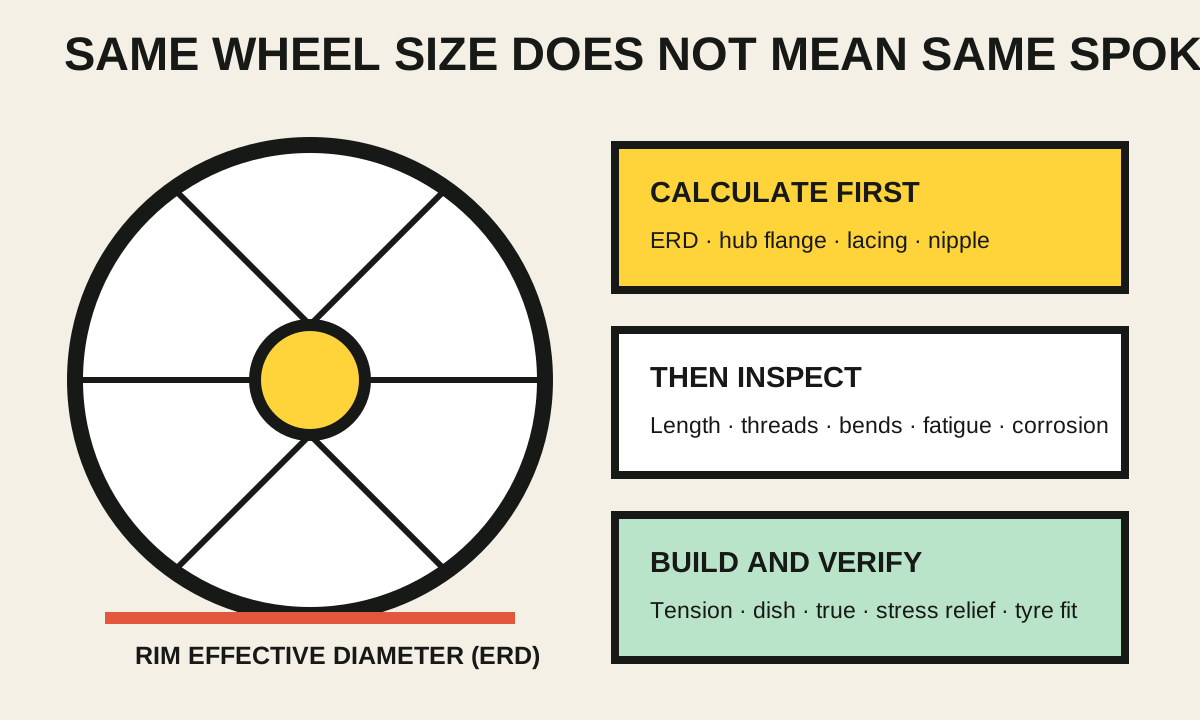
The question hiding inside “will these spokes fit?”
A recent r/bikewrench post asked whether existing spokes could be used with a taller replacement rim. That is a useful demand signal, but the answer cannot come from rim height alone.
A spoke must engage the nipple enough to carry load without bottoming out, protruding dangerously, or leaving too few threads engaged. The correct length depends on the complete wheel geometry. Two rims sold for the same tyre size can need different spokes.
Collect the build inputs before buying a rim
You need:
- the rim’s effective rim diameter, measured where the spoke ends sit in the nipples;
- spoke-hole count and drilling pattern;
- whether the holes are centred, alternating, or directionally drilled;
- hub flange diameters;
- centre-to-left-flange and centre-to-right-flange distances;
- front or rear wheel and brake/drive-side orientation;
- lacing pattern, such as radial, two-cross, or three-cross;
- spoke type, diameter, elbow or straight-pull interface, and nipple specification;
- any washers or proprietary nipple beds that affect the build.
Use the wheel maker’s product-support lookup when the wheel has an identification code. DT Swiss, for example, directs owners to its product support for the exact replacement spoke type and length, and provides a calculator for new builds.
Why a taller rim may need shorter spokes
Rim depth is measured from the tyre bed toward the hub, while ERD describes where the spoke ends effectively land. A deeper rim often places that landing point closer to the hub, reducing ERD and requiring shorter spokes. But construction details can change the relationship, so subtracting the depth difference is not a valid calculation.
Even a few millimetres matter. A spoke that is too short may not engage the nipple threads correctly. One that is too long may bottom out before tension is reached or protrude into the rim bed and threaten rim tape or an inner tube.
Run the old and proposed rims through the same reputable calculator with identical hub and lacing inputs. Record the required lengths for each side separately. If the result changes, buy the correct spokes rather than rationalising a near match.
When reuse is a poor bargain even if length matches
Replace the spokes when you find:
- corrosion, pitting, bent sections, damaged threads, or marked elbows;
- repeated spoke failures in the old wheel;
- a rim failure that may have heavily unloaded or bent nearby spokes;
- damaged straight-pull heads or hub interfaces;
- seized nipples that require twisting the spoke to remove them;
- a change in spoke count, lacing pattern, hub, or nipple system;
- maker instructions that call for new spokes or nipples;
- an unknown service history on a high-load or heavily used wheel.
A cracked rim around several spoke holes can reflect a tension or build problem, not just an unlucky rim. Read the spoke-hole crack guide before copying the old build unchanged.
Reusing spokes is not the same as reusing nipples
Nipples experience tool wear, corrosion, thread loading, and sometimes chemical locking compounds. Alloy nipples may be especially vulnerable to rounding or corrosion. A wheel maker may specify new nipples, washers, or thread treatment for a rebuild even when spokes can be reused.
Do not mix nipple lengths or materials simply to compensate for an incorrect spoke. The nipple must be compatible with the spoke thread and rim design, and its head must sit correctly in the rim.
Check rim compatibility beyond spoke length
A dimensionally buildable wheel can still be the wrong wheel. Verify:
- tyre size and pressure limits;
- hooked or hookless construction and approved tyre combinations;
- tubeless approval and required tape width;
- brake type and, for rim brakes, the correct brake track;
- maximum system weight and spoke-tension limits;
- valve type and hole size;
- external width, frame/fork clearance, and brake clearance;
- asymmetric-rim orientation.
Our hooked-versus-hookless guide and rim-tape guide cover two compatibility checks that are easy to miss.
Why a spoke calculator is necessary but not sufficient
A calculator only processes the dimensions entered. A copied marketing dimension, an ERD measured by a different convention, or left/right hub values entered backwards can produce a precise-looking wrong answer. DT Swiss explicitly recommends having a specialist or bicycle retailer verify calculated lengths.
After assembly, a wheel still needs even and appropriate tension, lateral and radial trueness, correct dish, stress relief, and a final inspection. Tension targets come from the rim and component makers, not from making every spoke “as tight as possible.”
A sensible decision rule
Reuse the spokes only if all five statements are true:
- The calculated required lengths match the existing spokes within the component maker’s acceptable range.
- The hub, lacing, drilling, nipple system, and wheel orientation are compatible.
- Every spoke passes inspection and the old wheel has no unexplained repeat-failure pattern.
- The rim and wheel makers permit the proposed parts and build.
- The builder can verify final tension, dish, true, and tyre-system compatibility.
If one statement is unknown, price the rim with new spokes and professional labour, then compare that total with a complete replacement wheel. Reusing inexpensive fatigue-loaded parts is not automatically the economical choice.
Your next step
Write down the wheel ID, hub model, rim model, spoke count, lacing pattern, and the calculated length for both sides. Ask a wheelbuilder to verify those inputs before ordering. If the new rim’s ERD or drilling differs, assume new spokes are needed until the calculation proves otherwise.
Sources and further reading
- DT Swiss spoke calculator
- DT Swiss spoke calculator conditions and verification recommendation
- Reddit demand signal: replacing a rim and asking whether taller-rim spokes can be reused — used to identify the question, not as wheelbuilding authority.