Can you install a setback seatpost backwards?
Find out when reversing a setback seatpost is manufacturer-approved, what changes on the bike, and when a different frame or zero-offset post is safer.
 Field guide / can-you-install-setback-seatpost-backwards
Sometimes—but only when the exact seatpost manufacturer says it can be reversed. Turning a setback post around moves the saddle clamp forward, changes saddle-angle adjustment and weight distribution, and may load a clamp in a direction it was not designed to accept. It is not a universal bike-fit shortcut.
The short answer: find the post’s brand and model, read its installation instructions, and treat silence as “do not reverse.” If reversal is approved, preserve the clamp’s marked front orientation, rail limits, insertion depth, and torque. If you need several centimetres of correction, reassess the frame size and fit instead.
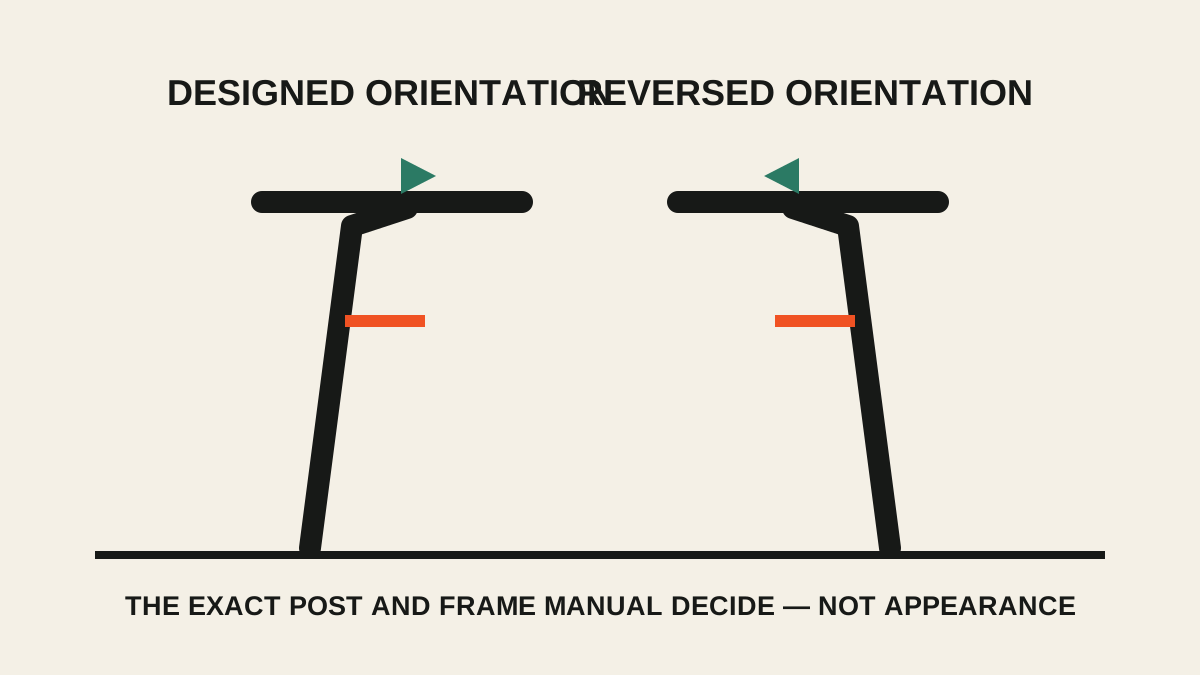
Why riders consider reversing a setback post
A setback post places the saddle clamp behind the centreline of the post. Reversing it can create an effective forward offset, bringing the saddle closer to the bottom bracket and usually closer to the bars. Riders try it when a bike feels too long, when converting a road bike for a time-trial-style position, or when a saddle has reached the front of its rails.
A current r/bikefit discussion shows the risk of treating that experiment as ordinary fit advice: the rider turned a setback post around and pushed the saddle fully forward while trying to rescue a difficult frame fit. The thread is useful as a demand signal, not proof that the setup was safe or correct.
The manufacturer—not the shape—gives the answer
Seatpost heads are not interchangeable designs. The shaft, bonded head, cradle, upper clamp, spherical washers, bolt direction, and allowed tilt range may all be directional.
Thomson is a useful example of why universal answers fail. Its Elite and Masterpiece instructions explicitly discuss reversing a setback post for a triathlon position, while still requiring the upper clamp marked FRONT to face forward. That permission applies to those posts and their specified hardware; it does not grant permission for another brand.
Use this order:
- Identify the exact post model, not only its diameter or brand.
- Find the current manufacturer installation sheet or frame manual.
- Look for explicit wording or a diagram covering reverse or forward-offset use.
- If the manual does not permit it, ask the manufacturer or use the correct post.
Do not infer approval because the saddle can be made level or the bolts appear to fit.
What reversal changes
Saddle position and pedalling support
Moving the saddle forward changes hip angle, knee relationship to the pedal, and how much body weight the saddle supports. It may reduce reach to the bars, but the saddle should not be used as a substitute stem. Trek’s fit guidance notes that fore-aft changes alter reach, weight distribution, handling, and hip rotation.
Clamp angle and hardware loading
After reversal, the clamp may not provide the same usable tilt range. A saddle forced level at the end of the mechanism’s travel is a warning, not a successful adjustment. Never substitute longer bolts or rearrange wedges and washers unless the instructions show that assembly.
Handling and frame-fit evidence
A large forward move shifts more rider weight toward the front wheel. If you also need a very short stem, fully forward saddle, or unusual handlebar position, the frame may be the wrong size or geometry. Read how to tell whether a road bike is too big or too small before stacking compensations.
A safe decision checklist
- Approved orientation: the exact post documentation permits reversal.
- Correct clamp direction: every marked piece faces the direction shown in the manual.
- Rail compatibility: round or oval rail dimensions match the clamp, and the clamp stays between the rail limit marks.
- Insertion: the post is inserted beyond both the post’s minimum line and any deeper frame requirement.
- Surface preparation: use grease or carbon assembly compound only where the frame and post makers specify it.
- Torque: use the exact value and tightening sequence for the clamp and frame.
- Function: the saddle becomes level without reaching a mechanical stop, and it cannot twist or tilt under firm hand pressure.
After installation, make a short test ride away from traffic. Recheck torque only as the maker instructs; repeatedly adding torque “just to be safe” can damage a post, frame, or saddle rails.
Better alternatives when reversal is not approved
A zero-offset seatpost is the direct component solution, provided its diameter, insertion length, frame compatibility, rail clamp, and rider-weight limit all match. A saddle with a different rail length can offer modest adjustment, but the clamp must remain inside its marks.
If the real goal is shorter handlebar reach, first establish a stable saddle position, then assess bar reach, hood position, and stem length. Our road-bike reach check separates those variables. When several extreme changes are required, put the money toward a correctly sized frame rather than another workaround.
Your next step
Photograph the post’s logo, model marking, clamp assembly, minimum-insertion line, and current rail position. Find the matching manual before loosening anything. If it does not explicitly show the orientation you want, install a compatible zero-offset post or ask a qualified shop to confirm the safe option.