Can a carbon road bike tow a child trailer?
Check frame approval, axle type, hitch clearance, weight limits, braking, and the exact trailer adapter before towing a child with a carbon road bike.
 Field guide / can-carbon-road-bike-tow-child-trailer
A carbon road bike can tow some child trailers, but carbon construction alone does not answer the question. Approval depends on the exact frame, rear axle, hitch, adapter, weight limit, and intended-use rules. Do not clamp a generic fitting to a carbon tube or replace a thru-axle with a “close enough” part.
The short answer: treat this as a documented compatibility check between three systems: bicycle, rear-wheel attachment, and trailer. An axle-mounted trailer may be permitted on a carbon bike when both manufacturers approve it and the correct axle adapter is used. If either manual is silent or says no, use another bicycle.
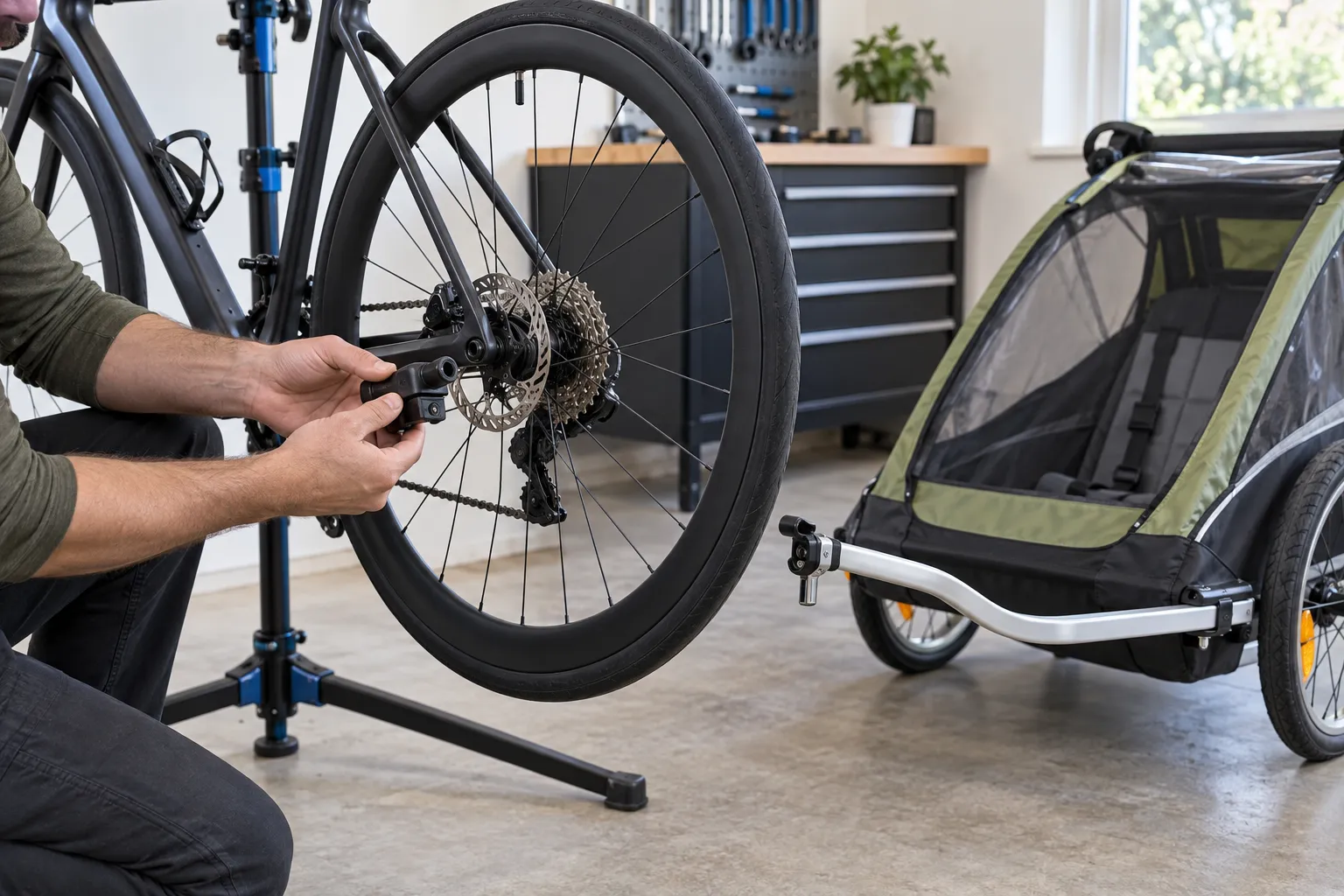
A trailer is not the same as a child seat
A frame- or seatpost-mounted child seat can apply clamping loads directly to a tube. An axle-mounted trailer transfers load through a hitch at the rear wheel attachment. Those are different installations, so a warning about one should not be casually extended to—or dismissed for—the other.
Trek’s owner manual says the bicycle must be suitable for a child seat or trailer and warns against attaching a child seat to a carbon frame or seatpost unless specifically equipped. It also tells riders to check compatibility with the carrier manufacturer. That wording makes the correct process clear: identify the exact product and mounting method rather than asking whether all carbon bikes are safe.
A recent public discussion asking whether a child trailer was safe on a carbon frame is a useful demand signal, but replies cannot approve an unseen frame or axle.
Check the bicycle first
Find the current manual for the exact model and model year. Then confirm:
- trailers are not prohibited by the bicycle maker;
- the total system-weight limit covers rider, bicycle, child, trailer, luggage, water, and accessories;
- the intended-use category permits the roads or paths you plan to ride;
- the rear dropout and axle are undamaged;
- the frame has not been repaired or modified around the rear triangle;
- the brakes, tyres, wheels, and gearing suit the added load and hills.
If the manual does not answer the trailer question, ask the bicycle manufacturer in writing. Give the model, model year, size, serial-number range if requested, trailer model, hitch type, and proposed adapter. “It looks strong” is not an approval.
Identify the rear axle exactly
Modern disc-brake road bikes commonly use a 12 mm thru-axle, but diameter is only one dimension. The replacement trailer axle must also match:
- thread pitch;
- overall usable length;
- flat or conical head shape;
- dropout interface;
- required thread engagement;
- hitch-side clearance;
- the bicycle maker’s tightening method and torque.
Thule’s current trailer fit guide explains that a thru-axle bike needs a purpose-made axle with space for its hitch plate, and that head shape, pitch, and length must all match. That guidance applies to its system, not every trailer. Use the instructions for your exact trailer.
Never stack washers, grind a hitch, extend a short axle, force a thread, or leave the axle under-engaged to make the pieces meet. A rear wheel that loosens can cause loss of control.
Check hitch and frame clearance
With the approved adapter identified, confirm that the hitch plate sits in the orientation required by the trailer maker and does not press against carbon, paint, the derailleur hanger, brake rotor, caliper, cable, hose, or axle head.
Turn and articulate the empty trailer through its allowed range. Nothing should bind, lever against the dropout, or touch the wheel. Fit the secondary retention strap exactly as instructed; do not wrap it around a carbon stay unless the manufacturer explicitly calls for that location and method.
Recalculate the complete load
Use the bicycle total system-weight guide and respect the lowest published limit in the complete setup. The trailer may have separate limits for passenger mass, cargo, total trailer load, child age or posture, speed, gradient, and number of passengers.
Also check tyre and wheel limits. Added trailer load does not sit entirely on the bicycle, but it changes acceleration, braking, cornering, and forces at the hitch. Do not invent a weight allowance by subtracting the trailer’s wheel load from the bicycle limit unless the manufacturer documents that method.
Practise before carrying a child
After a qualified check and installation:
- Recheck rear-wheel security and hitch retention.
- Load the trailer with secured ballast within the approved limit—not a child.
- Practise starting, stopping, tight turns, looking behind, and controlled braking in a traffic-free area.
- Test the lowest gear on a mild climb and a safe restart on a slope.
- Confirm the trailer tracks correctly and cannot contact the rear wheel.
- Reinspect the axle, hitch, wheel, tyre, brake, and frame after the test.
The added mass increases stopping distance and can make balance, cornering, and tipping more demanding. Choose a flatter, quieter first route with generous sight lines and no technical descents. Follow local passenger, helmet, visibility, and trailer laws.
When another bicycle is the better answer
Use a different approved bicycle when compatibility is unclear, the road bike has aggressive gearing or limited braking margin for the route, the hitch contacts the frame, the correct axle is unavailable, or the manufacturer prohibits towing.
A simple aluminium or steel utility bike with approved mounts, low gears, suitable brakes, and a documented trailer setup may be the safer and cheaper family tool. That is not a downgrade; it is choosing equipment for the job.
Your next step
Write down the exact bicycle, axle markings and measurements, trailer model, hitch version, total planned load, and route. Check both manufacturers’ current instructions, then have the assembled system inspected before the ballast test. If you are also choosing a family bike, use the hybrid-or-gravel family riding guide before buying.