Hybrid or gravel bike for fitness, family rides, and light trails?
Choose between a flat-bar hybrid and drop-bar gravel bike by pace, posture, surfaces, carrying needs, test-ride control, and total cost.
 Field guide / hybrid-or-gravel-bike-family-fitness
Before you view or pay
Check fit, condition, and starter gear first
Use the buying checklist to choose the right path: used-bike viewing, first-bike fit and type, hidden repair costs, or starter gear.
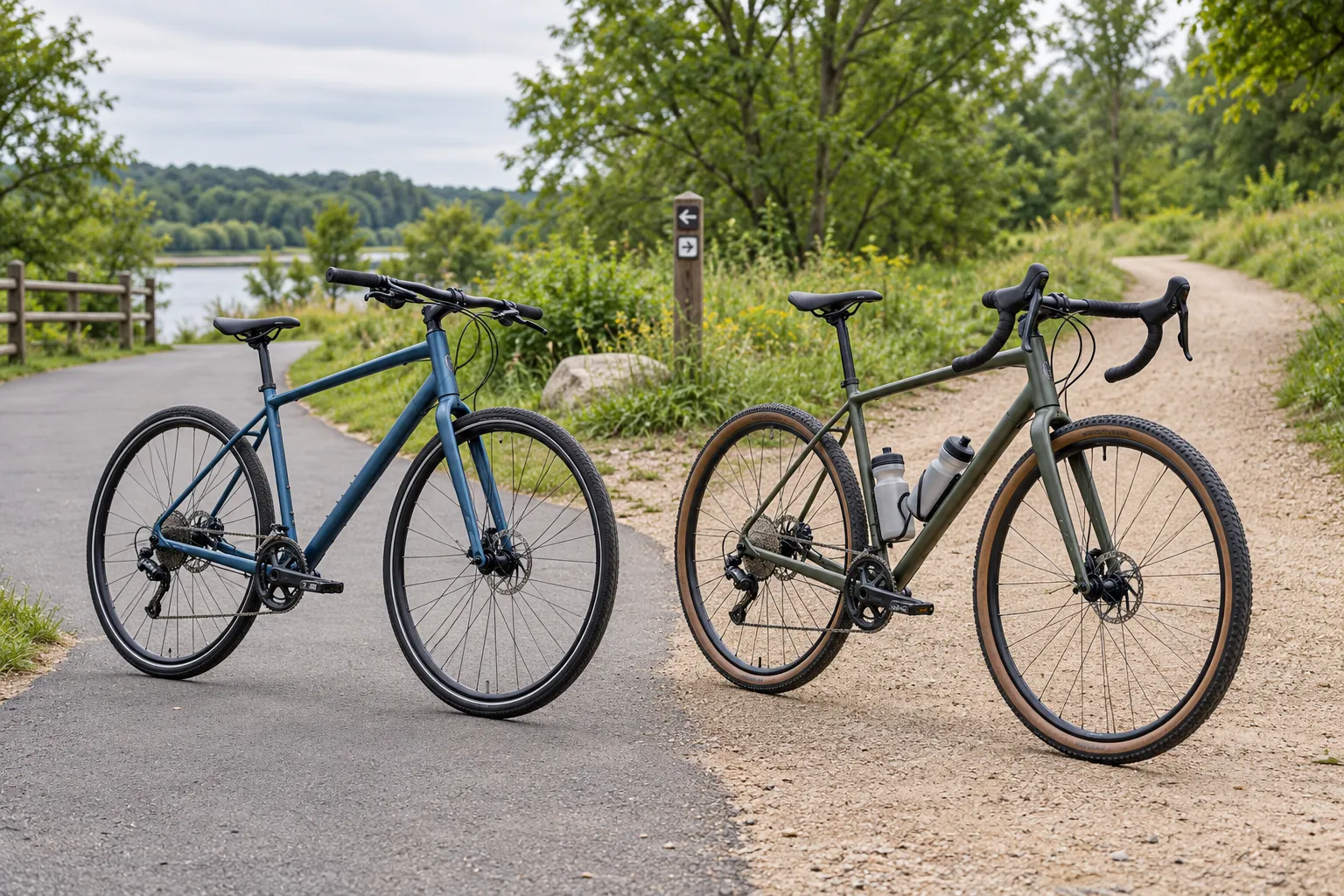
Choose a hybrid when most rides are relaxed, stop-start, upright, and shared with family or errands. Choose a gravel bike when you expect longer steady rides, value several hand positions, are comfortable with drop-bar controls, and will use its broader distance-and-surface capability. Either can handle paved paths and smooth light gravel with suitable tyres.
The short answer: do not buy the category that sounds most versatile. Buy the control position, gearing, tyres, mounts, and service plan that match the majority of your real rides.
Start with the ride you will repeat
Describe a normal week rather than the biggest adventure you might attempt:
- distance and time for a typical ride;
- pace of the people you ride with;
- proportion of pavement, compact gravel, loose material, and rough trail;
- hills and the lowest gear you may need;
- stops, traffic, children, luggage, and locks;
- storage, carrying stairs, and maintenance access.
If 80% of your riding is an easy hour on paths with frequent stops, optimise that. A future 50 km ride does not automatically require a gravel bike; a comfortable hybrid can cover it. A gravel bike becomes more compelling when longer rides are already a regular goal and drop bars feel natural.
Choose the control position first
A typical hybrid uses a flat or mildly swept bar. The wider hand position, direct brake access, and upright posture can feel intuitive at low speed and around frequent stops. The tradeoff is usually one main hand position and more frontal exposure during sustained riding.
A gravel bike uses drop bars with brake/shift controls at the hoods and drops. Multiple hand positions can help over longer rides, and the narrower posture may feel efficient into wind. The controls require familiarisation, and some riders dislike them for slow shared paths or constant mounting and dismounting.
Test whether you can brake firmly from the position you will actually use. Do not assume you will “grow into” a reach that locks your elbows or makes the levers hard to reach.
Match tyres to the actual surface
Tyre model, construction, width, tread, pressure, and rim compatibility matter more than the category name. For paved paths and firm fine gravel, both bike types can work on suitable moderate-width tyres. Loose stones, roots, mud, and ruts demand more volume, traction, skill, and margin.
Check the manufacturer’s maximum tyre clearance for the exact frame, fork, wheel, and any mudguards. Measure the fitted tyre rather than trusting the number printed on its sidewall. The first-bike tyre-clearance guide explains why more useful clearance can matter more than a racier label.
Compare gearing at both ends
Beginners are often told that 1× is simpler. One shifter is simple, but a drivetrain with one front ring can have larger jumps between rear gears or less total range. A 2× system adds a front shift but may offer close steps and both low climbing and high road gears.
Ignore the ring count until you compare the easiest ratio. Ride the steepest representative hill while seated. If the demonstration bike forces a low-cadence struggle, request easier gearing rather than assuming fitness will solve it.
Audit utility before the test ride
For family rides, commuting, or errands, check:
- rack and mudguard mounts;
- safe compatibility with any child seat, trailer, or cargo equipment;
- kickstand provisions if you require one;
- room for lights, bottles, a lock, and repair kit;
- maximum total system weight, including rider and cargo;
- common replacement tyres, brake pads, drivetrain parts, and wheels;
- whether a local shop will service the exact system.
Never attach a child carrier or trailer based on a generic category recommendation. The bicycle and accessory makers must approve the exact combination, mounting point, and weight.
Use one route to test both
Rent or test ride each category on a representative loop if possible. Include:
- a low-speed start and stop;
- several turns in both directions;
- one short climb;
- a rough but appropriate surface section;
- braking from your normal hand position;
- lifting or parking the bike as you would at home.
Afterward, record control, comfort, gear range, noise, and anything you had to tolerate. Excitement about speed should not erase difficult braking access, excessive reach, or a missing practical mount.
Know when each choice is stronger
Choose the hybrid when you prioritise:
- upright visibility and familiar flat-bar control;
- relaxed family pace and frequent stops;
- lower purchase and replacement-part cost;
- short fitness rides, errands, or utility;
- paved paths with occasional smooth gravel.
Choose the gravel bike when you prioritise:
- longer steady road and mixed-surface rides;
- multiple hand positions;
- joining drop-bar groups;
- carrying bottles or bikepacking luggage on approved mounts;
- a sportier position that already feels sustainable.
Neither choice needs suspension for ordinary pavement and light gravel. A cheap suspension fork can add weight and service needs without improving the rides you described. For rougher routes, compare the bike with the hybrid-versus-mountain-bike guide.
Your next step
Map your most likely 60-minute route and mark its worst surface, steepest hill, and every stop. Test a hybrid and gravel bike on those requirements, then price each with the same lights, repair kit, luggage, and fit changes. Take the one that makes the repeated ride easy to start—not the one designed for the most dramatic possibility.
For the full fit, condition, cost, and test-ride process, use the beginner road-bike buying checklist.
Sources and further reading
- r/cycling demand signal: choosing a hybrid or gravel bike for fitness, family rides, pavement, and unpaved trails — used as an editorial question signal, not as a product recommendation.