Broken cycle or pedestrian crossing signal: what should a rider do?
Stop before the crossing, do not infer permission from an adjacent green light, apply local rules, and choose a safe wait, reroute, or dismount option.
 Field guide / broken-cycle-crossing-signal
A dark, frozen, obstructed, or confusing bicycle-crossing signal is not permission to copy whichever nearby light turns green. Intersections contain turning traffic, separate phases, blind approaches, and rules that differ by place.
The short answer: stop before entering the conflict area. Identify the signal, sign, lane, or crossing that legally controls you. If it does not give a clear valid indication, do not improvise from an adjacent vehicle signal. Wait for a valid phase, use a working alternative crossing, or dismount and proceed as a pedestrian only where local rules allow and the route is visibly safe.
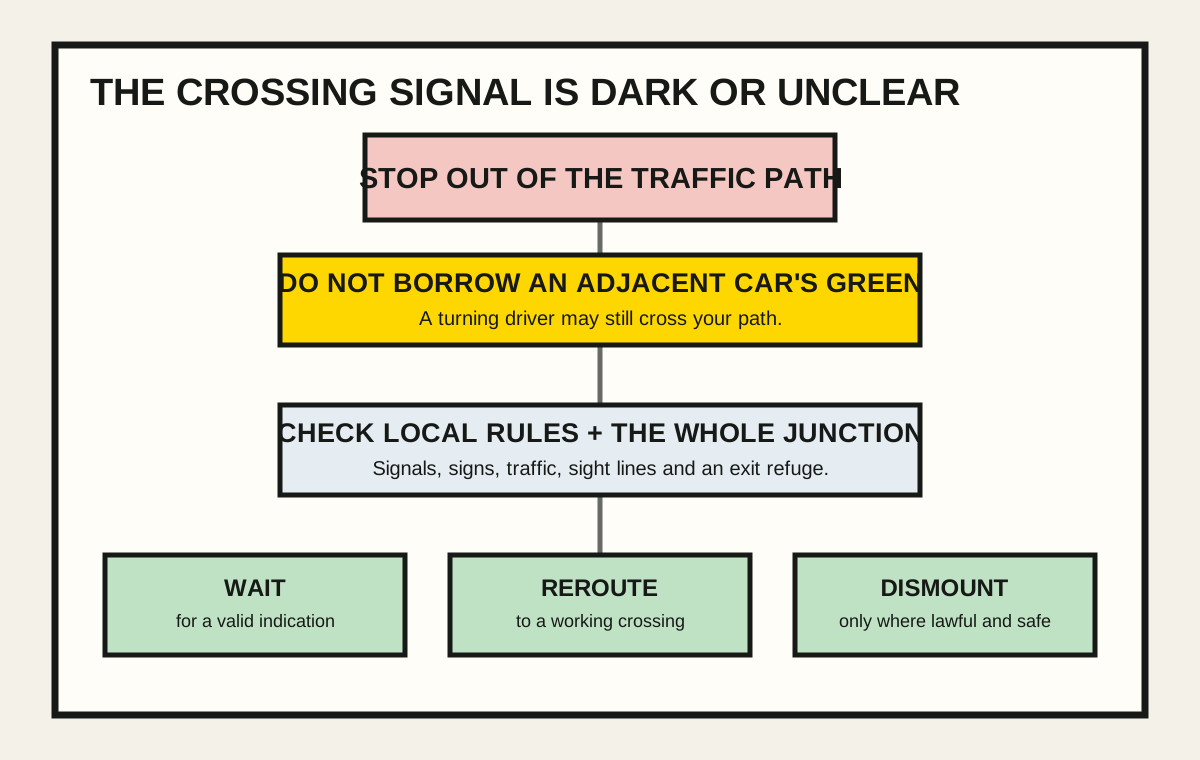
First, get out of decision pressure
Stop behind the line, kerb, or path edge that keeps you outside moving traffic. Keep the bicycle straight, hold both brakes, and leave room for pedestrians and other riders.
Do not roll into the crossing to improve your view. Do not follow another cyclist simply because they moved. Their decision may be wrong, and drivers may see one rider but not the next.
If you have already entered and the signal changes or becomes unclear, prioritise leaving the immediate conflict area predictably. Do not reverse into others or make a sudden diagonal move. Once safe, stop and reassess.
Identify what actually controls your movement
Look for:
- a bicycle signal head or bicycle symbol;
- a pedestrian walk/don’t-walk indication;
- ordinary traffic lights aligned with a bicycle lane;
- stop or give-way signs;
- painted stop lines and directional arrows;
- a push button or bicycle detection marking;
- temporary roadworks signals or a marshal;
- signs that require riders to dismount.
The controlling device depends on local law and the crossing design. A path crossing, protected junction, on-road bicycle lane, and shared sidewalk may use different rules in the same city.
NHTSA’s US guidance tells riders to obey traffic signs and signals, stop and look before entering a street, and practise traffic skills in a safe area first. It also tells sidewalk riders to check local law and be prepared to follow pedestrian signals when crossing. Use the equivalent road authority where you live.
Why the adjacent green is unsafe evidence
Modern junctions can separate straight vehicles, turning vehicles, bicycles, trams, buses, and pedestrians into different phases. The light you can see may face a different approach or permit a turn across your path.
Even when traffic beside you moves in the same direction, a driver may turn through the crossing. A green motor signal therefore proves only that a particular movement has permission under that junction’s rules. It does not prove your crossing is protected or legal.
Never use a driver’s hand wave as a substitute for checking every lane. The first driver cannot grant control over traffic approaching elsewhere.
Choose one conservative fallback
Wait for a complete cycle
If you are safely positioned, wait through one full signal cycle. The bicycle or pedestrian phase may require a button press or detector position. Do not repeatedly roll into the junction to trigger it.
If the signal never illuminates, treat it as a fault rather than assuming a hidden permission.
Reroute to a working crossing
This is often the cleanest answer. Continue along the path or road only if doing so is legal and safe, then cross at a junction you can understand. A few extra minutes is a good trade for removing an ambiguous conflict.
Dismount and become a pedestrian
Walking may change which rules apply, but it does not make a broken crossing safe. Use a pedestrian route only where cycling and walking access are lawful, signals or priority are clear, and you can cross every lane without forcing traffic to react.
Stop the trip
If darkness, heavy traffic, poor sight lines, weather, disability, anxiety, or route design removes your margin, turn around or arrange another mode. Completing the planned line on a map is not a safety requirement.
Do not make these common moves
- Do not enter on a vehicle green that does not control you.
- Do not weave from path to road in the junction.
- Do not ride against traffic to reach a different signal.
- Do not block the tactile paving or pedestrian waiting area.
- Do not stare at a phone while standing close to live traffic.
- Do not attempt to repair, open, or touch signal equipment.
- Do not rely on eye contact as proof a driver will yield.
If an officer, marshal, or authorised traffic controller is present, follow their lawful directions even when fixed signals display something different.
Report the fault after you are safe
Move away from the junction before using a phone. Record the road names, travel direction, signal type, time, and fault: dark, stuck, damaged, blocked, or failing to detect bicycles. A photograph from a safe public position can help, but never step into the road to obtain it.
Use the road authority, city, or emergency infrastructure channel appropriate to the urgency. Report exposed wires, a struck signal pole, or signals creating an immediate collision risk through the local emergency route. Do not assume another person has reported it.
Build city skills without live-junction improvisation
Practise starting, controlled stopping, signalling, shoulder checks, and holding a straight line in a traffic-free area. Then use a short, familiar, lower-speed route at a quiet time. Predictability beats bravery in traffic explains the operating principle, while looking behind without swerving gives you one skill to rehearse before busier streets.
Route planning should include two alternative crossings and a legal place to stop. That turns a failed signal from a pressured puzzle into a known detour.
Your next step
Find the official cycling rules and signal-fault reporting page for your city. Save both on your phone, then plan one short urban route with a working backup crossing before your next ride.
Sources and further reading
- NHTSA: learn to bike safely, including signals and traffic-free practice
- NHTSA: bicycle safety, predictable riding, crossings, and local sidewalk laws
- r/cycling reader context: a new city rider unsure how to handle an unavailable crossing indication — used as a current road-skill signal; no individual action in the thread was treated as legal guidance.