Bright or patterned cycling jersey: what helps drivers see you?
Choose road-cycling clothing for daytime and night visibility by separating fluorescent colour, contrast, reflective material, moving-leg cues, and bike lights.
 Field guide / bright-or-patterned-cycling-jersey-visibility
For daytime riding, a large fluorescent or strongly contrasting area is a more defensible choice than a dark, low-contrast fashion pattern. At night, fluorescent colour needs illumination and is not the main tool: legal bike lights and retroreflective details matter more. Reflective or fluorescent material on moving ankles or lower legs can also help an observer recognise a cyclist’s pedalling motion.
The short answer: do not search for one “safest jersey.” Choose contrast for the conditions, put night-time reflection where headlights can return it, use your required lights, and keep every layer visible instead of covering it with a dark jacket or backpack.
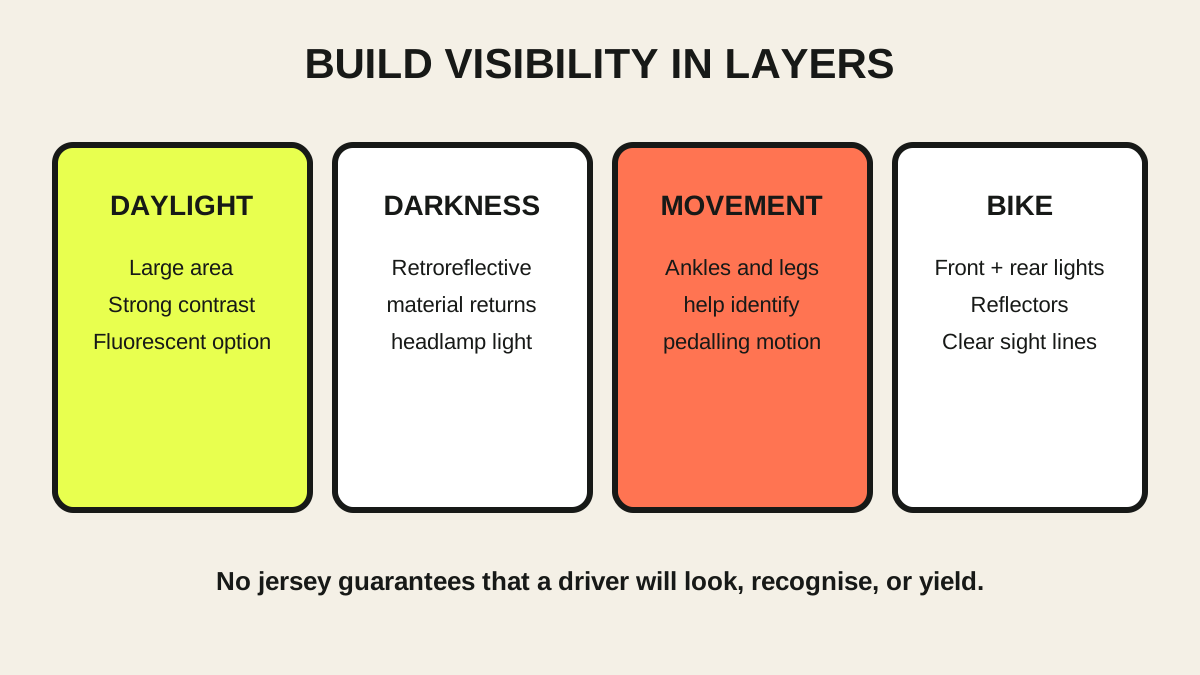
Pattern versus solid colour is the wrong first question
A current r/cycling discussion asked whether a patterned jersey or a solid block of bright colour makes a rider easier to notice. That is a useful shopping question, but research does not support a universal rule that every solid jersey beats every pattern.
What matters is the complete visual problem:
- contrast between the rider and the background;
- how much visible area carries that contrast;
- whether the material is fluorescent, ordinary coloured fabric, or retroreflective;
- daylight, dusk, darkness, weather, and street lighting;
- whether movement helps the observer identify a person on a bicycle;
- whether a backpack, gilet, or rain shell covers the useful area.
A complicated pattern can reduce one large colour block into smaller patches, but a bold pattern can also create contrast. Because road backgrounds constantly change, buy for conspicuity across your actual conditions rather than trusting a product name such as “visibility collection.”
In daylight, prioritise contrast and fluorescent area
Fluorescent material converts some ultraviolet energy into visible light, which is why it can appear unusually bright in daylight. An open-road study found that highlighting a rider’s pedalling legs with fluorescent material improved recognition compared with the same fluorescent jersey and dark legs. The study did not establish that any specific jersey prevents collisions, and its authors noted that real clothing patterns remain under-tested.
For a daytime purchase:
- Compare the jersey against the backgrounds you use: green hedges, grey city streets, brown winter lanes, and bright sky.
- Prefer a sizeable bright area on the back and shoulders over a tiny neon logo.
- Check what your rain jacket and backpack will cover.
- Add a daytime rear light selected for its beam, mounting, and run time—not just its peak lumen claim. Our daytime rear-light guide explains that choice.
Yellow-green is common because it can stand out well in many daylight scenes, but orange, pink, red-orange, or another colour may contrast better with a particular background. “Bright” is contextual.
At night, reflection and lights do different jobs
Fluorescent fabric is not the same as retroreflective material. Retroreflective material sends light back toward its source, so it can return vehicle-headlamp light toward a driver. Fluorescent colour has a daylight advantage but should not be assumed to glow in darkness.
Closed-road research has repeatedly found better cyclist recognition when retroreflective markings were placed on moving lower-leg joints than when reflection appeared only on the torso. The motion can help an observer recognise the distinctive pattern as a pedalling human rather than an unidentified bright patch.
That does not turn ankle bands into a substitute for lights. Use a white front light, red rear light, reflectors, and any other equipment required where you ride. Aim lights so they help others detect you without dazzling them. Start with how to ride a road bike after dark.
Build a four-layer visibility setup
1. The bicycle
Fit reliable lights with secure mounts and enough battery margin for the whole ride. Check that luggage does not block the rear light or reflector.
2. The torso
Use a large contrasting area in daylight. At night, choose real retroreflective panels rather than assuming silver-looking trim reflects effectively. Product descriptions should identify reflective material clearly.
3. The moving legs
Reflective ankle bands, reflective shoe details, or lower-leg panels can create a recognisable movement cue. Keep them visible from the direction of traffic; long dark overshoes can cover a useful shoe reflector.
4. The route and riding position
Clothing cannot compensate for a blind junction, an unlit fast road, or a position hidden behind parked vehicles. Choose lower-conflict routes where possible, avoid the door zone, and occupy a visible, predictable line.
A five-minute wardrobe audit
Put on the exact outfit, including backpack, rain layer, and winter accessories. Ask another person to view you from front, rear, and side in daylight and under vehicle-like illumination at night without standing in the road.
Check:
- Is the rear light visible when you lean forward?
- Does luggage hide the torso colour or reflector?
- Are there side-on cues at junctions?
- Do the lower legs show movement?
- Are reflective areas clean rather than coated in road spray?
- Does the outfit still let you signal, look behind, and control the bike comfortably?
Wash reflective garments according to their care label. Abrasion, dirt, and an incompatible outer layer can reduce the practical value of a good design.
What visibility clothing cannot promise
Research measures such as detection or recognition distance are not the same as proven crash prevention. A Cochrane review found evidence that visibility aids can improve drivers’ detection and recognition, while also finding no controlled trials that established their effect on pedestrian or cyclist collision rates.
So the honest claim is limited: good clothing can add useful visual cues. It cannot guarantee attention, judgement, passing distance, or compliance from a driver. You retain the same right to the road in ordinary clothing, and responsibility for safe driving remains with the driver.
Your next step
Choose one daytime cue, one night-time reflective cue on a moving part, and a reliable light setup. Then test the complete outfit with your normal luggage. If the most visible jersey will always stay in the drawer because it fits badly, choose a comfortable high-contrast option you will actually wear and strengthen the other layers.
Sources and further reading
- Original daylight study: highlighting bicyclist biological motion
- Original night study: lights, reflective clothing, and cyclist recognition
- Cochrane review: visibility aids improve detection, but collision effect remains unknown
- r/cycling reader context: solid colour versus patterned jersey visibility