21 mm vs 23 mm internal road-rim width: will you notice?
Treat a 2 mm rim-width difference as one part of the tyre, pressure, clearance, rim profile, hub, and support decision—not an automatic wheel upgrade.
 Field guide / 21mm-vs-23mm-internal-road-rim-width
Before you buy
Check the starter kit first
Print the one-page buying brief for helmet, lights, water, phone, and repair compatibility before comparing upgrades.
Moving from a 21 mm to a 23 mm internal road rim can change how a given tyre sits and measures, but the difference is not automatically night and day. Tyre model and size, pressure, external rim shape, wheel construction, and road surface may matter more than those two millimetres alone.
The short answer: choose the wheel whose complete system suits your approved tyre size, measured frame clearance, pressure range, braking system, axle, freehub, rider load, service needs, and budget. A 23 mm internal rim may make the same tyre measure slightly wider and alter its profile, but do not claim a comfort, grip, or speed improvement until the actual tyre and pressure are controlled.
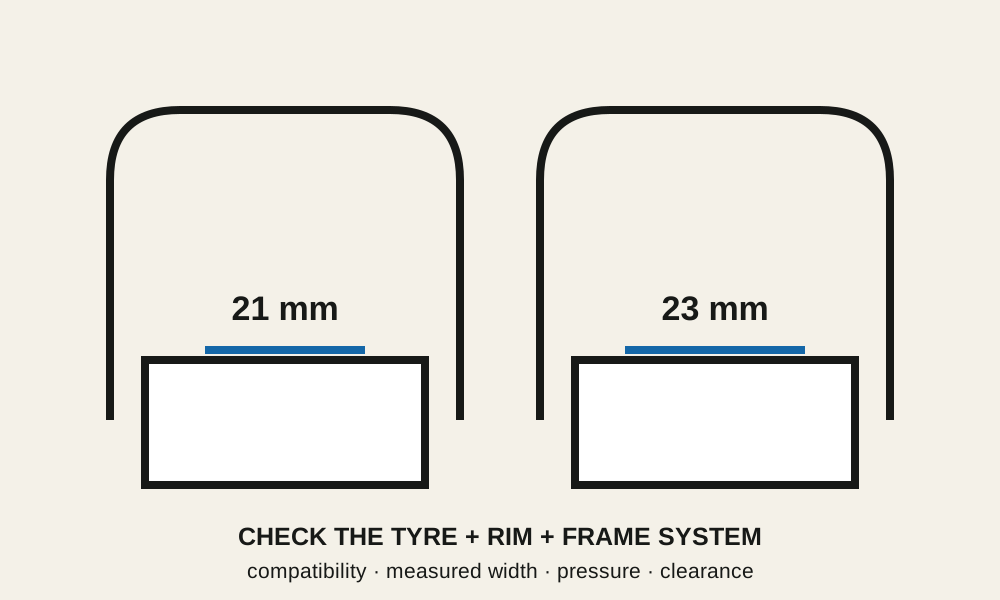
Internal width is only one rim dimension
Internal rim width is the distance between the bead seats inside the rim. It is not rim depth, external width, bead-seat diameter, hook type, or the width an inflated tyre will measure.
For a road wheel comparison, record:
- bead-seat diameter, commonly 622 mm for a 700C road wheel;
- internal and external rim width;
- rim depth and profile;
- hooked or hookless/straight-side construction;
- permitted tyre type and size range;
- maximum pressure for each tyre size;
- tubed and tubeless approval;
- wheel system-weight limit;
- axle, rotor interface, and freehub;
- spoke, bearing, and replacement-part support.
A 23 mm rim with the wrong tyre approval or no replacement spokes is not a better wheel than a supported 21 mm system.
What two extra millimetres can change
Holding the exact tyre and pressure constant, a wider internal rim generally supports the beads farther apart. That can change the inflated casing shape and measured external width. It may also change how the tyre transitions to the rim externally.
The size of that change is tyre-specific. Schwalbe notes that actual tyre width varies with rim width, pressure, and time after installation and that a stated tyre size can have manufacturing tolerance. Do not use a universal formula such as “2 mm more rim equals 2 mm more tyre.”
The practical result may be:
- a small change in measured tyre width;
- a different sidewall profile;
- different frame, fork, or brake clearance;
- a new pressure starting point;
- a different rim-to-tyre external transition.
Whether a rider notices depends on the rest of the wheel and test. Changing from stock aluminium wheels and one tyre to deeper carbon wheels and another tyre changes too many variables to credit the feeling to internal width.
Compatibility comes before feel
Use the current charts for the exact rim and tyre. Schwalbe’s compatibility guidance says inner diameter, tyre width, and inner rim width must match. It also says hookless or straight-side rims require compatible tubeless-ready tyres even when a tube is fitted, and that the wheel maker’s minimum tyre width and pressure limits still apply.
Check both manufacturers because the intersection of their limits is the usable range. If one allows a combination and the other does not, it is not approved.
This matters especially when comparing wheel generations. A newer 23 mm internal hookless rim may have more restrictive tyre and pressure requirements than a 21 mm hooked rim. “Wider” does not override those instructions.
Measure clearance with the tyre actually installed
A nominal 28 mm tyre may not measure 28 mm on either wheel. Install the approved tyre, inflate within the allowed range, let it settle as the tyre maker recommends, then measure the widest casing point.
Check clearance at:
- fork crown and both fork legs;
- chainstays and seatstays;
- seat tube or front derailleur area;
- mudguards and mounts;
- rim-brake caliper and pads where relevant;
- any frame protection or sensor.
Account for wheel flex, debris, manufacturing tolerance, and the bicycle maker’s minimum clearance. A tyre that clears in a workstand by a fraction is not proven safe under load.
If you are trying to fit a wider tyre to an older bicycle, use the older road-bike tyre-clearance guide.
Pressure must be reset, not copied blindly
An installed tyre with a different measured width and volume may need a different pressure starting point. Use the wheel and tyre limits plus a credible pressure calculator that accounts for system weight, tyre size, surface, and front/rear load.
Maximum sidewall or rim pressure is a ceiling, not a target. Do not reduce pressure merely because the rim is wider, and do not copy a friend’s value without comparing total load, actual measured width, casing, and surface.
After a wheel change, begin conservatively within approved limits and evaluate:
- rim-strike or pinch-flat evidence;
- cornering support;
- braking and handling;
- pressure loss;
- casing movement;
- comfort on a repeatable route.
Change pressure in small recorded steps. Do not combine a new wheel, new tyre, new sealant, and a large pressure drop on the first fast descent.
Compare the wheels on the factors you will live with
Internal width is easy to market because it is one number. Ownership is broader.
Fit and function
Confirm axle standard, rotor mount, freehub, cassette spacing, tyre approval, frame clearance, and total system weight.
Serviceability
Ask whether bearings, freehub parts, spokes, nipples, rim tape, valves, and crash-replacement support are available where you live. Check whether spoke replacement requires tyre and tape removal.
Braking and handling
Rim depth, external shape, spoke system, hub engagement, crosswind behaviour, and total wheel build can matter more than the 2 mm internal-width difference. Use independent test evidence for aerodynamic or stiffness claims; do not infer them from width.
Real cost
Add tyres, valves, tape, sealant, cassette spacers, rotors, lockrings, tools, and workshop labour. A wheel may require a different approved tyre even when your current tyre’s printed size looks suitable.
Make the buying decision without imagined speed
If both wheels support your preferred tyre and pressure, clear the bike, meet the load requirement, and have credible service support, the 21 versus 23 mm choice is unlikely to be the only decisive feature.
Prefer the option with clearer documentation, appropriate external width and depth, available parts, and a realistic warranty path. If the 23 mm wheel forces a tyre or pressure compromise, the extra internal width has no inherent value. If it gives an approved, well-supported match for your chosen 28–32 mm tyre and frame, it may be the more future-flexible system.
Use the road-bike buying checklist when the wheel choice is influencing which complete bike to buy. Fit, brakes, support, and total budget still come first.
Your next step
Make a two-column sheet for the complete wheel systems. Add the exact tyre model and size, approved pressure range, predicted and measured width, frame clearance, hook type, load limit, spares, and total installed cost. Choose only after those rows are filled.
Sources and further reading
- Schwalbe: tyre dimensions, installed-width variables, and tyre/rim matching
- Schwalbe: ETRTO-based tyre and inner-rim compatibility chart
- r/cycling reader context: whether a 21 mm to 23 mm internal-width change would be noticeable — used as a current comparison signal; product claims in the discussion were not treated as test data.