Will a road bike be faster than a hybrid—and by how much?
A road bike often becomes faster as speed rises because it enables a lower position and efficient road setup, but no honest fixed speed gain applies to every rider or route.
 Field guide / will-road-bike-be-faster-than-hybrid
Before you view or pay
Check fit, condition, and starter gear first
Use the buying checklist to choose the right path: used-bike viewing, first-bike fit and type, hidden repair costs, or starter gear.
A suitable road bike will usually be faster than a typical upright hybrid on smooth, open roads at the same sustainable effort. The main advantage is often the rider position the road bike supports, followed by tyres, gearing, weight on climbs, and the ability to change hand positions. But “two miles per hour faster” is an anecdote, not a transferable promise.
The short answer: expect the difference to grow on faster, wind-exposed, uninterrupted riding and shrink in traffic, on short trips, rough surfaces, steep climbs, or routes with frequent stops. A comfortable hybrid on good tyres can beat a poorly fitted road bike that you cannot control or sustain.
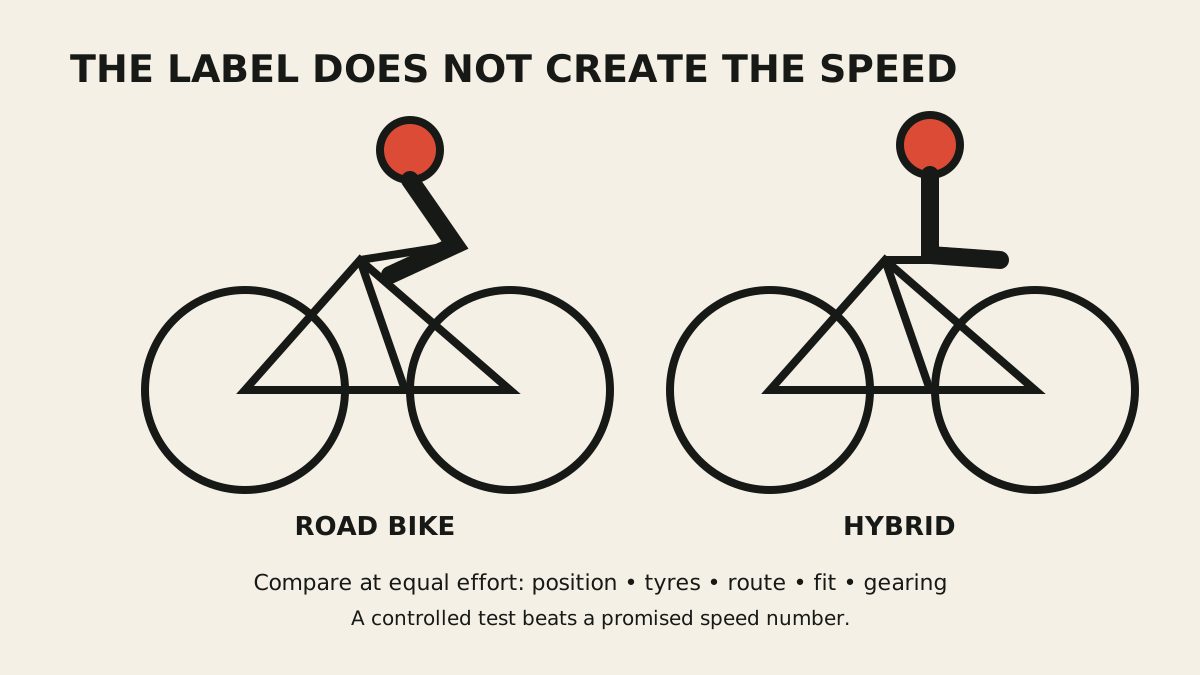
Rider position usually matters most on flat roads
As speed rises, moving air becomes a larger part of the resistance the rider must overcome. A road bike’s drop handlebar can support a narrower, lower position than many flat-bar hybrids while still offering accessible brakes and several hand positions.
Research consistently finds that cycling posture changes aerodynamic drag. A review of competition-cycling aerodynamics reports lower drag for dropped positions than upright road positions, while also showing substantial variation between riders and testing methods. That is why this article does not turn a wind-tunnel percentage into a promised commuting speed.
The position must be sustainable. A rider who cannot see ahead, breathe comfortably, produce normal power, brake confidently, or remain comfortable will sit up, slow down, or stop. Fit and practice decide whether the theoretical advantage survives the ride.
Tyres can narrow or widen the gap
Do not compare “road” with “hybrid” as if each has one tyre. A hybrid on supple road tyres at suitable pressure can roll very differently from the same bike on heavily treaded, stiff, underinflated tyres. A road bike with damaged, overinflated, or unsuitable tyres can be slow and harsh.
Compare:
- measured tyre width, not only the sidewall label;
- tread and casing intended for the actual surface;
- pressure appropriate to tyre, rim, load, and conditions;
- tube, tubeless, and puncture-protection choices; and
- wheel and brake condition.
Do not fit a narrow tyre merely to imitate a road bike. Use sizes approved for the rim and frame, with safe clearance and pressure. The tyre-pressure guide gives a safer starting process.
Weight matters most when you repeatedly lift it uphill
A lighter road bike can feel more responsive and require less energy to climb or accelerate, all else equal. On a steady flat road, total mass matters less than many buyers assume; air and rolling resistance remain present continuously.
Real routes are not laboratories. Stop-start traffic repeatedly asks the rider to accelerate. A laptop, lock, water, mudguards, rack, and clothing may outweigh the difference between two bare catalogue bikes. Compare them in the configuration you will actually ride.
Gearing changes usable speed, not free speed
Road gearing may offer close steps that help a rider hold a preferred cadence. A hybrid may provide easier gears for steep hills or loaded riding. Neither makes power by itself.
A very high gear does not make a beginner fast if it encourages slow, heavy pedalling. A very low gear does not make a bicycle slow if it lets the rider keep moving efficiently on a climb. Check whether the complete range matches the terrain rather than counting chainrings.
Control and route can erase the advantage
Hybrids often provide an upright view, straightforward low-speed control, wider tyres, and easy compatibility with utility equipment. Those traits can be faster in practice when the route includes potholes, unsealed sections, crowded paths, kerbs, frequent junctions, or luggage.
A road bike gains more on an open 50 km ride than on a three-kilometre trip with twelve traffic lights. Average speed also mixes riding with the effects of wind, gradient, traffic, turns, stops, confidence, and route choice. It is a poor isolated verdict on the bicycle.
Run a fair comparison
If you can borrow or test a road bike safely, compare without turning the session into a race:
- Confirm both bikes fit adequately and are mechanically sound.
- Use suitable tyre pressures and remove unnecessary differences in luggage.
- Choose a familiar, low-traffic route with a safe turnaround.
- Ride each bike at the same perceived effort, heart-rate range, or power—not the same excitement.
- Repeat on another day or reverse the order to reduce wind and fatigue bias.
- Record comfort, braking, hand positions, control, and desire to continue as well as time.
A one-off personal best on a new bike includes motivation and weather. A repeatable test is more useful than a dramatic first ride.
Decide whether speed solves your actual problem
Choose the road bike when you enjoy drop bars, ride mainly paved distances, want to join faster road groups, and can sustain its position. Keep or improve the hybrid when it already fits the route, carries what you need, and the real constraint is fitness, maintenance, tyres, or consistency.
If you are buying, do not convert a possible speed gain into permission to overspend. Use the first-road-bike complete budget and the road-bike buying checklist to include fit, service, essential gear, and return options.
Your next step
Write down the route you ride most, its surface and stops, your current tyre model and pressure, and the one limitation you want to fix. Test a correctly sized endurance road bike and your hybrid at equal effort. Buy only if the road bike improves the complete ride—not just the number on one windy segment.
Sources and further reading
- Sports Engineering review: riding against the wind and cycling posture
- Study of hand position, cycling kinematics, and joint-specific power
- Study of metabolic cost in upright, drops, and aero cycling positions
- r/cycling discussion: riders comparing the practical change from hybrid to road bike — used as an editorial demand signal; reported speed changes are anecdotes, not promises.