What does 'Zwift compatible' mean on a stationary bike?
Separate basic data broadcasting from controlled resistance, ERG mode, cadence, and virtual shifting before buying an indoor bike for Zwift.
 Field guide / what-zwift-compatible-stationary-bike-means
Before you buy
Check the starter kit first
Print the one-page buying brief for helmet, lights, water, phone, and repair compatibility before comparing upgrades.
“Zwift compatible” can mean anything from “sends enough data to move your avatar” to “automatically changes resistance for hills and workouts.” It does not, by itself, promise power accuracy, cadence, ERG mode, virtual shifting, or a good fit for multiple riders.
The short answer: verify the exact bike on Zwift’s current compatibility information and check which pairing tiles it fills: power source or speed, resistance, cadence, and controls. Buy only after you have seen the specific model pair with the device you will actually run Zwift on.
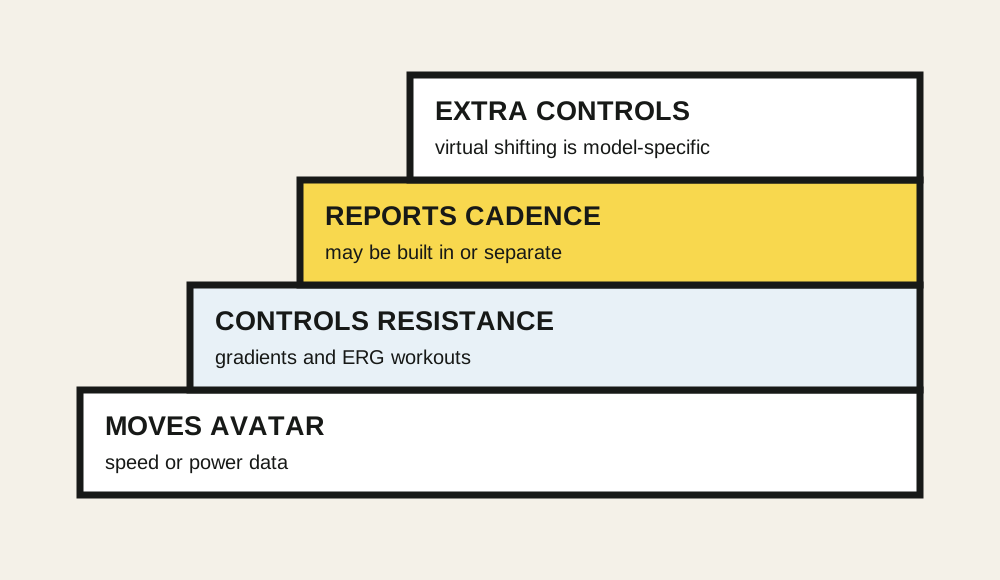
Start with the four pairing jobs
Zwift’s support guidance separates the connections clearly.
Power source or speed sensor
One of these is required to move in the game. A smart bike normally broadcasts calculated or measured power. A basic exercise bike may broadcast only speed, or nothing at all.
Resistance
A controllable device lets Zwift change resistance for simulated gradients and ERG workouts. ERG mode adjusts resistance to hold a workout target as cadence changes. If the bike appears only as a power source, hills may look steeper on screen while the pedals feel unchanged.
Cadence
Cadence is pedal revolutions per minute. Some bikes transmit it; others require a separate sensor. Missing cadence does not necessarily stop the avatar, but it removes useful training feedback.
Controls
Steering, buttons, and virtual shifting are extra capabilities with model and connection requirements. Zwift says virtual shifting requires supported hardware and a Wi-Fi or Bluetooth connection; ANT+ alone does not provide it.
Ask the seller for evidence, not a badge
For the exact model and production year, request:
- a screenshot or video of Zwift’s paired-devices screen;
- the tiles under which the bike appears;
- connection method: Bluetooth, Wi-Fi, ANT+, or a bridge app;
- firmware and companion-app requirements;
- whether power and cadence are native or estimated;
- whether resistance is controlled in free riding and ERG workouts;
- the supported phone, tablet, computer, or Apple TV configuration;
- whether another app must remain open during the ride.
“Bluetooth enabled” is not enough. Bluetooth can carry many kinds of data, and a phone connection used only by the maker’s app does not prove Zwift can use the bike directly.
Test the functions separately
Do not stop when the avatar moves. Run this short acceptance test:
- Pair the bike as the power source.
- Confirm watts rise smoothly when you pedal harder.
- Pair cadence and compare it with a counted 15-second sample.
- Pair resistance as a separate controllable device.
- Enter a route with a clear gradient change and confirm pedal resistance changes.
- Run a short ERG workout with two target-power steps.
- Stop pedalling, resume, and check reconnection.
- Wake the setup from a full power-off state and repeat.
This test distinguishes a working training system from a marketing claim. It also reveals whether one Bluetooth channel is being occupied by another phone or app.
Check whether the power data is useful
Two bikes can both send “power” while producing different numbers. Before using watts for structured training, look for a stated accuracy specification, calibration procedure, and independent testing for the exact model.
If no accuracy is published, treat the number as that bike’s internal scale. It may still support consistent easy, moderate, and hard sessions, but do not compare its FTP directly with a calibrated power meter or another machine.
For a household bike, repeatability can matter more than laboratory accuracy. Every rider should be able to reproduce saddle height and reach. Record adjustment markings and check the rider-height range, crank configuration, maximum user weight, and smallest usable resistance.
Price the missing pieces
A low-cost stationary bike may need:
- an external cadence sensor;
- a separate power meter;
- a Bluetooth bridge or ANT+ receiver;
- a device stand and fan;
- a tablet or computer capable of running Zwift;
- a paid subscription;
- an app or account just to update firmware.
Add those costs before comparing it with a smart trainer or fully supported smart bike. The smart trainer or exercise bike guide covers the wider space, noise, sharing, and fit decision. If you already own an outdoor bike, rollers, wheel-on, and direct-drive trainers may offer a clearer upgrade path.
Choose the right compatibility level
Basic fitness and virtual scenery
Power or supported speed data may be enough. Manual resistance is acceptable if you do not need realistic gradients or automatic workouts.
Structured workouts
Prioritise stable power, controllable resistance, ERG behaviour, cadence, and easy firmware support.
Racing or comparing data across bikes
Look for documented accuracy, calibration, reliable connectivity, and the rules of the event or platform. Do not assume an inexpensive bike’s displayed watts are interchangeable with another meter.
Several household riders
Prioritise adjustment range, quick repeatable settings, stability, user-weight limit, and simple account switching. A theoretically perfect protocol is no help if one rider cannot fit the bike.
Your next step
Make a four-row checklist: power/speed, controllable resistance, cadence, and controls. Put a verified answer and evidence link beside each row for the exact model. If the seller cannot demonstrate a feature, price the bike as if it does not have it.
Sources and further reading
- Zwift: connecting devices for cycling and what each pairing category does
- Zwift: compatible cycling hardware and recommended feature set
- r/cycling reader context: what a “Zwift-compatible” exercise bike actually controls and measures — used as a current buying signal; model claims in replies were not treated as specifications.