Smart trainer cannot reach target power: is it the gear or the trainer?
Separate an ERG-mode setup fault from a low-flywheel-speed resistance ceiling before replacing a smart trainer that will not hold a hard interval.
 Field guide / smart-trainer-cannot-reach-target-power
A smart trainer that reaches a hard interval only at an unusually high cadence may not be misreading your power. It may have reached the resistance it can create at that flywheel speed. Advertised maximum power is not always available in every physical gear and cadence combination.
The short answer: update and calibrate the trainer as its maker instructs, confirm it is paired as both the power source and controllable trainer, then repeat one short interval at a steady cadence. If the same target becomes available when the trainer’s flywheel spins faster, you have probably found a speed-dependent resistance limit. If gearing makes no difference, resistance slips, or reported power is implausible, stop and use the maker’s troubleshooting or warranty route.
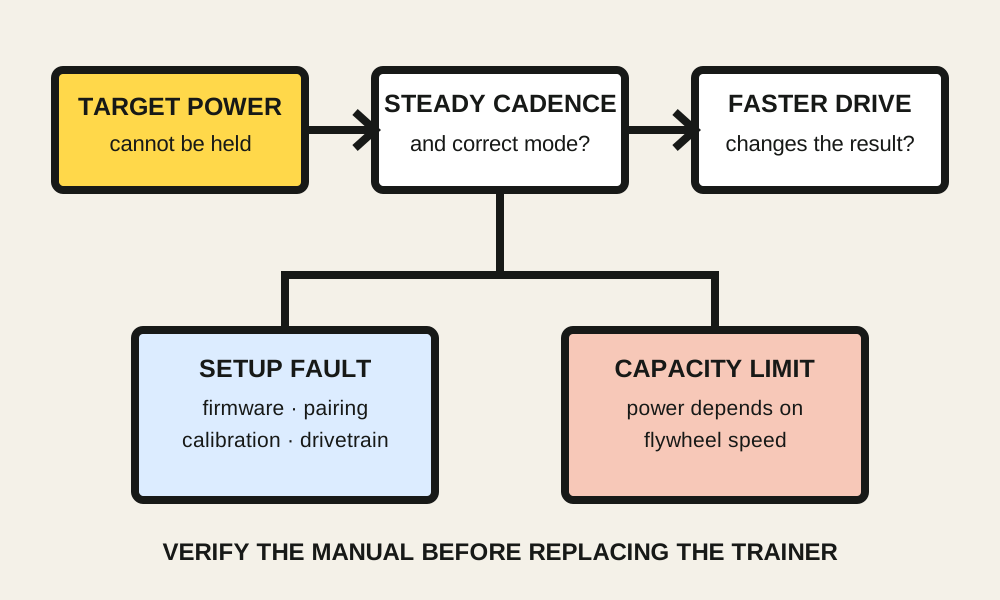
First identify the workout mode
In an ERG workout, the app requests a power target and the trainer changes resistance as cadence changes. Zwift’s current documentation says road gradient does not control resistance during an ERG interval. Riding a steeper virtual climb is therefore not a reliable solution to an ERG capacity problem.
Free ride, simulation, resistance, and FTP-test blocks can behave differently. In a free-ride block, you may need to shift and pedal harder to produce more power. Before diagnosing hardware, write down:
- the app and workout name;
- whether ERG was visibly enabled;
- target power and interval duration;
- cadence and physical chainring/cog or trainer cog;
- whether virtual shifting was active;
- which device supplied power and which controlled resistance.
Do not infer the mode from how the screen looked. Check the app’s mode indicator.
Why flywheel speed can matter
Power is the product of torque and rotational speed. A trainer must produce more resisting torque to hold the same power when its internal mechanism is turning slowly. Every trainer has physical limits, and a compact entry-level unit may reach one before its advertised peak wattage when used at low flywheel speed.
That is why two statements can both be true: ERG normally compensates for cadence, and a particular trainer may still fail to reach a high target in a slow physical gear. Decathlon rates the Van Rysel D100 at up to 600 W and explains that ERG changes resistance with cadence; those numbers do not promise 600 W at every cadence and drive speed.
Do not turn a Reddit reply into a specification for your trainer. Use the exact maker’s performance information, firmware notes, and support answer for your serialised product.
Run a controlled five-part check
Use a short test, not a maximal workout.
- Update first. Install current trainer firmware and the current training app. Restart both devices.
- Calibrate only when required. Follow the maker’s warm-up and calibration process. Some trainers need regular calibration; some self-calibrate; an unnecessary third-party spindown can be wrong.
- Pair deliberately. Select the intended trainer as the controllable device and the intended meter as the power source. Disconnect other apps and computers that may also control it.
- Hold one achievable target. Choose a power you can sustain safely for two or three minutes and maintain a normal, steady cadence. Avoid sprinting into the interval.
- Change one drive-speed variable. After recovery, repeat the same target and cadence using the maker-approved physical gearing that spins the trainer faster. With a cassette trainer this often means a larger chainring and smaller rear sprocket, but use the trainer’s instructions and keep the chain line sensible.
If the target becomes stable only at the faster drive speed, record both combinations. You now have useful evidence for support and for choosing future workouts.
Do not “solve” ERG problems by shifting constantly
Zwift generally advises holding a steady cadence and not changing gears in ERG mode. Shifting can make the trainer chase two changes at once and can turn a simple capacity test into noise.
The exception is a deliberate diagnostic where the physical gearing may be outside the trainer’s usable range, or a maker specifically instructs a gear change for that model. Make one change between repeated test blocks, not a sequence of shifts during the interval.
Also distinguish a resistance ceiling from the ERG “spiral of death.” At too low a cadence, ERG increases resistance to preserve target power; cadence then falls further until pedalling becomes extremely hard. Zwift recommends entering a high-power interval with cadence already established. A trainer that cannot create enough resistance is the opposite sensation: cadence rises or the rider runs out of gear while power remains below target.
Check the drivetrain and installation
An apparent resistance limit can be mechanical.
- A worn chain on a different cassette may skip under load.
- A loose cassette or wrong spacer can move rather than transmit force cleanly.
- Poor indexing can make a chosen high gear noisy or unusable.
- Wrong axle adapters can let the bicycle move on the trainer.
- An internal belt fault can feel like smooth power suddenly gives way.
Decathlon’s D100 support page says a slipping sensation during sharp acceleration can indicate a slack internal belt and directs the owner to customer service. Do not keep producing hard efforts to “wear it in.”
If a bike power meter and trainer agree at easy and moderate power but separate only near the same drive-speed boundary, save the dual recording. Agreement at one workload does not prove the resistance unit can control every higher workload.
Decide whether the trainer suits the job
A trainer can be working as designed and still be the wrong tool for your workouts. Compare your required sustained intervals and sprints with:
- maximum power and the conditions attached to it;
- maximum simulated gradient;
- accuracy range;
- supported cadence and virtual-shifting behaviour;
- resistance response time;
- cooling and duration limits;
- warranty and repair support.
Leave headroom. A workout target close to a trainer’s boundary gives the control system little room for cadence changes. If repeated, maker-approved tests show the trainer cannot deliver your normal sessions, use the repairable smart-trainer checklist before upgrading. A bigger headline wattage is useful only if the manufacturer documents the operating range and supports the product.
Your next step
Build a two-block test workout and record mode, target, cadence, physical gear, firmware version, and result. If faster flywheel speed fixes the interval, train within the documented range or ask the maker to confirm it. If it does not, stop guessing and send the evidence to support while the warranty is active.
Sources and further reading
- Decathlon: Van Rysel D100 setup, ERG behaviour, calibration, and troubleshooting
- Decathlon: D100 stated 600 W and 6% specifications
- Zwift: ERG mode behaviour and resistance floor
- Zwift: ERG mode troubleshooting
- r/cycling reader context: a trainer reaching a hard target only at very high cadence — used as a current demand signal; replies were not treated as the product specification.