Replaceable vs riveted bike chainrings: which crankset should you buy?
Identify bolted, direct-mount, and non-replaceable chainrings, then compare compatibility, replacement cost, gearing, and realistic service life before buying a crankset.
 Field guide / replaceable-vs-riveted-bike-chainrings
Before you view or pay
Check fit, condition, and starter gear first
Use the buying checklist to choose the right path: used-bike viewing, first-bike fit and type, hidden repair costs, or starter gear.
Replaceable chainrings are useful when you expect to keep the crankset for years, want to change gearing, or can confirm that compatible rings will remain available. A less expensive crankset with riveted or permanently attached rings can still be sensible on a utility bike when the complete replacement is affordable and the existing gearing works.
The short answer: visible chainring bolts suggest replaceable rings, but bolt count and diameter are not enough. Match the crank model, mounting interface, bolt-circle diameter where relevant, ring position, tooth combination, chain speed, shifting features, chainline and frame clearance. Compare the price of the rings you will actually need with the price and labour of a complete compatible crankset.
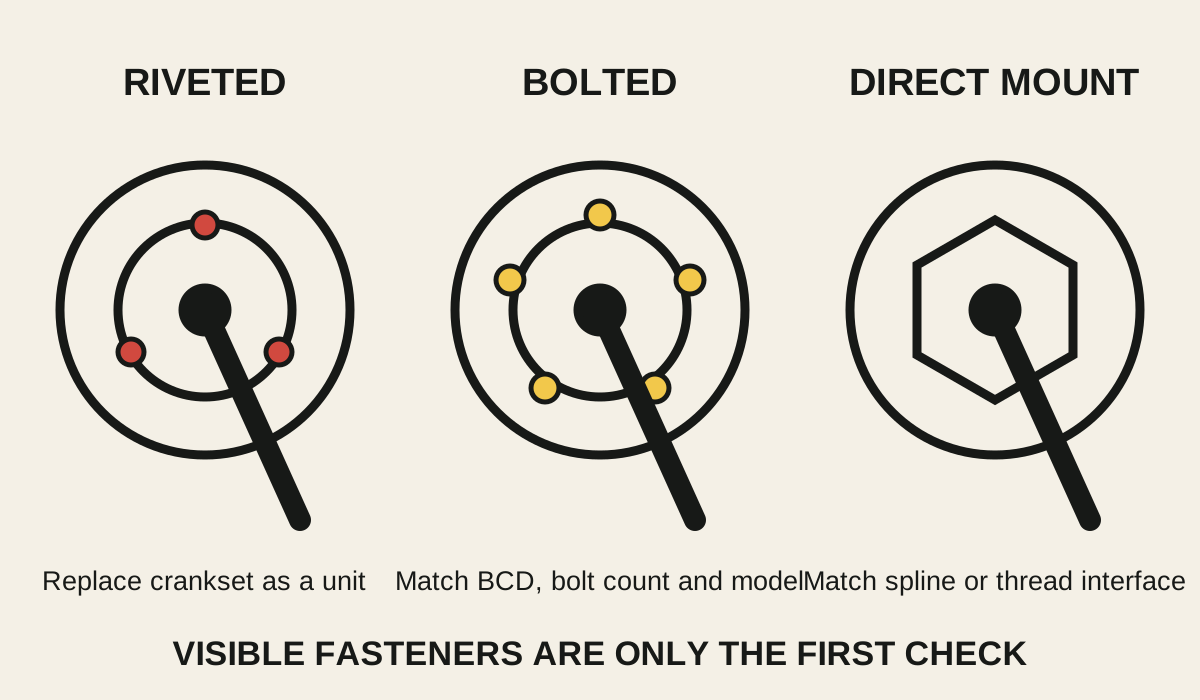
Tell the three common systems apart
Riveted or permanently attached rings
Entry-level multi-ring cranksets often join the rings with smooth factory rivets or stakes rather than removable chainring bolts. If the teeth wear out, the intended service part is usually the complete crankset. Do not drill out the rivets and improvise bolts; the assembly was not designed or tested as a modular spider.
Check the manufacturer’s exploded diagram before declaring a ring non-replaceable. A fixing can be hidden on the back, and some one-piece-looking road systems use a proprietary direct-mount interface.
Bolted chainrings on a spider
Traditional replaceable rings attach to a spider with chainring bolts. Record:
- the exact crank model;
- number and position of bolts;
- bolt-circle diameter (BCD), including asymmetric patterns;
- inner or outer ring position;
- tooth count and approved ring combination;
- chain speed and front-shifting design; and
- chainline, offset and frame clearance.
Two rings can share a nominal BCD yet place ramps, pins, countersinks or asymmetric bolt holes differently. On a two-ring road crank, the inner and outer rings are designed as a shifting pair. Changing one tooth count without checking the approved combination can make front shifting unreliable.
Direct-mount or integrated ring/spider systems
Some modern rings attach directly to the crank with splines, threads or a multi-bolt interface; others combine the ring, spider and power meter. SRAM’s own service documents show that interface and product family matter, and that some direct-mount power-meter chainrings require replacement of the complete ring/power-meter/spider assembly.
Do not use “direct mount” as a compatibility specification. Confirm the exact spline or thread design, offset, chainline, tooth profile and retaining procedure.
When replaceable rings are worth paying for
Choose a serviceable crank when at least one of these is true:
- you ride enough to expect multiple chainring service cycles;
- replacement rings for the exact model are readily available at a sensible price;
- you want an approved alternate gearing combination;
- the crank arms, spindle or power meter are worth retaining; or
- replacing the complete crank would also force a bottom-bracket or chainline change.
The benefit is future choice, not guaranteed savings. Premium outer chainrings can cost nearly as much as an entry-level complete crank. Labour also matters: a complete crank replacement may need bottom-bracket compatibility checks and front-derailleur setup, while a ring swap may involve awkward hidden hardware and a specified tightening sequence.
When a non-replaceable crank is rational
A riveted crankset can be a good value when the bike is a dependable commuter or backup, the current ratios suit the terrain, and an exact complete replacement is inexpensive. Chainrings usually outlast several chains when the drivetrain is kept clean and chains are replaced before severe elongation.
The decision becomes weaker when the complete crank is obscure, the bottom-bracket interface is disappearing, or replacing it later would require several linked parts. Before buying, verify that a compatible crank and bottom bracket exist—not merely that the advertised crank length and tooth counts look similar.
Use the crankset compatibility checklist for spindle, bottom bracket, chainline and frame clearance.
Price the real replacement path
Make two complete totals.
Serviceable option:
- crankset purchase;
- likely replacement ring or matched pair;
- model-specific bolts or hardware;
- installation labour and tools; and
- any front-derailleur adjustment.
Unit-replacement option:
- complete future crankset;
- bottom bracket if the interface changes;
- chain if wear or ring size requires it;
- labour and setup; and
- availability risk for the intended bike life.
Do not assume the smallest ring will wear least or the ring you use most will always fail first. Contamination, chain wear, shifting under load and tooth design affect wear. Replace based on inspection and performance, using the chainring replacement guide, not a guessed kilometre interval.
Check compatibility before ordering
- Read the full model code from the back of the crank arm or spider.
- Find the maker’s exploded view and compatible spare-part table.
- Confirm whether rings are sold separately and as singles or matched sets.
- Verify speed, tooth combination, chainline and front-derailleur capacity.
- Confirm the bottom-bracket and spindle interface for any complete-crank alternative.
- Check crank length, pedal thread, Q-factor where relevant, and chainstay clearance.
- Price the complete job, including tools and labour.
If the crank is unmarked or documentation is missing, take clear photographs and measurements to a bike shop. “Same number of bolts” is not a safe purchase rule.
Your next step
Write down the current crank’s exact model and locate its parts diagram. If compatible rings are available and the long-term total makes sense, buy serviceability. If the bike’s job is simple and a complete, documented replacement costs less, riveted rings are not automatically a false economy.
Sources and further reading
- Shimano: current road crankset dealer manual and chainring procedures
- SRAM: X-SYNC road direct-mount chainring service documents
- SRAM/Quarq: power-meter and chainring replacement requirements
- r/cycling discussion: replaceable rings versus a lower-cost complete crankset — used as an editorial demand signal, not as a compatibility source.