JIS vs ISO 1-inch headset: measure before buying parts
JIS and ISO/European one-inch headsets can share a steerer size and thread yet use different cup and crown-race press fits.
 Field guide / jis-vs-iso-one-inch-threaded-headset
JIS and ISO/European one-inch headsets can both use a 25.4 mm steerer and 24-threads-per-inch threaded top, yet their frame cups and fork crown races are not the same press fit. Ordering by “one-inch threaded” alone can leave you with parts that are loose, impossible to press safely, or mixed into an unreliable stack.
The short answer: identify the complete interface. A conventional JIS system is commonly coded EC29 and uses a 30.0 mm cup outside diameter with a 27.0 mm crown-race inside diameter. The common ISO/European EC30 system uses a 30.2 mm cup and 26.4 mm crown-race ID. Measure the frame bore and fork crown seat, then buy a documented matching headset.
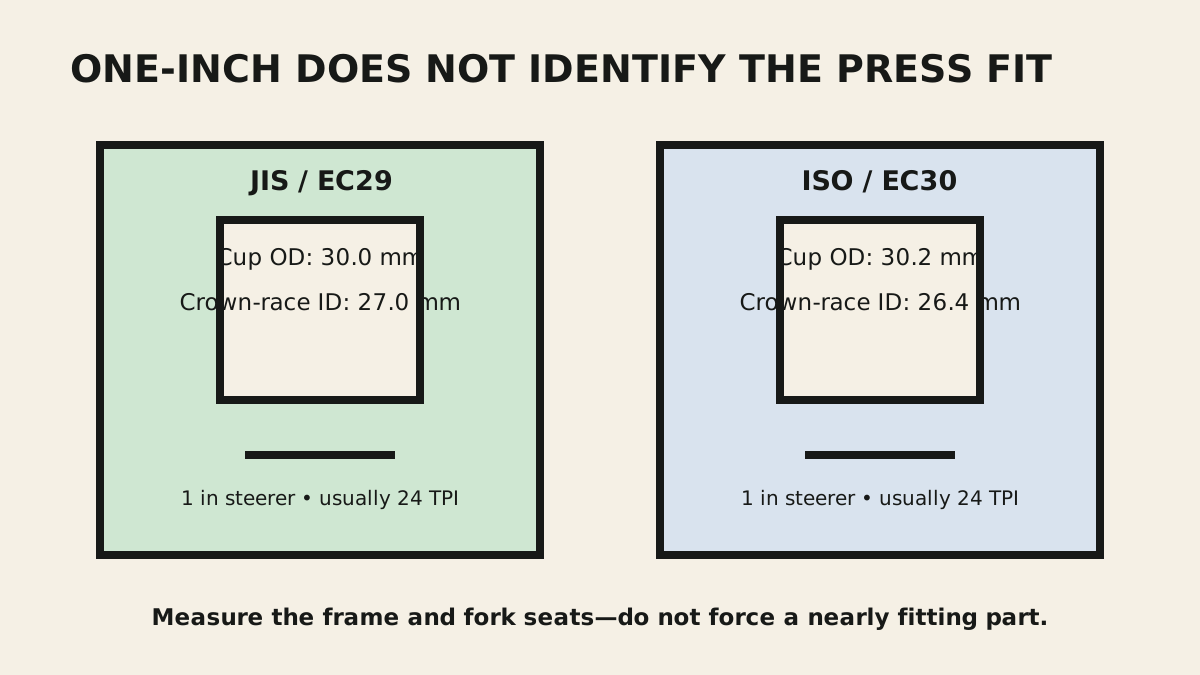
The dimensions that matter
For the two common conventional systems, Park Tool’s standards tables list:
| Interface | JIS / EC29 | ISO or European / EC30 |
|---|---|---|
| Steerer outside diameter | 25.4 mm | 25.4 mm |
| Common threaded steerer | 24 TPI | 24 TPI |
| Headset cup outside diameter | 30.0 mm | 30.2 mm |
| Typical frame bore range | 29.8–29.9 mm | 30.0–30.1 mm |
| Crown-race inside diameter | 27.0 mm | 26.4 mm |
| Fork crown-seat range | about 27.1–27.2 mm | about 26.5–26.7 mm |
These are precision fits, not nominal decoration. Two-tenths of a millimetre at the cup and six-tenths at the crown race are large differences for pressed bicycle parts.
Some French, BMX, integrated, zero-stack, and proprietary systems add more possibilities. Do not use this two-column table to identify every old bicycle.
Why the locknut does not identify the lower parts
The visible threaded locknut may screw onto both common 1-inch, 24 TPI steerers. That only describes the thread it touches. It does not prove the cup size in the head tube, the crown seat on the fork, stack height, bearing angle, or seal arrangement.
Brand and country of manufacture are clues, not measurements. Parts may have been replaced during the bike’s life, and frames and forks can be mixed. Treat “Japanese bike means JIS” and “European bike means ISO” as hypotheses to verify.
Measure without creating a false result
If the headset is still assembled and safe enough to handle, first photograph every spacer, washer, keyed tab, cable stop, seal, and bearing orientation. Record visible markings before cleaning removes useful evidence.
For a reliable identification, a workshop may measure:
- the head-tube bore after the cups are correctly removed;
- the cup outside diameter at clean, undamaged areas;
- the fork crown-seat outside diameter after the race is removed; and
- the crown-race inside diameter.
Paint, corrosion, burrs, ovality, plated surfaces, worn caliper jaws, and measuring at an angle can move a reading. A cheap ruler cannot distinguish these systems. Repeat measurements around the part and compare with the headset maker’s drawing.
Do not drive cups or a crown race out with a screwdriver if you are trying to preserve a thin old frame or fork. Use the correct removal and support tools, or have a shop do the identification.
Do not force the close-looking option
An oversized cup forced into a smaller bore can damage or split the head tube. An undersized cup may move under steering and braking loads. A too-small crown race may not seat; a too-large race may remain loose. Adhesive, centre punches, shims, filing, or extreme tightening do not turn a wrong press fit into the right standard.
Park Tool notes that a JIS frame and fork can sometimes be professionally machined to the European standard because material is removed from the frame bore and crown seat. The reverse is not the same operation. This is precision frame and fork preparation, not a beginner workaround, and suitability depends on the actual components and remaining material.
Buy the complete headset, not a visual match
Once the system is identified, compare:
- upper and lower SHIS codes or complete dimension drawing;
- threaded steerer size and pitch;
- crown-race seat and cup fits;
- stack height available above the head tube;
- bearing type and contact angle;
- locknut, keyed washer, spacers, and cable hanger needs; and
- tool and preparation requirements.
If replacing only bearings or one race, confirm that the contact surfaces are designed to work together. Similar-looking loose balls, retainers, races, and cups are not automatically a set.
After assembly, the steering should turn smoothly without play, binding, cable tension, or roughness. Recheck after the initial rides according to the component instructions. The loose-headset guide explains why tightening the top locknut without correct adjustment can create a different fault.
Your next step
Write down four measurements—cup OD, frame bore, crown-race ID, and fork crown-seat OD—plus the steerer thread and every marking. Convert that record into a complete SHIS or manufacturer specification before ordering.
Sources and further reading
- Park Tool: Standardized Headset Identification System
- Park Tool: headset standards and press-fit ranges
- Park Tool: one-inch JIS and European service dimensions and conversion cautions
- r/FixedGearBicycle discussion: identifying a one-inch headset while distinguishing JIS and ISO fits — used as an editorial demand signal, not as measurement evidence.