Hybrid or mountain bike for paved paths and light gravel?
Choose between a hybrid and hardtail mountain bike by surface, route share, tyre clearance, suspension quality, gearing, cargo needs, and test-ride evidence.
 Field guide / hybrid-or-mountain-bike-paved-paths-light-gravel
Before you view or pay
Check fit, condition, and starter gear first
Use the buying checklist to choose the right path: used-bike viewing, first-bike fit and type, hidden repair costs, or starter gear.
For mostly paved roads, cycle paths, and firm light gravel, a rigid hybrid with suitable tyre clearance is usually the simpler, faster choice. Choose a hardtail mountain bike when rough, loose, steep, or technical off-road riding is a real part of the plan—not merely something the bike shop says you might try one day.
The short answer: buy for the surface you will ride most often and the hardest surface you genuinely expect each month. A hybrid suits routine pavement and smooth gravel with less weight and drivetrain loss. A hardtail adds tyre volume, low gearing, stability, and front suspension for rougher terrain, at the cost of road efficiency and extra maintenance.
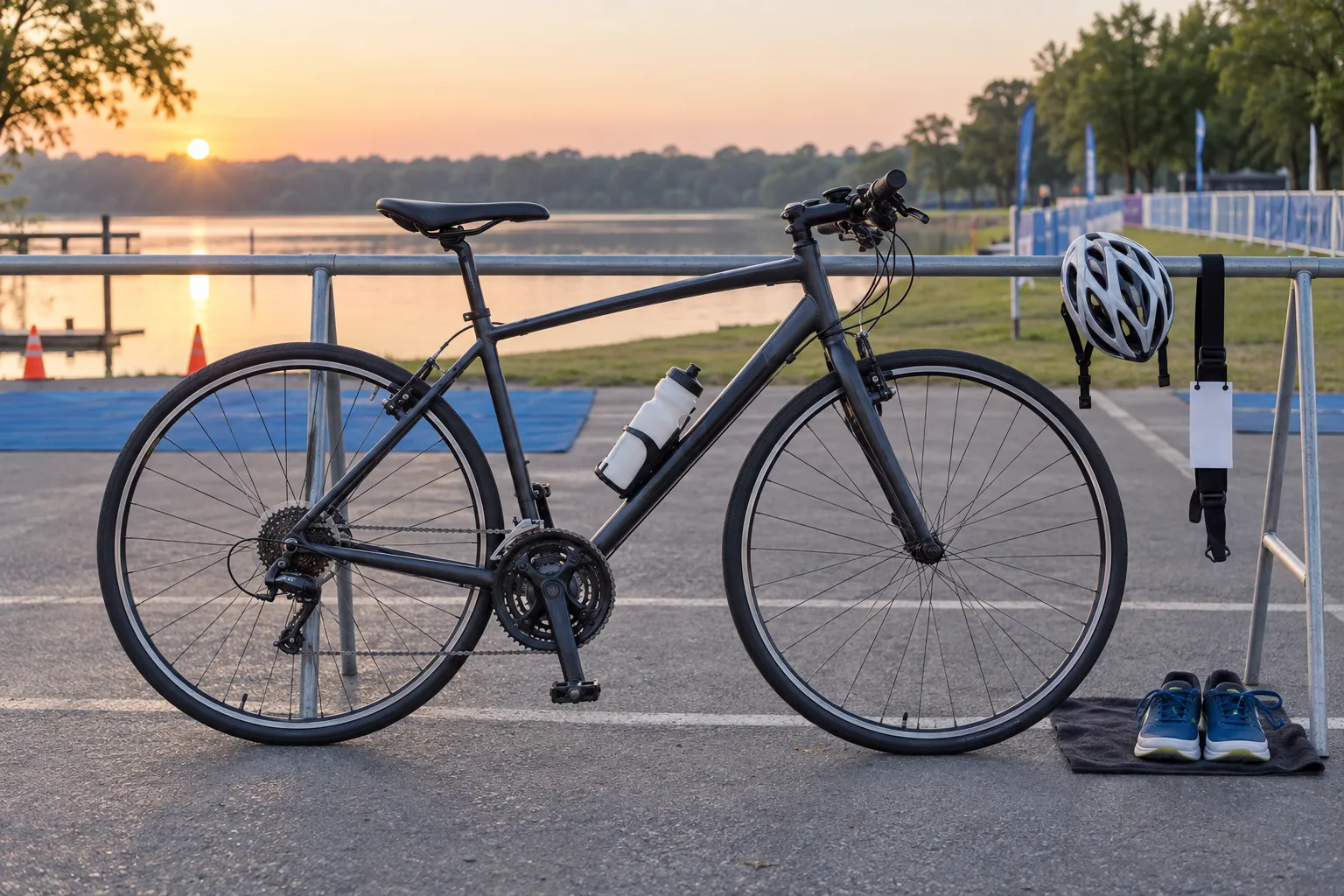
Describe the route in percentages and consequences
A detailed Reddit question about a rider expecting mostly pavement and firm gravel while a shop recommended a mountain bike illustrates the missing information in many first-bike decisions: “mixed use” could mean a smooth canal path or a rocky descent. The personal recommendations in that thread are not universal product advice.
Write down:
- the percentage of weekly time on pavement, firm gravel, loose gravel, and trail;
- potholes, roots, rocks, mud, kerbs, and gradients;
- whether you must carry shopping, work equipment, or a child seat;
- typical ride duration;
- whether you will ride in traffic, on shared paths, or on remote trails; and
- the nearest realistic route—not the fantasy route from a product video.
Then identify the consequence of under-biking. Walking a 200-metre rough patch is a small consequence. Losing control on a rocky descent is not. Buy enough bike for the real safety margin, without burdening every paved ride for a trail you may never visit.
What a hybrid does well
A hybrid usually combines flat bars, a relatively upright position, 700C wheels, mid-width tyres, road-friendly gearing, and fittings for racks or mudguards. Variants differ widely: some are fast fitness bikes with narrow tyres, while others accept wide tyres and resemble rigid mountain bikes.
A hybrid is the stronger default when:
- most riding is paved;
- gravel is firm, graded, and non-technical;
- commuting or errands matter;
- rack and mudguard mounts are useful;
- low weight and easy acceleration matter more than descending rough trails; and
- you want fewer suspension parts to buy and maintain.
Cycling UK describes hybrids as general-purpose bikes that can handle tarmac and firm tracks, while mountain bikes are designed around rough off-road use. That category guidance is useful, but the exact model’s tyres, clearance, brakes, gearing, and fit still decide what it can do.
What a hardtail mountain bike does well
A hardtail mountain bike has a suspension fork but no rear shock. It commonly adds wide tyres, lower gearing, wide bars, strong brakes, and geometry intended to remain stable on rough ground.
Choose it when:
- rough forest tracks or trails are regular, not hypothetical;
- surfaces are loose, rocky, rooted, rutted, or steep;
- traction and control at low speed matter more than pavement pace;
- you want to develop mountain-bike skills; or
- the additional tyre volume and fork travel create meaningful control and comfort on your routes.
The fork must be appropriate and functional. A very cheap, heavy suspension fork can add weight and maintenance without controlling bumps well. A rigid bike with larger correctly pressured tyres may feel better on broken pavement and firm gravel than a poor suspension fork.
Compare the complete systems
Do not compare only category names.
| Question | Hybrid advantage | Hardtail advantage |
|---|---|---|
| Mostly pavement | Usually lighter and quicker-feeling | Works, but tyres and position may feel slower |
| Firm gravel | Suitable with adequate tyres and clearance | More margin than necessary for many routes |
| Rough trail | Can reach its limits quickly | Designed for greater control and impact margin |
| Cargo and mudguards | Mounts are common | Mounts vary; check exact frame |
| Very low climbing gears | Varies by model | Common |
| Maintenance | Rigid fork is simple | Suspension adds inspection and service |
| Tyre choice | Efficient road-to-gravel range | High-volume off-road range |
Efficiency is not moral superiority. If a mountain bike makes rough routes accessible and enjoyable, some extra road effort may be a fair trade. If every ride is a 30-minute paved loop, the trade may become a reason not to ride.
Tyres may decide more than suspension
Check the exact fitted width and manufacturer-approved maximum width. Wider tyres at suitable pressure can improve grip and comfort on rough surfaces, but frame, fork, rim, brake, and mudguard clearance all matter.
Do not fit the widest tyre that barely rotates in a clean workshop. Leave the clearance required by the manufacturer for wheel flex, debris, and mud. Choose tread for the surface: a supple road or all-road tyre can roll efficiently on pavement; larger knobs help loose ground but add noise and vibration on tarmac.
The maximum pressure printed on a tyre is not a target. Use the tyre, rim, and bicycle limits and a sensible pressure for total load and surface. Read why maximum tyre pressure is not a target before the test ride.
Test the controls, not just the saddle
Ask to ride both bikes over representative pavement and, where permitted, a short rough section. During the test:
- start and stop several times;
- shift into the easiest gear on a climb;
- brake progressively from both levers;
- ride slowly around a tight turn;
- pass over a rough patch seated and standing;
- check whether wrists, shoulders, and hands stay relaxed; and
- confirm the fitted size leaves a workable position.
Do not let an incorrectly adjusted saddle decide the category. Ask the shop to set basic saddle height and brake-lever reach on both bikes before comparing.
Buy for the 80 percent, rent for the experiment
If nearly all routine riding is paved and light gravel, choose the bike that serves that 80–90 percent well. Rent or borrow a suitable mountain bike for a first trail-centre visit. That is cheaper and safer than compromising every regular ride for an untested interest.
If you discover that technical off-road riding is the part you love, you will make the later purchase with real evidence about terrain, fit, wheel size, suspension, and handling.
Avoid four buying traps
- The shop-stock trap: the best bike in the room is not necessarily the best bike for your route.
- The future-proof trap: more suspension does not guarantee more useful versatility.
- The skinny-tyre assumption: many current hybrids accept capable tyre widths; check, do not guess.
- The category shortcut: two hybrids can differ more than one hybrid and one rigid mountain bike.
Compare the exact geometry, tyre clearance, gearing, mounts, weight, warranty, and service plan. Put each candidate through the road-bike buying checklist even if it is not a road bike; the fit, condition, test-ride, budget, and support checks still apply.
Your next step
Map your three most likely routes and label every surface. If at least four out of five riding hours are pavement or firm paths, test a rigid hybrid with adequate tyre clearance first. If rough, loose, or technical trail is a routine destination, test a properly sized hardtail on representative ground before paying.
Sources and further reading
- Cycling UK: which bike should I buy?
- Cycling UK: where a hybrid stops and a mountain bike becomes appropriate
- r/whichbike reader context: hybrid versus mountain bike for pavement and firm gravel
Reddit was used to identify the route-choice question. The rider’s circumstances and commenters’ brand preferences were not treated as universal evidence.