How to turn off a shared-use path safely
Use observation, an early signal, predictable positioning, speed control, and a stop-and-cross fallback when turning across or off a busy cycle path.
 Field guide / how-to-turn-off-shared-use-path-safely
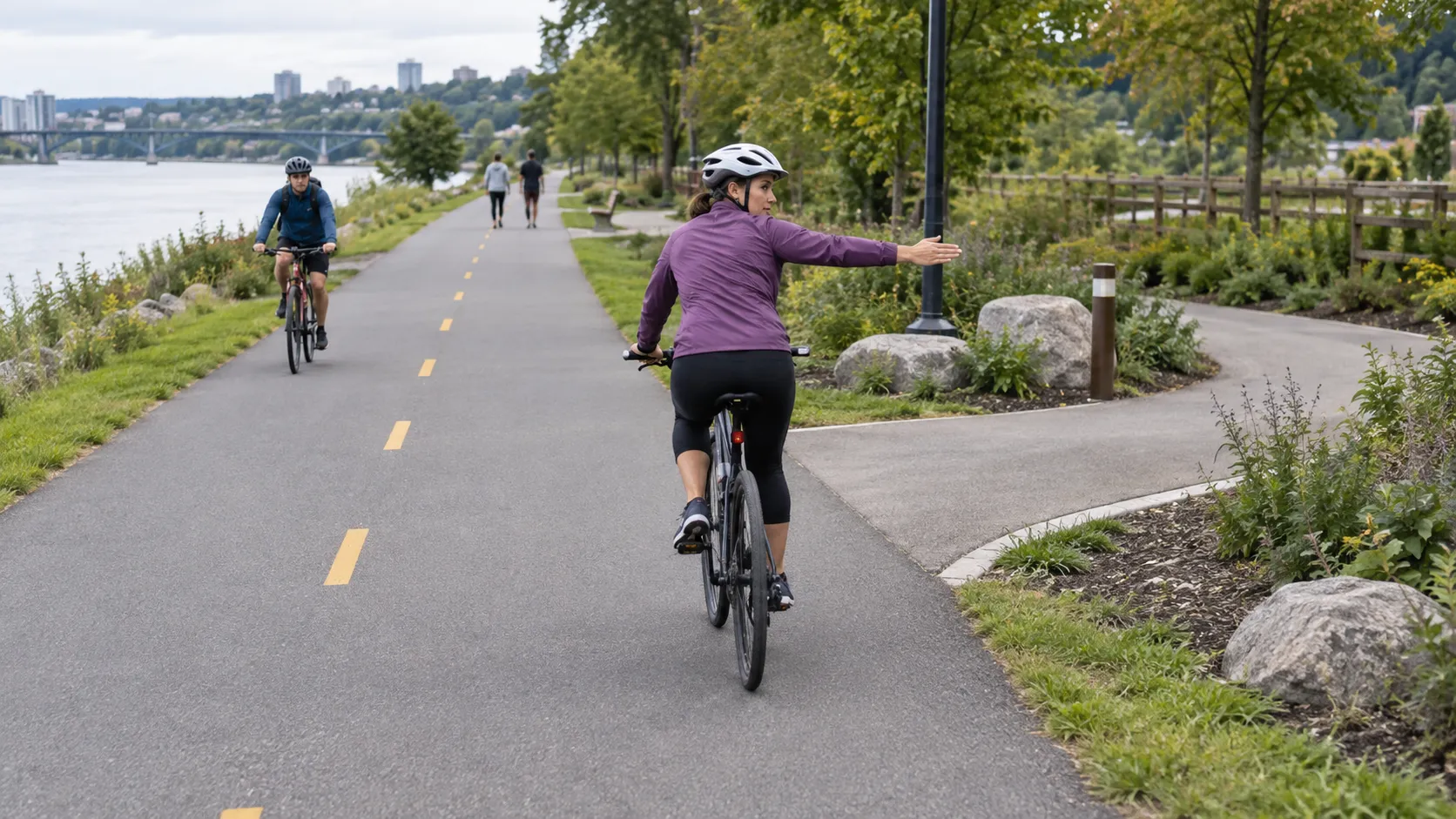
Turning off a shared-use path is a small manoeuvre with traffic in several directions: faster riders may approach from behind, people may come toward you, and pedestrians may cross the exit. The safe routine is to look, signal early, control your speed, look again, and turn only when the space is clear.
The short answer: keep a straight line while checking behind, signal without swerving, move only when it is safe under local rules, and cancel the turn if someone is already overtaking. If the path is too busy or the turn feels complicated, pull completely out of the traffic line, stop, and cross in stages.
Why this manoeuvre causes confusion
In a recent r/cycling discussion, a new rider asked about signalling a turn while a faster group approached from behind. Another rider described a near collision while turning across a multi-use path with a child.
Comments disagreed about blame and etiquette. That disagreement is exactly why a repeatable safety routine matters. Reddit anecdotes cannot establish the law, timing, visibility, or full facts of an incident.
Official UK cycle-training standards provide a useful general sequence: look behind for following traffic, signal when necessary, and perform the manoeuvre only after observation. They also state that pedestrians have priority on shared-use paths. Your local rules may differ, so treat this as a riding method—not universal legal advice.
Use look, signal, look, move
1. Identify the turn early
Notice whether you are turning toward the near side of the path or crossing another stream of users. Scan the exit for pedestrians, bollards, gravel, kerbs, dogs, and riders entering the path.
Do not wait until the junction is beside your front wheel. Early planning gives you time to slow gradually rather than braking while turning.
2. Check behind without drifting
Hold a predictable line and glance over the relevant shoulder. You need to know whether someone is already overtaking or approaching too quickly for a safe line change.
If looking back makes you swerve, practise on an empty space first with the look-behind-without-swerving drill. A mirror can add information, but it does not remove the need to understand the blind area beside you.
3. Signal clearly and early
Use the hand signal required or recognised where you ride. Extend the arm clearly while you still have enough straight path to be seen. Keep the other hand controlling the handlebar and brake.
A signal is communication, not a reservation. If the surface is rough, steering is unstable, or braking demands both hands, return your hand to the bar and prioritise control.
4. Look again
Conditions change between the first glance and the turn. Check behind and ahead again. A faster rider may have committed to passing; an oncoming child may change line; a pedestrian may step into the exit.
If the gap has disappeared, continue straight or slow to a controlled stop in a safe place. Missing the turn is cheaper than forcing it.
5. Turn at a controllable speed
Finish most braking before you lean. Cross painted lines, wet leaves, gravel, or raised edges as upright as practical. Give pedestrians and oncoming users the priority required locally and enough space to behave unpredictably.
If someone starts overtaking
Do not race them to the junction or turn across their wheel. Hold your line, cancel the turn, and let the immediate conflict clear. You can be legally or morally in the right and still be the person who falls.
The overtaking rider also carries responsibility to observe, communicate, and pass only with safe space. But you cannot control their judgment from your handlebars. Build an escape option into the manoeuvre.
If a bell or “passing” call arrives after you have signalled, do not jerk sideways. Stay predictable, reassess, and turn only after you know where the other rider is.
When to stop and cross in stages
A dismounted or two-stage turn is often the calmest option when:
- the path is busy in both directions;
- you are riding with a child or inexperienced rider;
- sight lines are blocked;
- the exit crosses pedestrians or another path at an awkward angle;
- surface edges, bollards, or kerbs reduce control;
- you cannot look behind without wobbling;
- local design or signs direct you to use a crossing.
Move fully out of the path’s travel line before stopping. Do not pause in the centre to decide. Once stopped, check every direction and walk across where legal and appropriate.
Riding with another beginner or child
Explain the turn before reaching it. Agree on a simple call such as “slow,” “stop,” or “straight on.” The leader should not begin crossing while the following rider is still processing the instruction.
On a busy path, stop together in a safe area and cross as a small group. Do not assume a hand signal from the front rider is visible to everyone behind.
What faster riders should do
Approach junctions and slower users at a speed that leaves a stopping option. Look for shoulder checks, signals, changes in cadence, and path geometry. A bell or voice is useful information, not permission to squeeze through a closing gap.
Avoid beginning a pass at a junction or path exit. Leave enough lateral space that a wobble does not become a collision. On shared paths, adapt speed to pedestrians, dogs, children, mobility devices, and limited sight lines. Read the broader shared-use path riding guide.
Your next step
Practise the sequence on a quiet path: identify, look, signal, look again, then turn. Repeat it in both directions and rehearse the fallback of continuing straight. Before using it in traffic, check your local path rules, priority rules, and recognised hand signals.
Sources and further reading
- UK Department for Transport: National Standard for Cycle Training
- Transport for London: cycling safety and turning guidance
- Transport Victoria: using shared paths
- r/cycling reader context: turning while riders approach from behind
- r/cycling reader context: multi-use path turning and passing conflict