How to buy used road-bike parts without buying twice
Check compatibility, wear, crash history, missing hardware, service cost, and current replacement price before buying used road-bike components.
 Field guide / how-to-buy-used-road-bike-parts
A used component is good value only when it is compatible, measurably serviceable, complete, and still cheaper after installation. A low asking price cannot rescue a worn cassette, a bent derailleur, an unknown carbon handlebar, or a bargain wheel that needs an unavailable freehub.
The short answer: identify the exact model first, verify every interface, inspect the wear and damage that matters for that part, add missing hardware and labour, then compare the total with a current new alternative. If the seller cannot provide enough information to make those checks, walk away.
Why used-part prices are difficult
A highly active recent r/cycling thread complained that years-old parts were being listed close to current retail prices. The frustration is understandable, but “percentage off original price” is still the wrong test.
Original retail may describe a market that no longer exists. Compare the listing with:
- the current price of an equivalent compatible part;
- completed sales, not only ambitious active listings;
- remaining wear life;
- included bolts, spacers, adapters, batteries, chargers, and manuals;
- installation tools and labour;
- your ability to return it if the description is wrong.
The seller’s sunk cost does not determine your value.
Verify compatibility before condition
Ask for a photograph of the model code and write down every interface. Depending on the part, that may include:
- drivetrain speed and shift family;
- cable pull or electronic generation;
- cassette range and derailleur capacity;
- freehub type;
- axle diameter, length, and thread pitch;
- hub spacing and brake mount;
- rotor diameter and pad compound;
- handlebar, stem, steerer, seatpost, and saddle-rail dimensions;
- wheel diameter, internal rim width, tyre type, and frame clearance.
“Shimano 11-speed” or “fits most road bikes” is not a compatibility specification. Search the exact model in the maker’s technical documents and compare it with the model already on your bike. For wheels, use the replacement-wheel compatibility checklist.
Treat consumables as wear, not treasure
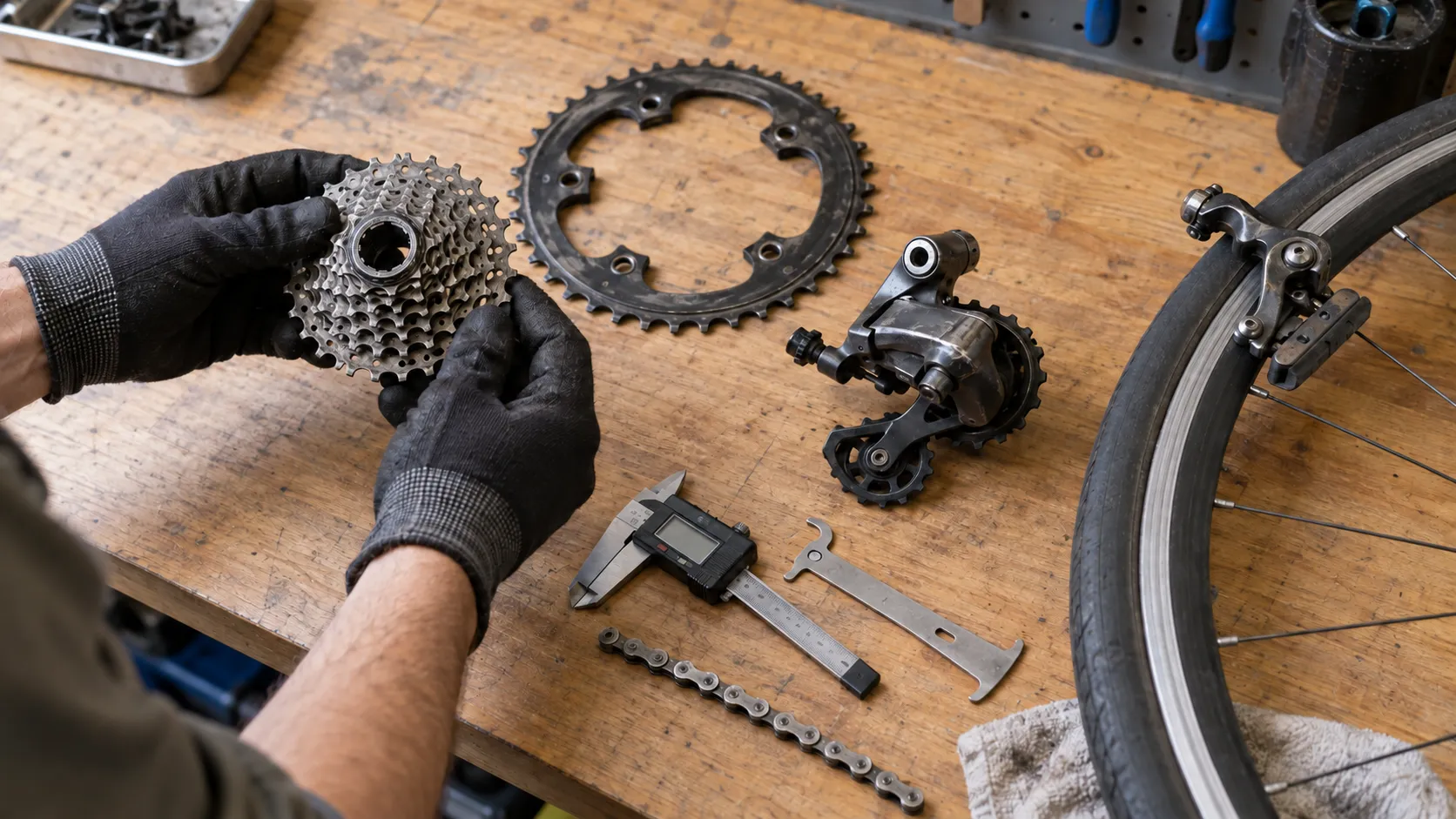
Chains, cassettes, chainrings, brake pads, rotors, tyres, bearings, cables, and bar tape lose usable life. A clean photograph does not show how much.
SRAM’s maintenance guidance notes that cassette wear has no simple standalone gauge; skipping under load with a new chain is one useful sign that replacement is due. That makes a loose used cassette hard to prove. Unless the seller can document low use and the price leaves room for failure, a new cassette is often the cleaner purchase.
For a used drivetrain:
- measure the chain with the approved gauge for that system;
- inspect teeth for hooked or uneven wear;
- look for corrosion, bent links, damaged shift ramps, and loose rivets;
- ask whether a new chain ran without skipping;
- assume cleaning does not restore worn metal.
Read whether to replace the chain or cassette before buying a mixed-wear combination.
Inspect moving parts under load
A rear derailleur should have straight cage plates, free pivots, smooth pulleys, sound threads, and no visible impact damage. A wheel should turn smoothly, hold lateral and radial truth, maintain spoke tension, and have a serviceable braking surface or rotor mount.
Video helps, but local inspection is better. Ask to see the part installed and functioning when practical. A derailleur that shifts on the seller’s bike proves more than a loose part rotated by hand—though it still does not prove compatibility with yours.
Do not let “it just needs adjustment” end the inspection. Bent hangers, worn freehubs, cracked rims, and damaged threads are routinely misdescribed as adjustment.
Be conservative with hidden structural damage
Impact damage can be hard to assess in forks, handlebars, stems, seatposts, cranks, and wheels, especially in carbon fibre. Ask directly about crashes, transport damage, over-tightening, slipping, creaking, and repairs. Inspect in strong light and follow the component maker’s limits and service instructions.
For a safety-critical component with unknown history, the discount must not persuade you to invent certainty. Buy new, buy from a seller offering inspection and returns, or pay a qualified mechanic to assess it.
Price the missing pieces
A used part often arrives without the small items that make it work:
- proprietary bolts or washers;
- cassette spacers;
- bleed blocks, olives, barbs, or hoses;
- battery, charger, wire, junction, or firmware support;
- rotor lockring or axle adapters;
- mounting brackets and cable guides;
- a compatible quick link or connector.
Build a checkout list before paying. If one proprietary piece is discontinued, the rest of the bargain may be useless.
Use a simple maximum-price rule
Calculate:
maximum sensible offer = current compatible alternative − immediate parts − tools/labour − uncertainty reserve
The uncertainty reserve is not a universal percentage. Make it larger for unverifiable wear, no returns, complicated installation, or a part whose failure would force another purchase. If that result feels insulting to the seller, do not argue—buy elsewhere.
Your next step
For the listing you are considering, copy the exact model number into the manufacturer’s manual search, make a compatibility checklist, and price every missing piece. If it remains clearly worthwhile, arrange inspection before payment. If the used part is part of a larger bike purchase, run the whole machine through the used road-bike test ride.