How hot does bicycle chain wax need to be? Follow the exact product process
Choose and control chain-wax temperature safely: separate ordinary rewaxing from additive activation, verify the tool, and never improvise one universal number.
 Field guide / how-hot-chain-wax-needs-to-be
There is no single correct temperature for every bicycle chain wax process. Ordinary rewaxing, a first treatment for a factory-greased chain, and an additive that needs activation can require different temperatures and hold times. The product instructions—not a forum average—control the process.
The short answer: identify the exact wax, additive, chain condition, and vessel first. Heat only to the maker’s specified temperature, hold it for the specified time, and remove the chain at the specified temperature. If your heater cannot reliably reach and hold that process, use a suitable controlled vessel or choose a preparation method your equipment supports.
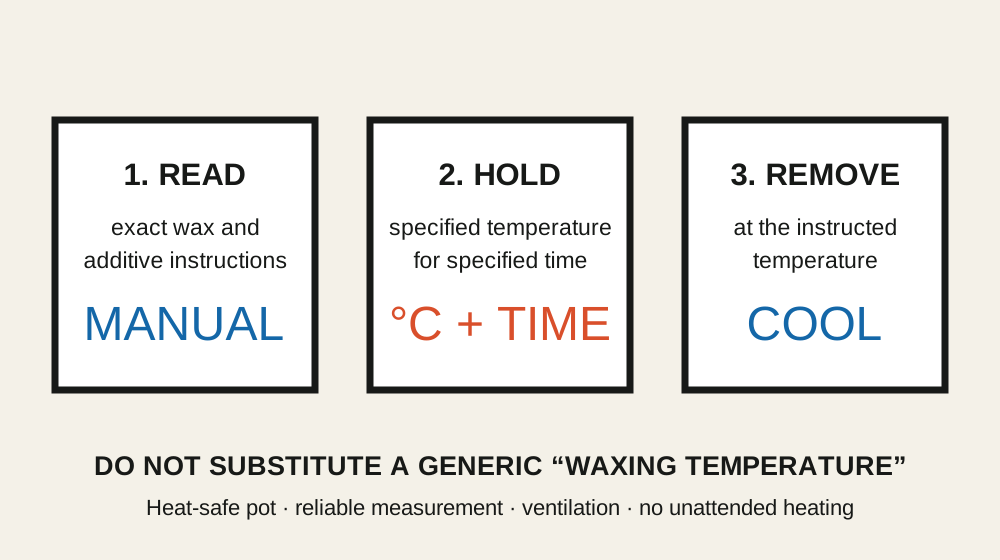
First identify which job you are doing
Write down four things before turning on a heater:
- The exact wax product and version.
- Every additive in the pot.
- Whether the chain is factory-new, chemically stripped, previously waxed, or contaminated by oil.
- The vessel’s temperature range and how it measures temperature.
A previously waxed, clean chain normally needs a different process from a new chain still carrying factory lubricant. An additive can also override the base wax’s normal temperature. Follow the highest required process only when the manufacturer explicitly says the products may be combined.
Do not put an oily used chain into clean wax and expect heat to make contamination disappear. Use the maker’s preparation route. The chain lube, drip wax, and hot-wax comparison helps decide whether this maintenance system suits you at all.
One product shows why a generic number fails
SILCA’s current StripChip instructions are product-specific: one chip is used with a factory-new standard chain, the blend is held at 125°C for 10 minutes, then cooled to 75°C before the chain is removed. SILCA separately says the product was designed for its Secret Chain Blend and has not been tested with every wax.
That is not a universal recommendation to heat all chain wax to 125°C. It is the activation process for that named additive. SILCA’s own temperature article explains that its ordinary ideal removal temperature is 75°C and that removing at 125°C left less wax in the tested chain.
If another wax says 75°C, 90°C, or a temperature band, use that instruction. If it gives no safe process, ask the manufacturer rather than borrowing a number from another brand.
Decide whether the heater is suitable
The displayed number is useful only if the vessel can safely reach, hold, and recover to the required temperature.
Check:
- the appliance’s rated temperature range;
- whether its control is a thermostat, fixed heat setting, or vague label;
- whether the sensor measures the vessel, hot plate, or wax itself;
- how much the temperature overshoots after the heater switches off;
- whether the pot is stable with the chain suspended;
- whether the power lead and controls remain clear of hot wax.
A removable bowl is convenient for cleaning, but that does not prove temperature accuracy. A numerical display is also not proof. If the process depends on a narrow target, compare the settled wax temperature with a suitable independent probe in the location recommended by the appliance maker.
Do not allow the probe to create a tip-over or splash hazard. Do not use a household thermometer unless its range, construction, and instructions make it suitable for the task.
Run the process in a calm sequence
- Prepare and fully dry the chain by the product’s method.
- Set the vessel on a level, heat-resistant surface away from children, pets, water, and clutter.
- Add the specified mass of wax and only approved additives.
- Heat gradually and confirm the actual temperature has stabilised.
- Lower the chain with a secure dry hook. Avoid splashing.
- Agitate and hold only as the instructions require.
- Change the set point if the removal temperature differs from the activation temperature.
- Wait for the wax itself—not merely the display—to reach that point.
- Lift the chain, let excess wax drain safely, and hang it where nobody can touch it.
- Switch off and let the vessel cool undisturbed.
Use a timer. Do not rely on remembering when the chain entered the pot while doing another repair.
Avoid four tempting shortcuts
Do not estimate by appearance
Fully liquid wax does not confirm the correct temperature. A required additive may not have activated, or the wax may be hotter than necessary.
Do not turn an uncontrolled pot to maximum
More heat is not faster maintenance. Overshoot can breach the product or appliance instructions and increases burn and fire risk.
Do not add water to cool wax
Keep water away from hot wax and electrical heating equipment. Lower the set point and let the controlled system cool as instructed.
Do not assume a sous-vide bath can perform every process
SILCA explicitly says its StripChip cannot be used with the sous-vide method because that method cannot reach the additive’s required activation temperature. A different preparation method may still let you use a normal-temperature wax process—check the exact product instructions.
Choose equipment around the process, not the logo
For occasional rewaxing, a simple thermostatically controlled vessel may be enough if it covers the specified range and is verified. A higher-temperature additive may require different equipment. The cheapest safe answer can be to use a separate chain-preparation product and keep the wax step within your existing heater’s supported range.
Price the complete workflow: vessel, chain hook, reliable measurement, preparation chemicals or additive, drying time, safe storage, and replacement wax. If that feels excessive, a careful drip lubricant routine is still valid. The goal is a clean, correctly lubricated chain—not membership in a maintenance tribe.
Your next step
Open the instructions for the exact wax and additive you own. Write the activation temperature, hold time, removal temperature, chain-preparation requirement, and vessel limit on one card. If any line is unknown, stop there and ask the manufacturer before heating.
Sources and further reading
- SILCA: StripChip specifications and current temperature instructions
- SILCA: test of chain-removal temperature and retained wax
- r/cycling reader context: choosing a vessel that can control a product-specific StripChip process — used as a current equipment-choice signal; user methods were not treated as product instructions.