Heart palpitations while cycling: stop, assess, and know when to get help
Use symptoms—not a training score—to respond to a racing, pounding, fluttering, or skipped heartbeat during cycling and prepare useful information for medical care.
 Field guide / heart-palpitations-while-cycling
A flutter, skipped beat, pounding heartbeat, or “heart in the throat” feeling during a ride is not a signal to finish the interval and inspect the graph later. Stop safely, assess symptoms, and get emergency help when red flags are present. A cycling computer can preserve context, but it cannot diagnose the episode or clear you to continue.
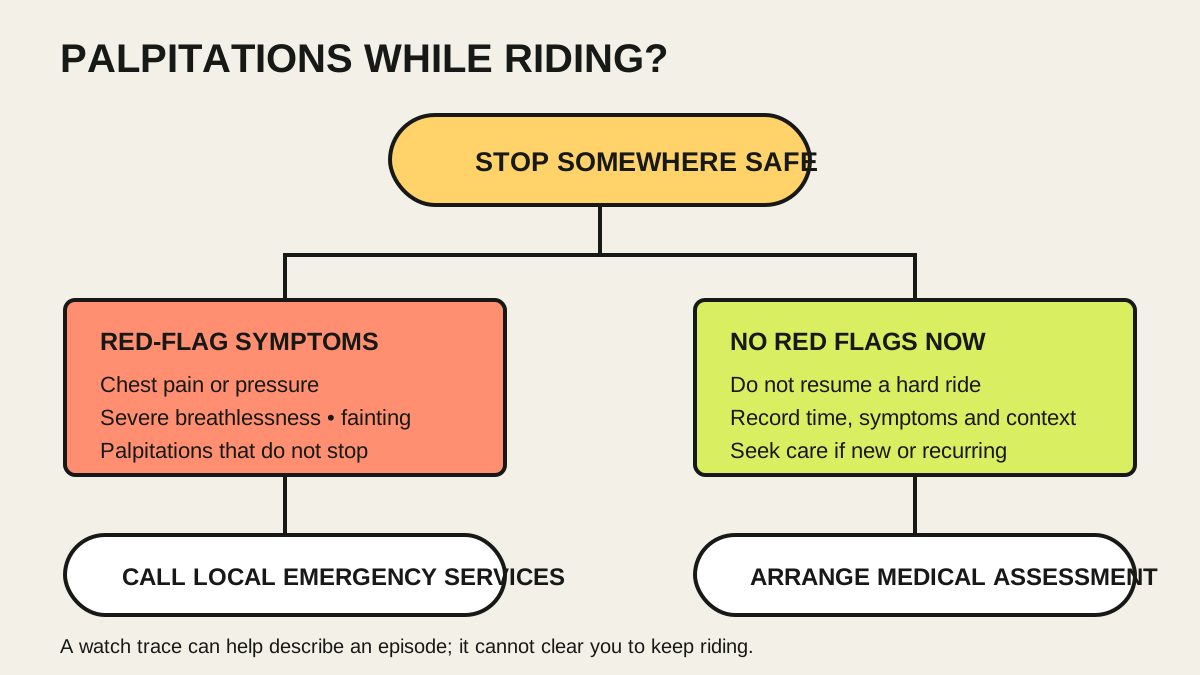
The short answer: stop away from traffic. If palpitations do not settle or occur with chest pain or pressure, severe breathlessness, fainting, or near-fainting, call local emergency services. If the episode stops and no emergency signs remain, do not restart hard exercise; record what happened and arrange medical advice for a new, recurring, worsening, or prolonged pattern.
Why “overtraining or heart problem?” is the wrong first question
A current r/cycling discussion about palpitations, chest heaviness, breathlessness, and poor recovery drew the only safe editorial conclusion: strangers cannot determine the cause. Training load, sleep, stress, heat, illness, medication, stimulants, anaemia, thyroid problems, and heart-rhythm conditions can overlap. A forum cannot examine the rider or exclude dangerous causes.
Do not begin by choosing a diagnosis. Begin with urgency.
Stop the ride safely
Signal and leave the carriageway or trail without a sudden move. Sit or lie somewhere protected from traffic, heat, and further falls. Tell a riding companion what you feel. Do not descend, ride home alone, or “spin it out” while dizzy or breathless.
Note the time the episode began. If you can do so without delaying help, observe whether the sensation is fast, slow, irregular, pounding, or fluttering and whether it is continuous or comes in bursts.
Use emergency help for red flags
The NHS advises emergency care when current palpitations do not go away or occur with chest pain, shortness of breath, feeling faint, or fainting. The American Heart Association similarly lists chest pain or pressure, breathlessness, dizziness, fainting, sweating, and collapse among concerning rhythm or heart-attack signs.
Call the emergency number where you are. Give your exact location, access point, symptoms, age if asked, and whether the person is conscious and breathing normally. Follow dispatcher instructions. Do not drive or cycle yourself to care.
If symptoms have stopped after including those warning signs, seek urgent medical advice rather than treating their disappearance as clearance.
A wearable is supporting evidence, not the verdict
A chest strap or watch can produce cadence lock, poor-contact spikes, dropouts, or delayed readings. It can also capture a real change. Neither a strange trace nor a smooth one diagnoses what happened.
Preserve:
- the complete activity file, not only a screenshot of the maximum;
- the heart-rate graph with time scale;
- power, cadence, speed, temperature, and elevation if available;
- any wearable ECG recording already captured without delaying care;
- device, sensor, firmware, and battery details.
Do not perform another hard effort to reproduce the event. Use the unexpected maximum-heart-rate guide later to audit data quality, after symptoms have been addressed.
Record the episode for a clinician
Write down:
- start and stop time;
- what the heartbeat felt like;
- every associated symptom;
- exercise intensity and duration before onset;
- whether symptoms continued at rest;
- recent illness, surgery, dehydration, sleep loss, or major training change;
- prescribed and non-prescribed medicines, supplements, caffeine, nicotine, alcohol, and other stimulants;
- personal heart history and relevant family history;
- how long recovery took.
This is a description, not self-diagnosis. Do not stop prescribed medication or add electrolyte, iron, or other treatment based on internet advice; discuss changes with a qualified clinician.
When non-emergency assessment still matters
The NHS recommends medical review when palpitations keep returning, become more frequent, last longer than a few minutes, or occur in someone with a heart condition or relevant family history. A new exercise-triggered pattern, marked fall in capacity, or unusually prolonged recovery is useful information to bring to that assessment.
Being previously fit does not prove a new symptom is benign. Being anxious does not prove anxiety is the cause. A normal consumer wearable does not rule out a rhythm problem, and one abnormal point does not establish one.
Until assessed, follow the clinician’s advice about exercise. If you have not yet obtained advice, avoiding the effort that reliably triggers symptoms is safer than repeatedly testing it.
What not to do
- Do not label the event “just overtraining” from mileage alone.
- Do not ask a group to watch you repeat the effort.
- Do not use a lower heart-rate zone as a medical clearance.
- Do not ride through chest pressure because the number is below your maximum.
- Do not dismiss symptoms because a recent test was normal; report the new pattern to the treating clinician.
- Do not crowdsource a medication or supplement change.
For ordinary fatigue without concerning symptoms, use how to take a cycling recovery week. That is training guidance, not treatment for palpitations.
Your next step
If symptoms are happening now, stop reading and use the urgent route above. Otherwise, export the activity, write the nine-point episode record, and contact an appropriate medical professional. Do not schedule a “confirmation ride.”
Sources and further reading
- NHS: heart palpitations and when to seek emergency or non-emergency help
- NHS: chest pain emergency signs
- American Heart Association: arrhythmia symptoms, diagnosis, and monitoring
- r/cycling reader context: exercise symptoms framed as overtraining versus a heart problem — used as an editorial demand signal, not medical evidence.