Can you mix Shimano 105 and GRX parts?
Check Shimano 105 and GRX compatibility by exact model number, speed, shifting type, brake hose, gearing, chainline, and current official charts.
 Field guide / can-you-mix-shimano-105-and-grx-parts
Before you view or pay
Check fit, condition, and starter gear first
Use the buying checklist to choose the right path: used-bike viewing, first-bike fit and type, hidden repair costs, or starter gear.
Some Shimano 105 and GRX parts can work together, but “105 plus GRX” is not one combination. Compatibility depends on exact model codes, generation, number of speeds, mechanical or electronic control, one-by or two-by layout, cassette range, chainline, brake hose and fittings, and the frame itself.
The short answer: write down every model number and trace the proposed system through Shimano’s current compatibility chart. Do not infer compatibility from the group name, price tier, shared mineral oil, or “12-speed” label. A mixed build is valid only when the chart connects those exact parts and every capacity, chainline, mount, hose, rotor, and frame requirement is also met.
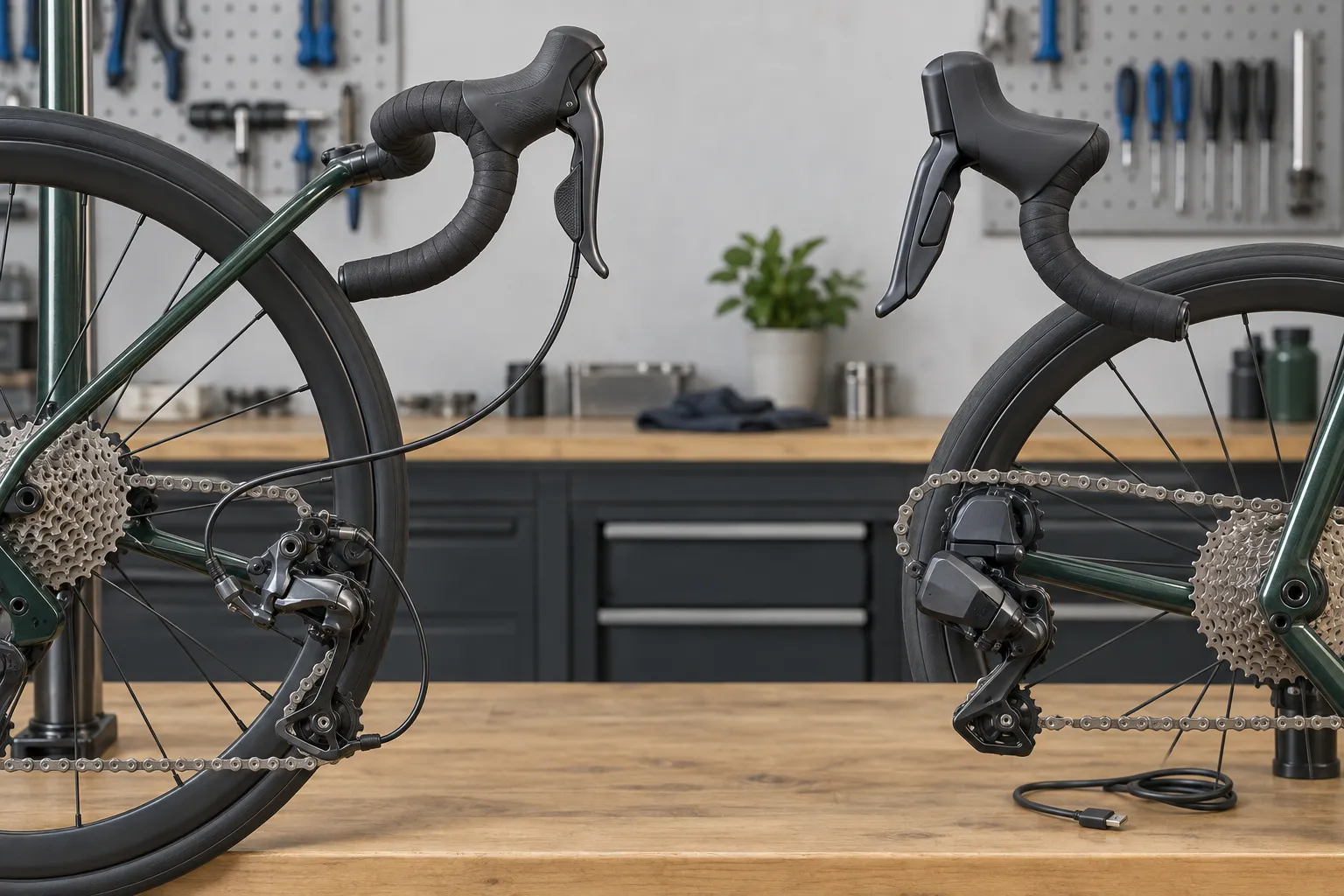
Why the group names are not enough
105 and GRX each span multiple generations and architectures. A listing may say only “105 shifter” while hiding whether it is mechanical, Di2, 10-, 11-, or 12-speed. GRX includes one-by and two-by controls, mechanical and Di2 parts, different derailleur capacities, and brake-only left levers.
A current r/bikewrench thread asked whether 105 mechanical levers and calipers could be used with a GRX 12-speed one-by rear derailleur. The useful signal is the recurring desire to save money or choose preferred ergonomics. The answer still comes from the current manufacturer chart, not a commenter’s successful build.
Shimano revised its compatibility documents during 2026. Always use the latest chart available when buying, and save a copy with the build record.
Make a model-number inventory
Find the stamped or printed code for each proposed part:
- right and left shift/brake levers;
- front derailleur, if any;
- rear derailleur, including cage version;
- crankset and chainring combination;
- cassette model and tooth range;
- chain;
- brake calipers;
- brake hose and connection kit;
- rotors and adapters;
- rear hub or freehub;
- battery, wires, junctions, and firmware-supported parts for Di2.
Model codes look like ST-R..., ST-RX..., RD-R..., RD-RX..., BR-R..., and BR-RX.... Photograph them. A seller’s phrase such as “GRX 800” may omit the one character that changes the system.
Check rear shifting as a complete chain
The rear system is not just lever plus derailleur. Trace:
shifter → rear derailleur → cassette → chain → freehub
Confirm:
- mechanical or Di2 control matches;
- the speed count is in the same compatible row;
- the exact rear derailleur supports the cassette’s largest and smallest sprockets;
- total capacity suits the crank and cassette combination;
- the chain type is listed;
- the cassette fits the actual freehub body and any required spacer is specified.
Shimano’s current overview groups road and gravel drivetrains by system, but the detailed chart contains exceptions. Follow the detailed connection for the exact model. Do not assume all road and gravel 12-speed parts share one cable pull or electronic network merely because some current combinations do.
Check the front system separately
For a two-by build, trace:
left shifter → front derailleur → crankset and chainrings → frame mount and chainline
GRX cranksets may use a chainline intended for gravel frames and tyre clearance. A 105 front derailleur and a GRX crankset are not declared compatible by their tooth count alone. Check the exact front-derailleur and crankset table, braze-on or clamp fit, frame clearance, and cable routing.
For a one-by build, decide what the left control should do. A two-by 105 left lever may contain an unused shift function, while a compatible GRX family may offer a brake-only or dropper-control option. That is an ergonomics and system decision, not a reason to connect an unlisted part.
Check hydraulic brakes as their own system
Sharing Shimano mineral oil does not settle brake compatibility. Trace:
lever → hose and joint kit → caliper → pad and rotor → frame/fork mount
The current Shimano road/gravel hydraulic chart lists lever groups, specific hose families and connection kits, and compatible calipers. It includes many cross-series connections, but the lines matter. Verify:
- exact lever and caliper models are connected;
- hose model and lever/caliper fittings match;
- flat-mount or post-mount hardware suits the frame and fork;
- rotor diameter and adapter are allowed by both brake and frame makers;
- pad material is permitted with the rotor;
- bleed procedure and supported oil are current.
Hydraulic brakes are safety-critical. A hose that threads in is not necessarily the correct hose-and-insert system.
Compare ergonomics after compatibility
Once two combinations are officially compatible, choose by hand fit and use. 105 and GRX levers may differ in hood shape, texture, lever-blade geometry, reach adjustment, free-stroke or Servo Wave features, and availability of a left brake-only control. These details vary by model.
Test with the gloves and hand positions you actually use. Confirm that you can brake firmly from the hoods and drops, operate every shift control, and maintain wrist comfort. A nominally higher group tier is not automatically the better-shaped control for your hand.
Build a purchase table before ordering
Use a simple record:
| Function | Exact model | Official compatibility reference | Other limit |
|---|---|---|---|
| Right lever | Rear drivetrain row | Mechanical/Di2, speed | |
| Rear derailleur | Shifter and cassette connection | Largest sprocket, capacity | |
| Cassette | Rear drivetrain row | Freehub and spacer | |
| Left lever | Front or brake chart | 1x, 2x, or brake-only | |
| Front derailleur | Front drivetrain chart | Crank and chainline | |
| Calipers and hose | Hydraulic chart | Mount, rotor, fittings |
If one box depends on “people online say,” the shopping list is not finished. Use the replacement-part identification guide to locate codes before paying.
When a complete matched group is the better value
Mixing can save money when compatible parts are already owned or one control shape clearly suits you. It can also create extra labour, duplicate hoses, wrong small parts, return shipping, and a system that is harder to explain at the next service.
Price the complete build including adapters, hoses, olives, inserts, cables, chain, cassette, rotors, bleed supplies, tools, and workshop labour. A discounted lever is not a saving if it creates three unresolved interfaces.
For a first bike, use the road-bike buying checklist before letting one groupset feature decide the whole purchase.
Your next step
Photograph every existing model code and create the six-row purchase table above. Open Shimano’s latest compatibility document, not an archived retailer chart, and trace each connection. Have a competent shop confirm the final list when hydraulic brakes, frame routing, or a costly mixed build is involved.
Sources and further reading
- Shimano: latest product compatibility information
- Shimano: current road hydraulic shift/brake-lever specifications
- Shimano: manuals and technical documents
- r/bikewrench reader context: comparing GRX and 105 mechanical controls in a mixed build
Reddit supplied the compatibility and ergonomics question. Individual successful builds and tier comparisons were not treated as manufacturer approval for another model combination.