Is toe overlap on a road bike normal?
Understand why your shoe can touch the front tyre at low speed, test toe overlap safely, separate it from poor bike fit, and learn the handling habit that prevents contact.
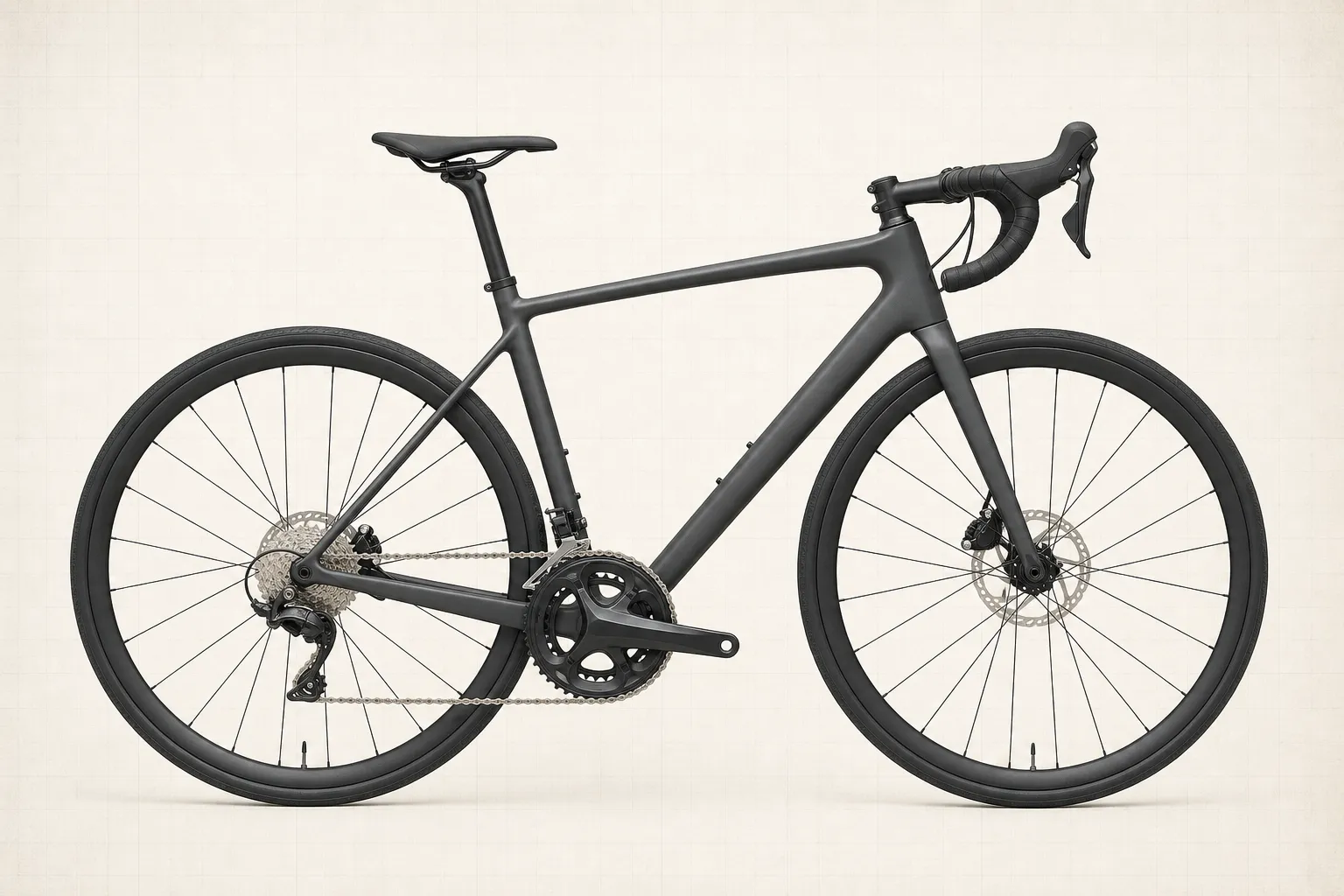 Field guide / toe-overlap-road-bike
Before you view or pay
Check fit, condition, and starter gear first
Use the buying checklist to choose the right path: used-bike viewing, first-bike fit and type, hidden repair costs, or starter gear.
Some toe overlap on a road bike can be a normal consequence of frame geometry, shoe size, crank length, tyres, and mudguards—especially on smaller frames. It does not automatically mean the bike is the wrong size. It does mean your forward shoe can touch the turned front wheel at very low speed, so you need to know where it happens and avoid pedalling through tight turns.
The short answer: test the real bike with your real shoes and pedal setup. If contact occurs only with a sharply turned wheel at walking speed, learn to coast with the inside pedal up. If it happens in ordinary riding, prevents safe starts or U-turns, or accompanies broader fit problems, have the bike and fit assessed.
Why riders mistake overlap for a sizing verdict
Recent fit threads asked whether a beginner’s shoe hitting the wheel meant a bike was too small and used apparent overlap while debating the size of a test bike. Video perspective and comments cannot reliably measure either fit or clearance.
Toe overlap is a physical clearance condition. Bike fit is the relationship between the rider and contact points while pedalling and handling the bike. They influence each other, but one does not settle the other.
What toe overlap actually is
With one crank pointing forward, turn the handlebar sharply toward that foot. If the tyre or mudguard enters the space occupied by the toe of your shoe, the setup has toe overlap.
It is most relevant during:
- very slow U-turns;
- tight starts and stops;
- weaving around barriers;
- track-standing attempts;
- low-speed climbing that requires large steering corrections.
At normal road speed, you steer mainly through small inputs and lean. The front wheel usually does not turn far enough to reach the foot. That does not make overlap harmless; it explains why many riders encounter it only in a car park.
Test it safely while stationary
Use a wall or have a helper support the bike:
- Wear the exact shoes and use the exact pedals you ride.
- Put one crank horizontal and forward.
- Place that foot in its normal position on the pedal.
- Slowly turn the handlebar toward the forward foot.
- Note the steering angle at first contact—do not force the tyre past the shoe.
- Repeat on the other side.
- Repeat with any mudguard you plan to use.
Check whether the contact is toe-to-tyre, toe-to-mudguard, or heel-to-frame. These are different clearance problems.
Cannondale’s owner manual defines toe overlap as shoe or toe-clip contact with a sharply turned front tyre or mudguard, says it is common on small frame sizes, and warns that contact can cause loss of control.
The handling habit: inside pedal up
Before a tight turn, stop pedalling and place the pedal on the inside of the turn at roughly 12 o’clock:
- turning left: left pedal up;
- turning right: right pedal up.
Coast through the tightest part, then resume pedalling as the handlebar straightens. This also improves pedal clearance from the ground while cornering.
Trek’s owner manual similarly warns about contact during slow riding with the handlebar turned and advises not pedalling in that condition.
Practise with flat pedals first if you are also learning clipless release. Do not combine two unfamiliar skills in the same tight-turn drill.
What changes the clearance
Toe overlap can increase or decrease with:
- frame front-centre geometry;
- frame size and fork design;
- crank length;
- tyre diameter and width;
- mudguard shape and clearance;
- shoe length and toe-box shape;
- cleat fore-aft position;
- pedal or toe-clip design.
This is why another rider with the same height or nominal frame size may report a different result.
Do not move cleats, fit shorter cranks, change tyre size, or alter the fork solely to chase clearance without considering fit, compatibility, handling, pedal stroke, and manufacturer limits. A change that gains a few millimetres can create a more important problem elsewhere.
Does overlap mean the bike is too small?
Not by itself. Small frames often need design compromises to fit standard-size wheels while preserving steering and riding position. A correctly fitting bike can have overlap, and a poorly fitting bike can have none.
Assess size with separate evidence:
- Can you reach the hoods and brakes with relaxed elbows?
- Is saddle height achievable within the post’s insertion limits?
- Is the handlebar height suitable without an unsafe stem setup?
- Can you ride without being cramped, stretched, or pushed onto your hands?
- Does the bike handle predictably in ordinary turns?
Use how to tell if a road bike is too big or too small for that decision. For a purchase, test the actual setup rather than relying on a geometry-chart size label.
When overlap is too much for you
Walk away from a purchase or seek a professional assessment when:
- your shoe contacts the tyre during ordinary steering rather than only a very tight turn;
- you cannot start, stop, or make necessary low-speed turns with confidence;
- your local riding requires frequent tight manoeuvres and the clearance feels unmanageable;
- a mudguard makes safe operation impractical;
- avoiding contact requires an unsuitable cleat position or other fit compromise;
- the overlap comes with clear reach, standover, saddle-range, or handling problems.
“Common” does not mean you must accept a setup you cannot operate safely.
Include it in a test ride
At a used-bike viewing or shop test:
- Perform the stationary clearance check.
- Confirm the tyres and planned mudguards represent how you will ride.
- In a traffic-free space, practise wide turns before tighter ones.
- Coast with the inside pedal up.
- Test starts and stops without weaving.
- Reject the bike if basic control still feels compromised.
Add this to the used road-bike test-ride process and the road-bike buying checklist. It is one decision criterion, not a shortcut to the whole fit decision.
Your next step
Check your current bike while stationary with your normal shoes, pedals, tyres, and mudguards. If overlap exists only at a sharp angle, practise five slow, wide turns each way with the inside pedal up. If contact intrudes into normal handling, stop experimenting and get the bike assessed.