Should you buy bike insurance? Check these seven policy details
Compare home, renters, and bicycle-specific insurance by theft location, crash cover, payout basis, limits, deductibles, liability, and exclusions.
 Field guide / should-you-buy-bike-insurance
Before you view or pay
Check fit, condition, and starter gear first
Use the buying checklist to choose the right path: used-bike viewing, first-bike fit and type, hidden repair costs, or starter gear.
Bike insurance is worth comparing when replacing your bike after theft or a crash would seriously disrupt your finances. It is not automatically good value, and “covered by home insurance” is not a complete answer. The useful question is which losses are covered, where, for how much, and under what conditions.
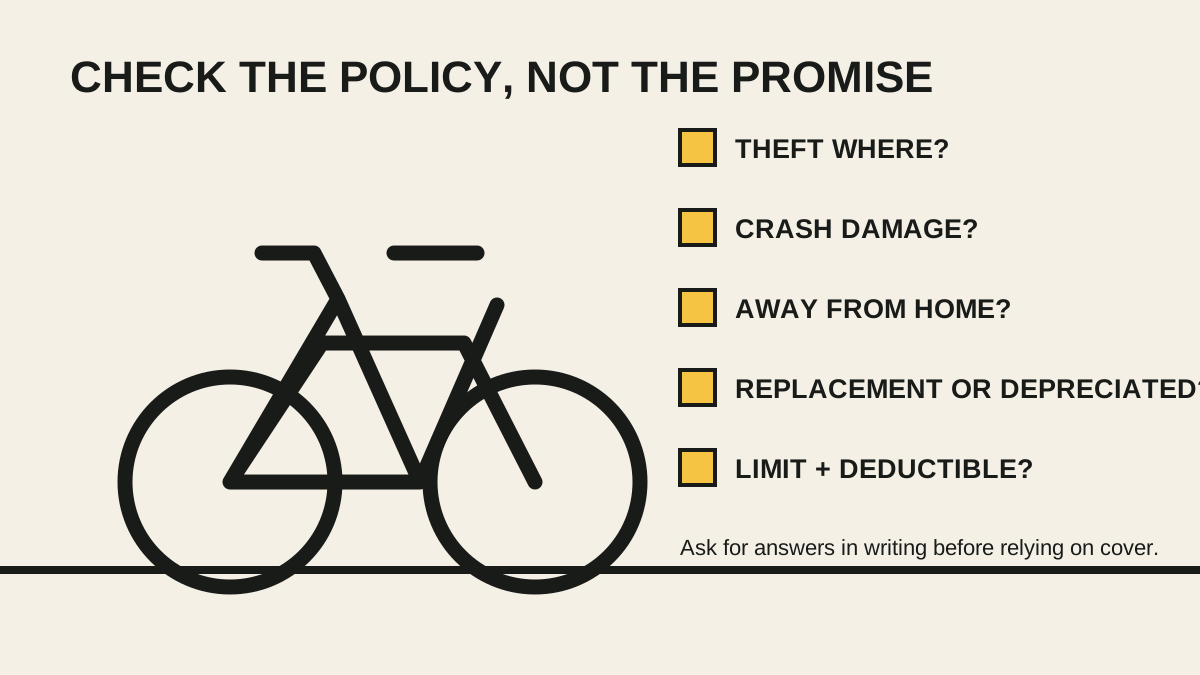
The short answer: get the wording for your existing home or renters policy and one bicycle-specific quote. Compare the same seven items: theft away from home, accidental crash damage, travel and transport, replacement-cost versus depreciated payout, single-item limits, deductible, and personal liability. Buy only when the remaining financial risk matters more to you than the premium and claim conditions.
Why riders keep getting conflicting answers
Recent discussions asked whether home insurance sufficiently covers a valuable bike and whether standalone cover makes sense when a home policy has a low per-bike limit. Those threads are useful demand signals, but another rider’s answer cannot describe your contract.
Two policies sold under the same broad label can differ on away-from-home theft, unattended-bike locks, organised racing, cosmetic damage, airline handling, accessories, and the value used to settle a claim. Read the actual schedule, definitions, exclusions, and endorsements.
Compare these seven details
1. Where theft is covered
Ask about the garage, shared storage, workplace, street, car, hotel, event transition area, and travel outside your home region. “Personal property” may be covered away from home, but sub-limits or different conditions can apply.
Check the lock wording literally. A policy may specify an approved lock, what the bike must be locked to, how long it may remain unattended, and whether theft from a vehicle or roof rack qualifies. If you cannot follow those conditions in ordinary use, the apparent cover has little value.
2. Whether accidental crash damage is covered
Theft and accidental damage are different risks. Ask whether the policy covers a solo fall, collision with another rider, racing, a pothole strike, damage while transporting the bike, and a carbon-frame inspection when damage is uncertain.
Do not assume “accidental damage” includes every sporting use. Look for exclusions covering competition, timed events, professional use, wear, poor maintenance, or mechanical failure.
3. How the payout is calculated
The National Association of Insurance Commissioners distinguishes replacement cost from actual cash value, which accounts for depreciation. That difference can dominate the result on a several-year-old bike.
Ask whether a total loss is settled using:
- the cost of a comparable new bike;
- the bike’s depreciated value immediately before the loss;
- the original purchase price;
- an agreed or scheduled value; or
- a repair-first process chosen by the insurer.
Also ask whether upgrades, wheels, a power meter, lights, luggage, and clothing share the bike’s limit or have separate treatment.
4. The limit for one bicycle
A large overall personal-property limit does not prove that one bicycle can be paid in full. Look for a bicycle, sporting-goods, valuables, or single-item sub-limit. Confirm whether the limit includes tax and accessories.
Use the complete replacement figure, not only the frame price. Your first-road-bike budget method can be reused here: bike, fitted parts, permanent accessories, and realistic replacement cost.
5. The deductible and claim economics
Subtract the deductible from the likely payout before comparing premiums. A policy with a high deductible may be useful for a total loss but irrelevant for a bent wheel.
Ask how a claim could affect renewal, premiums, or eligibility. NAIC consumer guidance notes that insurers may review claim history when pricing or renewing home cover. That does not mean you should avoid a valid claim; it means the decision should include more than the immediate cheque.
6. Liability and injury are separate questions
Cover for the bike does not necessarily cover injury to you, injury to someone else, or damage you cause. Check personal liability, medical or health cover, travel insurance, motor-related rules, and any local compulsory insurance separately.
If you ride in groups, events, or abroad, ask how those settings change cover. Do not infer liability protection from a theft benefit.
7. The evidence and claim process
Before relying on a policy, record:
- serial number and full model;
- receipt or other proof of purchase;
- dated photographs of the whole bike and key components;
- upgrade receipts and workshop records;
- lock make, model, and proof of ownership if required;
- where the bike is normally stored;
- the insurer’s written answers to unusual-use questions.
NAIC recommends a home inventory with model, serial number, price, date, receipts, and photographs to support a property claim. Store a copy somewhere that will remain available if your phone or home is involved in the loss.
A simple value test
Use three numbers:
- Likely uninsured loss: what you would actually need to spend to restore a usable setup, minus any dependable existing cover.
- Annual policy cost: premium plus fees.
- Claim contribution: deductible and any expected shortfall from depreciation or limits.
Insurance transfers a risk; it is not an investment expected to return more than it costs. It becomes more compelling when the possible loss is unaffordable, the bike spends time in covered high-risk settings, and the wording fits how you actually ride and store it.
Self-insuring can be rational when you could replace the bike without financial stress, the deductible approaches its value, existing cover is adequate, or exclusions remove the risks you care about. Put the premium you avoid into a repair-and-replacement fund rather than pretending the risk disappeared.
Questions to send the insurer
Copy this list and ask for written answers:
- What is the maximum payout for this exact bike and its accessories?
- Is settlement replacement cost, actual cash value, agreed value, or another basis?
- Which theft locations and lock arrangements are covered?
- Are solo crashes, group-ride crashes, events, travel, and transport covered?
- What deductible applies to each type of claim?
- What evidence is required before and after a loss?
- Are there exclusions for unattended time, racing, wear, maintenance, or cosmetic damage?
- Does the policy include personal liability, and in which places and activities?
- Could a claim affect another policy or renewal?
- What must you do immediately after theft or a crash?
If the answer depends on a definition or endorsement, ask for the clause rather than accepting a sales summary.
Your next step
Photograph the bike, record its serial number, and calculate the realistic replacement cost. Then compare your current policy with one specialist quote using the same questions above. If you are still deciding what to buy, use the road-bike buying checklist before insuring a bike that may not fit your needs.