How to evaluate budget carbon road wheels before buying
Check a carbon wheelset's exact identity, tyre and brake compatibility, documented limits, service parts, testing claims, warranty, and recall support.
 Field guide / how-to-evaluate-budget-carbon-road-wheels
Before you view or pay
Check fit, condition, and starter gear first
Use the buying checklist to choose the right path: used-bike viewing, first-bike fit and type, hidden repair costs, or starter gear.
A low price and positive owner comments do not prove a carbon wheel is unsafe—or safe. Country of manufacture is also a poor shortcut. Evaluate the exact model as a complete safety-critical system: rim, hub, spokes, nipples, axle interfaces, freehub, tyre, pressure, brakes, documentation, and support after the sale.
The short answer: do not buy until the seller provides an exact model, serial-number system, tyre and pressure chart, rider/system weight limit, axle and freehub specifications, spoke and bearing details, warranty process, crash-replacement terms, and evidence behind any standards claim. If you cannot identify parts or reach support before purchase, assume ownership will be harder afterward.
Replace horror stories with an evidence checklist
A current r/cycling discussion asked for bad experiences or catastrophic failures involving inexpensive carbon wheels. Anecdotes can reveal questions to investigate, but they cannot establish a failure rate: owners, usage, mileage, impacts, setup, tyre pressure, and exact production version are usually unknown.
Established premium brands are not immune to defects either. In 2025, the U.S. CPSC announced a recall covering specific DT Swiss carbon road wheel IDs because a defect could compromise structural integrity. The correct lesson is not that one price tier or manufacturing country is safe. It is that exact model identification, traceability, recall monitoring, and a workable remedy matter.
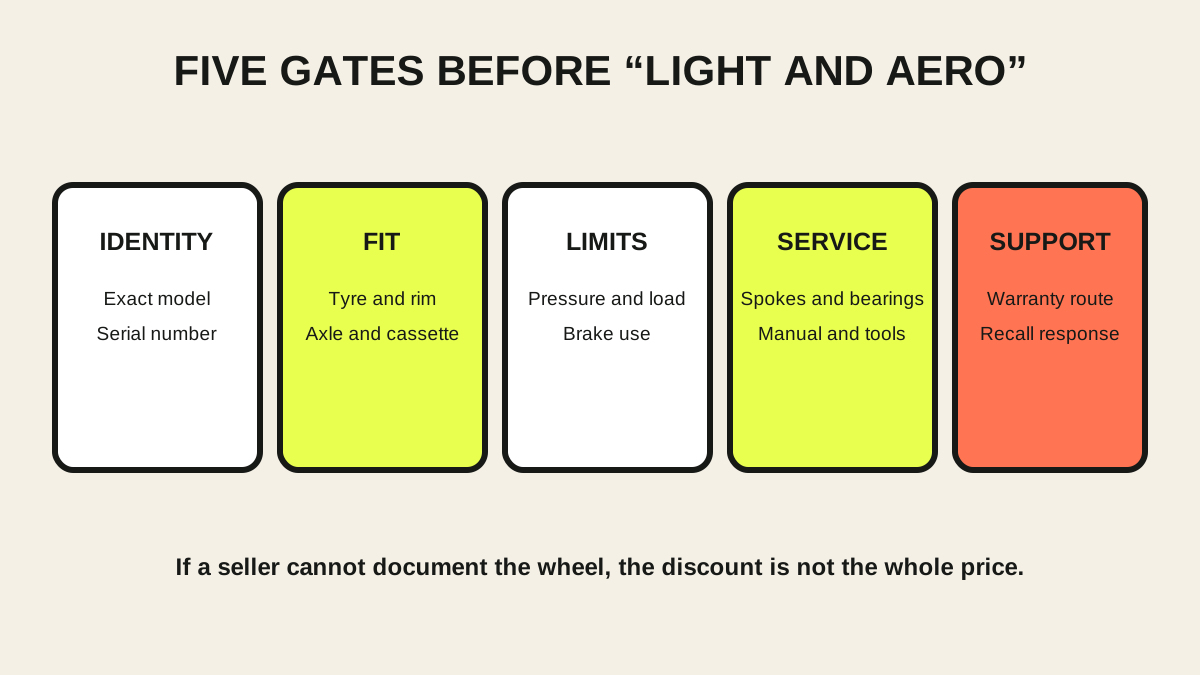
Gate 1: establish the wheel’s identity
Record more than the marketing name:
- exact front and rear model codes;
- rim depth, external width, and internal width;
- rim-brake or disc-brake version;
- hooked, hookless, or another documented bead design;
- model year or production revision;
- serial-number location and example format;
- hub and freehub model;
- spoke brand, model, length, and count;
- seller’s legal business name and support contact.
A serial number is valuable only if the manufacturer can use it to identify production and contact affected owners. Ask how to register the wheel and where safety notices are published.
Marketplace listings sometimes combine photos or specifications from several versions. Save the order page and written specification for the exact item you receive.
Gate 2: prove compatibility as a system
The wheel must work with the bike and the intended tyre. Check:
Frame and drivetrain
- front and rear axle type, diameter, and spacing;
- disc rotor mount: Center Lock or six-bolt;
- cassette/freehub standard and required spacers;
- minimum clearance around tyre, fork, stays, brakes, and frame;
- freehub engagement and replacement availability.
Tyre and rim
- matching bead-seat diameter, usually expressed with an ISO/ETRTO size such as 622;
- tyre type approved by both tyre and rim manufacturers;
- permitted tyre-width range for that internal rim width;
- the lower of the tyre, rim, and tape pressure limits;
- tubeless tape and valve specification where applicable.
ETRTO’s public recommendations tell users to confirm that tyre and rim sizes match and to inspect the rim, valve hole, spokes, and rim tape before fitting. A generic statement such as “works with all 700c tyres” is not enough.
Use the replacement road-bike wheel compatibility guide before comparing weight or depth.
Gate 3: obtain limits in writing
The manual should state:
- maximum total system weight and what it includes;
- maximum tyre pressure by tyre width where relevant;
- approved tyre type and size range;
- permitted brake pads for rim-brake wheels;
- rotor size or use restrictions, if any;
- spoke-tension or truing guidance for service technicians;
- intended-use category and exclusions.
“Tested to ISO” needs detail. ISO 4210-7:2023 specifies wheel and rim test methods for bicycles, but a logo or one-line claim does not tell you which exact model, configuration, laboratory, report, or pass criteria are represented. Ask for the standard edition, report or declaration, test entity, and whether the production wheel matches the tested construction.
Standards are a baseline, not a prediction that a wheel will survive every pothole, crash, overload, incorrect tyre, or pressure error.
Gate 4: price the service path
An inexpensive wheel can become expensive when one proprietary spoke or freehub body is unavailable.
Before buying, find answers to these questions:
- Can a local shop obtain or substitute the spokes and nipples?
- Are spoke lengths published for front, rear-drive, and rear-non-drive sides?
- Are hub bearings standard sizes or proprietary assemblies?
- Can you buy the freehub body, axle end caps, ratchet or pawl parts, and rim tape?
- Does truing require a special internal nipple tool or tyre removal?
- Will the seller provide a replacement rim if a rebuild is required?
- Is there a service manual in a language your mechanic can use?
Show the exact specification to the shop that would maintain the wheel. A pre-purchase “yes, we can service this” is more useful than discovering the opposite after a spoke breaks.
Gate 5: test the support before you need it
Send the seller one concise technical question before ordering. For example:
Please confirm the exact model’s maximum system weight, approved 28 mm tyre pressure range, replacement rear-drive-side spoke specification, and warranty contact for my country.
Judge the response:
- Did it answer the exact model or paste a generic sales paragraph?
- Did it provide a manual or chart?
- Is the support channel operated by the manufacturer, a marketplace seller, or an importer?
- Who pays shipping for inspection or replacement?
- Does the warranty cover only the first buyer?
- Is crash replacement separate from manufacturing-defect coverage?
- What happens if the model is discontinued?
Also search the manufacturer, exact model, and serial range in official recall databases for the markets where it was sold. Absence from one national database is not proof that no notice exists elsewhere.
Inspect the delivered wheel before fitting tyres
Do not discard packaging until inspection and setup are complete.
Check:
- model and serial numbers match the order;
- both rims are free of cracks, soft spots, wrinkles, deep scratches, chips, and shipping impact;
- bead seats and valve holes are smooth and undamaged;
- spokes are present, seated, and not obviously slack;
- hubs turn smoothly without play;
- freehub and axle hardware match the specification;
- rim tape is centred, intact, and rated for the planned setup;
- included manual and pressure limits match the online listing.
A wheel can arrive slightly out of true without being structurally defective, but do not make that judgment from a photo when carbon damage is suspected. Document concerns before installation and use the seller’s inspection route.
Use a controlled first-ride plan
Have the cassette, rotors, tyres, and axles installed to their manufacturers’ instructions and torque values. Confirm tyre seating and pressure, wheel retention, brake operation, and frame clearance.
Then:
- Perform a stationary brake and wheel-security check.
- Ride at walking speed in a traffic-free area.
- Add gentle braking and turns.
- Stop and inspect tyre seating, rotor clearance, axle security, and spoke feel.
- Complete a short familiar loop before descending fast or riding remotely.
Stop for a new click, crack, rub, wobble, pressure loss, spoke movement, or visible damage. “Carbon makes noises” is not a diagnosis.
Decide whether the discount survives the full comparison
Compare delivered cost, tax, rotors, cassette spacers, tubeless parts, replacement spokes, shop setup, warranty shipping, and resale—not just wheelset price.
A budget wheel can be a rational buy when it has clear documentation, standard service parts, compatible limits, traceability, and responsive support. A more expensive wheel can be the better value when local parts and warranty reduce downtime. The name on the decal does not replace this calculation.
If the purchase is part of a first-bike decision, route it through the beginner road bike buying checklist. A wheel upgrade should not consume money needed for correct fit, safe tyres, maintenance tools, or a repair reserve.
Your next step
Ask the seller for five documents or answers: exact model and serial scheme, tyre/pressure chart, system-weight limit, spoke and hub service parts, and warranty/recall contact. If any answer is missing or contradictory, pause the purchase rather than filling the gap with forum praise or fear.